

1. FATTY ACID OCCURRENCE AND DISTRIBUTION
39
atoms (192), whereas human tubercle bacilli "fat" contains tuberculostearic (D( —)-10-methyl stearic) acid (51, 193).
The higher molecular weight phthioic (C^HsaOa) acid, with three
branched methyl groups, isolated by Anderson (194) has since proved
to be a mixture from which several components have been separated.
These include (-f-) -2,4,6-trimethyltetracos-2-enoic (mycolipenic) acid
(52) and (—)-2,4,6-trimethyloctacosanoic (mycoceranic) acid (53).
Thus the same organism is shown to elaborate acids with similar structures but of opposite configuration.
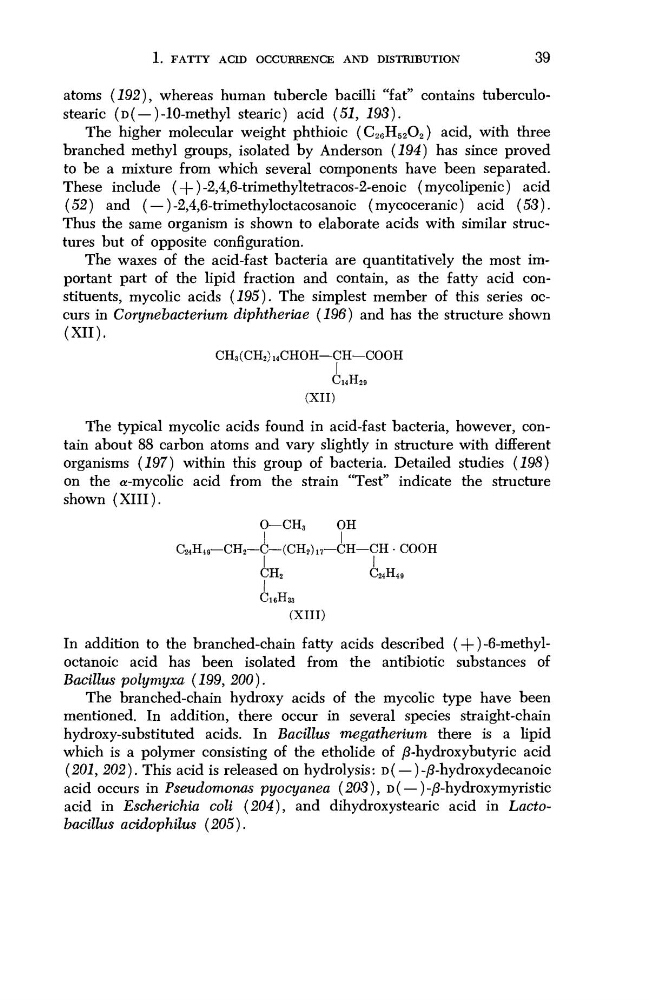
The waxes of the acid-fast bacteria are quantitatively the most important part of the lipid fraction and contain, as the fatty acid constituents, mycolic acids (195). The simplest member of this series occurs in Corynebacterium diphtheriae (196) and has the structure shown
(XII).
CH 3 (CH 2 ) 14 CHOH—CH—COOH
I
C14H29
(xii)
The typical mycolic acids found in acid-fast bacteria, however, contain about 88 carbon atoms and vary slightly in structure with different
organisms (197) within this group of bacteria. Detailed studies (198)
on the α-mycolic acid from the strain "Test" indicate the structure
shown (XIII).
O—CH 3
OH
!
I
C 2 4H 49 —CH 2 —C—(CH 2 ) 17 —CH—CH · COOH
CH2
C24H49
1
C16H33
(XIII)
In addition to the branched-chain fatty acids described (+) -6-methyloctanoic acid has been isolated from the antibiotic substances of
Bacillus polymyxa (199, 200).
The branched-chain hydroxy acids of the mycolic type have been
mentioned. In addition, there occur in several species straight-chain
hydroxy-substituted acids. In Bacillus megatherium there is a lipid
which is a polymer consisting of the etholide of ß-hydroxybutyric acid
(201, 202). This acid is released on hydrolysis: D( — )-ß-hydroxydecanoic
acid occurs in Pseudomonas pyocyanea (203), D( —)-/?-hydroxymyristic
acid in Escherichia colt (204), and dihydroxystearic acid in Lactobacillus acidophilus (205).
39
atoms (192), whereas human tubercle bacilli "fat" contains tuberculostearic (D( —)-10-methyl stearic) acid (51, 193).
The higher molecular weight phthioic (C^HsaOa) acid, with three
branched methyl groups, isolated by Anderson (194) has since proved
to be a mixture from which several components have been separated.
These include (-f-) -2,4,6-trimethyltetracos-2-enoic (mycolipenic) acid
(52) and (—)-2,4,6-trimethyloctacosanoic (mycoceranic) acid (53).
Thus the same organism is shown to elaborate acids with similar structures but of opposite configuration.
The waxes of the acid-fast bacteria are quantitatively the most important part of the lipid fraction and contain, as the fatty acid constituents, mycolic acids (195). The simplest member of this series occurs in Corynebacterium diphtheriae (196) and has the structure shown
(XII).
CH 3 (CH 2 ) 14 CHOH—CH—COOH
I
C14H29
(xii)
The typical mycolic acids found in acid-fast bacteria, however, contain about 88 carbon atoms and vary slightly in structure with different
organisms (197) within this group of bacteria. Detailed studies (198)
on the α-mycolic acid from the strain "Test" indicate the structure
shown (XIII).
O—CH 3
OH
!
I
C 2 4H 49 —CH 2 —C—(CH 2 ) 17 —CH—CH · COOH
CH2
C24H49
1
C16H33
(XIII)
In addition to the branched-chain fatty acids described (+) -6-methyloctanoic acid has been isolated from the antibiotic substances of
Bacillus polymyxa (199, 200).
The branched-chain hydroxy acids of the mycolic type have been
mentioned. In addition, there occur in several species straight-chain
hydroxy-substituted acids. In Bacillus megatherium there is a lipid
which is a polymer consisting of the etholide of ß-hydroxybutyric acid
(201, 202). This acid is released on hydrolysis: D( — )-ß-hydroxydecanoic
acid occurs in Pseudomonas pyocyanea (203), D( —)-/?-hydroxymyristic
acid in Escherichia colt (204), and dihydroxystearic acid in Lactobacillus acidophilus (205).