

508
W. SANDERMANN
zene, naphthalene, quinoline, and benzopyrone derivatives are involved;
these are discussed elsewhere. Here a few examples will be presented
to illustrate the diverse linkages into which the hemiterpene residue
may enter (VIII-XI). As will be discussed in greater detail later, the
group of hemiterpenes has additional importance in that many natural
furans are derived biogenetically from hemiterpenes (6).
B. TERPENES {1-5,
7)
Terpenes and compounds derived therefrom basically contain one of
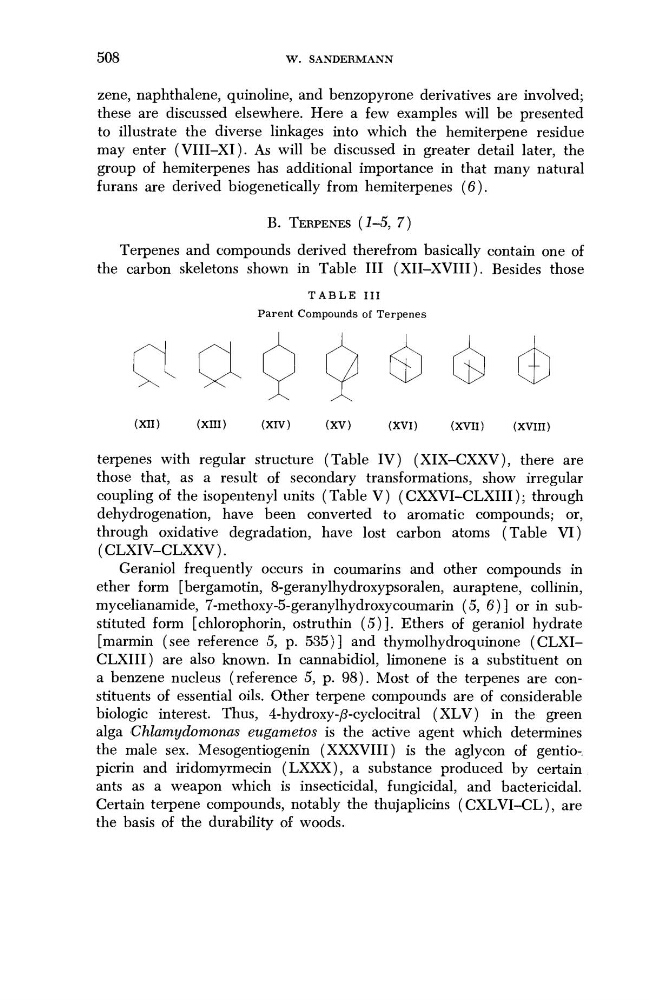
the carbon skeletons shown in Table III (XII-XVIII). Besides those
TABLE III
Parent Compounds of Terpenes
Ci öc) (} ώ ώ ώ
(XII)
(XIII)
(XTV)
(XV)
(XVI)
(XVII)
(XVIII)
terpenes with regular structure (Table IV) (XIX-CXXV), there are
those that, as a result of secondary transformations, show irregular
coupling of the isopentenyl units (Table V) (CXXVI-CLXIII); through
dehydrogenation, have been converted to aromatic compounds; or,
through oxidative degradation, have lost carbon atoms (Table VI)
(CLXIV-CLXXV).
Geraniol frequently occurs in coumarins and other compounds in
ether form [bergamotin, 8-geranylhydroxypsoralen, auraptene, collinin,
mycelianamide, 7-methoxy-5-geranylhydroxycoumarin (5, 6)] or in substituted form [chlorophorin, ostruthin (5)]. Ethers of geraniol hydrate
[marmin (see reference 5, p. 535)] and thymolhydroquinone (CLXICLXIII) are also known. In cannabidiol, limonene is a substituent on
a benzene nucleus (reference 5, p. 98). Most of the terpenes are constituents of essential oils. Other terpene compounds are of considerable
biologic interest. Thus, 4-hydroxy-ß-cyclocitral (XLV) in the green
alga Chlamydomonas eugametos is the active agent which determines
the male sex. Mesogentiogenin (XXXVIII) is the aglycon of gentiopicrin and iridomyrmecin (LXXX), a substance produced by certain
ants as a weapon which is insecticidal, fungicidal, and bactericidal.
Certain terpene compounds, notably the thujaplicins (CXLVI-CL), are
the basis of the durability of woods.
W. SANDERMANN
zene, naphthalene, quinoline, and benzopyrone derivatives are involved;
these are discussed elsewhere. Here a few examples will be presented
to illustrate the diverse linkages into which the hemiterpene residue
may enter (VIII-XI). As will be discussed in greater detail later, the
group of hemiterpenes has additional importance in that many natural
furans are derived biogenetically from hemiterpenes (6).
B. TERPENES {1-5,
7)
Terpenes and compounds derived therefrom basically contain one of
the carbon skeletons shown in Table III (XII-XVIII). Besides those
TABLE III
Parent Compounds of Terpenes
Ci öc) (} ώ ώ ώ
(XII)
(XIII)
(XTV)
(XV)
(XVI)
(XVII)
(XVIII)
terpenes with regular structure (Table IV) (XIX-CXXV), there are
those that, as a result of secondary transformations, show irregular
coupling of the isopentenyl units (Table V) (CXXVI-CLXIII); through
dehydrogenation, have been converted to aromatic compounds; or,
through oxidative degradation, have lost carbon atoms (Table VI)
(CLXIV-CLXXV).
Geraniol frequently occurs in coumarins and other compounds in
ether form [bergamotin, 8-geranylhydroxypsoralen, auraptene, collinin,
mycelianamide, 7-methoxy-5-geranylhydroxycoumarin (5, 6)] or in substituted form [chlorophorin, ostruthin (5)]. Ethers of geraniol hydrate
[marmin (see reference 5, p. 535)] and thymolhydroquinone (CLXICLXIII) are also known. In cannabidiol, limonene is a substituent on
a benzene nucleus (reference 5, p. 98). Most of the terpenes are constituents of essential oils. Other terpene compounds are of considerable
biologic interest. Thus, 4-hydroxy-ß-cyclocitral (XLV) in the green
alga Chlamydomonas eugametos is the active agent which determines
the male sex. Mesogentiogenin (XXXVIII) is the aglycon of gentiopicrin and iridomyrmecin (LXXX), a substance produced by certain
ants as a weapon which is insecticidal, fungicidal, and bactericidal.
Certain terpene compounds, notably the thujaplicins (CXLVI-CL), are
the basis of the durability of woods.