

10. TERPENOIDS: STRUCTURE AND DISTRIBUTION
507
means of different types of cyclization, they lead to a number of irregularly constructed triterpenes.
II. Structure and Distribution of Terpenoids
So that the structure (Tables II-XII) and distribution (Tables
XIII-XVI) of terpenoids might be discussed succinctly, steroids and
carotenoids have been left out of consideration. A tabular form of
presentation seems to be the most convenient.* Citation of the literature
has posed a great problem, since lack of space has necessitated a minimal allotment for references. For this reason, reference has been made
in the table to standard works, such as those of Simonsen (1), Guenther
(2), Gildemeister (3), de Mayo (4), and Karrer (5). Good reviews of
individual topics are afforded by the following authors: Aneja and coworkers (6), hemiterpenes; Haagen-Smit (7, 8), lower terpenes, sesquiterpenes, and diterpenes; Jeger (9), triterpenes; Jones and Halsall (10),
tetracyclic triterpenes; Steiner and Holtzem (11), triterpenes; and
Tsutsui and Tsutsui (12), diterpenes.
A. HEMITERPENE COMPOUNDS
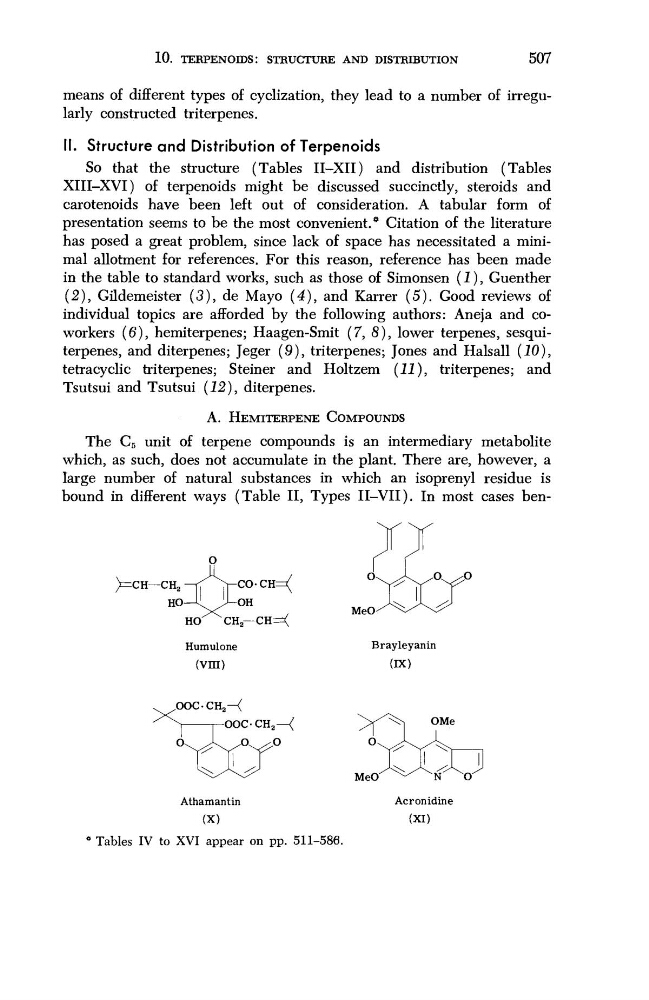
The C 5 unit of terpene compounds is an intermediary metabolite
which, as such, does not accumulate in the plant. There are, however, a
large number of natural substances in which an isoprenyl residue is
bound in different ways (Table II, Types II-VII). In most cases benHumulone
(vm)
Brayleyanin
(IX)
^OOC-CH.,—<
-OOC-CH 2 -{
O^ ^
Athamantin
Acronidine
(X)
(XI)
Tables IV to XVI appear on pp. 511-586.
507
means of different types of cyclization, they lead to a number of irregularly constructed triterpenes.
II. Structure and Distribution of Terpenoids
So that the structure (Tables II-XII) and distribution (Tables
XIII-XVI) of terpenoids might be discussed succinctly, steroids and
carotenoids have been left out of consideration. A tabular form of
presentation seems to be the most convenient.* Citation of the literature
has posed a great problem, since lack of space has necessitated a minimal allotment for references. For this reason, reference has been made
in the table to standard works, such as those of Simonsen (1), Guenther
(2), Gildemeister (3), de Mayo (4), and Karrer (5). Good reviews of
individual topics are afforded by the following authors: Aneja and coworkers (6), hemiterpenes; Haagen-Smit (7, 8), lower terpenes, sesquiterpenes, and diterpenes; Jeger (9), triterpenes; Jones and Halsall (10),
tetracyclic triterpenes; Steiner and Holtzem (11), triterpenes; and
Tsutsui and Tsutsui (12), diterpenes.
A. HEMITERPENE COMPOUNDS
The C 5 unit of terpene compounds is an intermediary metabolite
which, as such, does not accumulate in the plant. There are, however, a
large number of natural substances in which an isoprenyl residue is
bound in different ways (Table II, Types II-VII). In most cases benHumulone
(vm)
Brayleyanin
(IX)
^OOC-CH.,—<
-OOC-CH 2 -{
O^ ^
Athamantin
Acronidine
(X)
(XI)
Tables IV to XVI appear on pp. 511-586.