

478
VERNON H. CHELDELIN, CHIH H. WANG, AND TSOO E. KING
sorbose. Bertrand also proved Pelouze's fermentation to be a process of
bacterial oxidation of sorbitol that occurred in the berry juice. Bertrand
further isolated the "sorbose bacterium" or Acetobacter xylinum (307).
He then tested a number of polyols and formulated a general rule about
their oxidizability. Later the rule was supplemented by Hudson et al.
(308), so that it is known as the Bertrand-Hudson rule. The generalization is that Acetobacter can oxidize the hydroxy group at the position
next to the primary alcohol of only those polyols that possess the two
cis-vicinal secondary hydroxyls adjacent to a primary alcohol group. In
addition to Bertrand's pioneer work, subsequent investigations by Kluyver, Hudson, Fulmer, Underkofler, Edson, Shaw, Reichstein, Richtmyer,
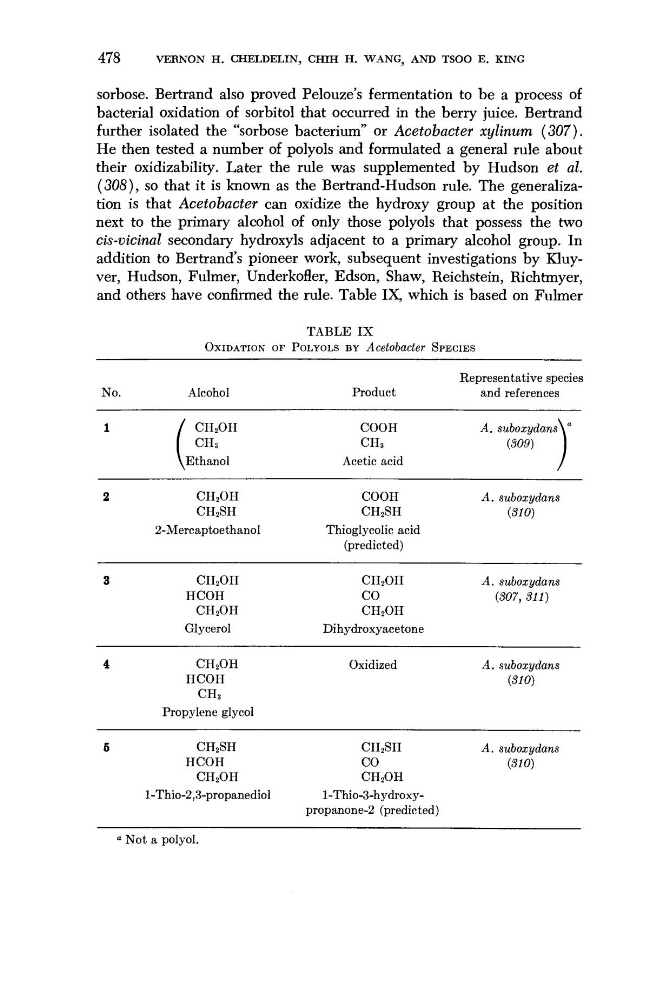
and others have confirmed the rule. Table IX, which is based on Fulmer
TABLE IX
OXIDATION OF POLYOLS BY Acetobacter SPECIES
No.
1
2
3
4
Alcohol
/ CH 2 OH
1 CH 3
\Ethanol
CH2OH
CH 2 SH
2-Mercaptoethanol
CH2OH
HCOH
CH2OH
Glycerol
CH2OH
HCOH
CH 3
Propylene glycol
Product
COOH
CH 3
Acetic acid
COOH
CH 2 SH
Thioglycolic acid
(predicted)
CH2OH
CO
CH2OH
Dihydroxyacetone
Oxidized
Representative species
and references
A.
suboxydansy
(S09)
}
A. suboxydans
(310)
A. suboxydans
(807, 311)
A. suboxydans
(310)
5
CH 2 SH
CH 2 SH
A. suboxydans
HCOH
CO
(310)
CH2OH
CH2OH
1 -Thio-2,3-propanediol
1 -Thio-3-hy droxypropanone-2 (predicted)
0 Not a polyol.
VERNON H. CHELDELIN, CHIH H. WANG, AND TSOO E. KING
sorbose. Bertrand also proved Pelouze's fermentation to be a process of
bacterial oxidation of sorbitol that occurred in the berry juice. Bertrand
further isolated the "sorbose bacterium" or Acetobacter xylinum (307).
He then tested a number of polyols and formulated a general rule about
their oxidizability. Later the rule was supplemented by Hudson et al.
(308), so that it is known as the Bertrand-Hudson rule. The generalization is that Acetobacter can oxidize the hydroxy group at the position
next to the primary alcohol of only those polyols that possess the two
cis-vicinal secondary hydroxyls adjacent to a primary alcohol group. In
addition to Bertrand's pioneer work, subsequent investigations by Kluyver, Hudson, Fulmer, Underkofler, Edson, Shaw, Reichstein, Richtmyer,
and others have confirmed the rule. Table IX, which is based on Fulmer
TABLE IX
OXIDATION OF POLYOLS BY Acetobacter SPECIES
No.
1
2
3
4
Alcohol
/ CH 2 OH
1 CH 3
\Ethanol
CH2OH
CH 2 SH
2-Mercaptoethanol
CH2OH
HCOH
CH2OH
Glycerol
CH2OH
HCOH
CH 3
Propylene glycol
Product
COOH
CH 3
Acetic acid
COOH
CH 2 SH
Thioglycolic acid
(predicted)
CH2OH
CO
CH2OH
Dihydroxyacetone
Oxidized
Representative species
and references
A.
suboxydansy
(S09)
}
A. suboxydans
(310)
A. suboxydans
(807, 311)
A. suboxydans
(310)
5
CH 2 SH
CH 2 SH
A. suboxydans
HCOH
CO
(310)
CH2OH
CH2OH
1 -Thio-2,3-propanediol
1 -Thio-3-hy droxypropanone-2 (predicted)
0 Not a polyol.