

8. POLYSACCHARIDASES
379
and vegetable kingdoms, and the dispersion constant, calculated from the
optical rotation, is different in pancreatic and mold amylases, the two
a-amylases in which it has been studied (190). The other characteristics
appear to be more or less independent of the origin of the enzyme.
(3). Stability of a-amylases. This depends to a large extent on the
degree of purification of the enzyme, as well as on the purification and
crystallization procedures used. Crude B. subtilis amylase, for instance,
is much more stable at 70° than the crystalline enzyme (8, 189).
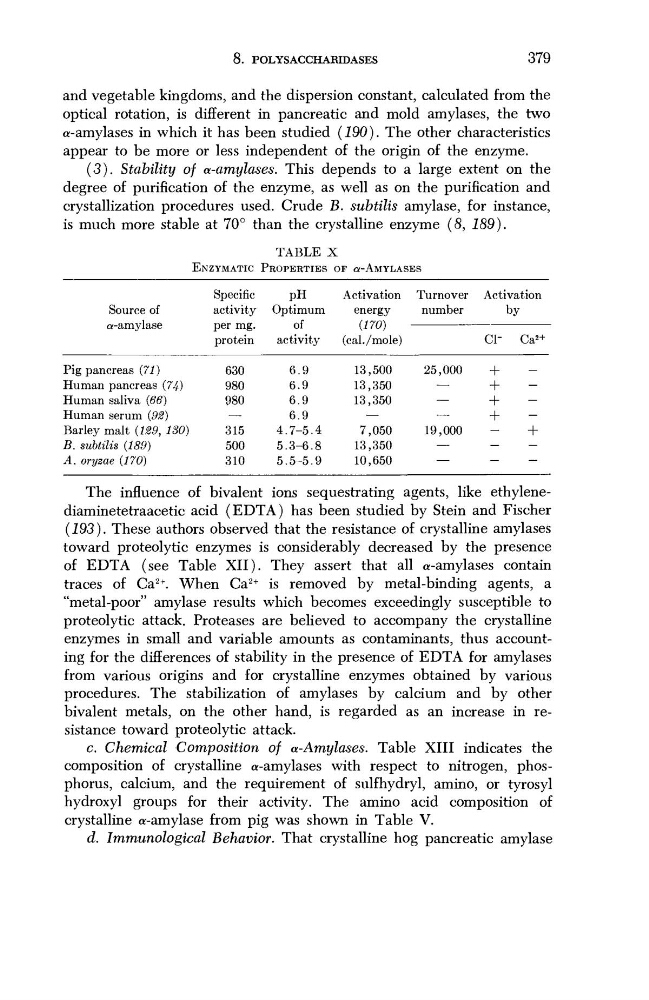
'"fABLE X
ENZYMATIC PROPERTIES OF a-AMYLASES
Specific
pH
Activation Turnover Activation
Source of
activity Optimum
energy
number
by
a-amylase
per mg.
of
(170)
protein
activity
(cal./mole)
CI- Ca 2 +
Pig pancreas (71)
630
6.9
13,500
25,000
+
Human pancreas (74-)
980
6.9
13,350
+
Human saliva (66)
980
6.9
13,350
+
Human serum (92)
6.9
+
Barley malt (129, 130)
315
4.7-5.4
7,050
19,000
+
B. subtilis (189)
500
5.3-6.8
13,350
A. oryzae (170)
310
5.5-5.9
10,650
The influence of bivalent ions sequestrating agents, like ethylenediaminetetraacetic acid (EDTA) has been studied by Stein and Fischer
(193). These authors observed that the resistance of crystalline amylases
toward proteolytic enzymes is considerably decreased by the presence
of EDTA (see Table XII). They assert that all a-amylases contain
traces of Ca
2 +. When Ca
2 + is removed by metal-binding agents, a
"metal-poor" amylase results which becomes exceedingly susceptible to
proteolytic attack. Proteases are believed to accompany the crystalline
enzymes in small and variable amounts as contaminants, thus accounting for the differences of stability in the presence of EDTA for amylases
from various origins and for crystalline enzymes obtained by various
procedures. The stabilization of amylases by calcium and by other
bivalent metals, on the other hand, is regarded as an increase in resistance toward proteolytic attack.
c. Chemical 'Composition of a-Amylases. Table XIII indicates the
composition of crystalline a-amylases with respect to nitrogen, phosphorus, calcium, and the requirement of sulfhydryl, amino, or tyrosyl
hydroxyl groups for their activity. The amino acid composition of
crystalline a-amylase from pig was shown in Table V.
d. Immunological Behavior. That crystalline hog pancreatic amylase
379
and vegetable kingdoms, and the dispersion constant, calculated from the
optical rotation, is different in pancreatic and mold amylases, the two
a-amylases in which it has been studied (190). The other characteristics
appear to be more or less independent of the origin of the enzyme.
(3). Stability of a-amylases. This depends to a large extent on the
degree of purification of the enzyme, as well as on the purification and
crystallization procedures used. Crude B. subtilis amylase, for instance,
is much more stable at 70° than the crystalline enzyme (8, 189).
'"fABLE X
ENZYMATIC PROPERTIES OF a-AMYLASES
Specific
pH
Activation Turnover Activation
Source of
activity Optimum
energy
number
by
a-amylase
per mg.
of
(170)
protein
activity
(cal./mole)
CI- Ca 2 +
Pig pancreas (71)
630
6.9
13,500
25,000
+
Human pancreas (74-)
980
6.9
13,350
+
Human saliva (66)
980
6.9
13,350
+
Human serum (92)
6.9
+
Barley malt (129, 130)
315
4.7-5.4
7,050
19,000
+
B. subtilis (189)
500
5.3-6.8
13,350
A. oryzae (170)
310
5.5-5.9
10,650
The influence of bivalent ions sequestrating agents, like ethylenediaminetetraacetic acid (EDTA) has been studied by Stein and Fischer
(193). These authors observed that the resistance of crystalline amylases
toward proteolytic enzymes is considerably decreased by the presence
of EDTA (see Table XII). They assert that all a-amylases contain
traces of Ca
2 +. When Ca
2 + is removed by metal-binding agents, a
"metal-poor" amylase results which becomes exceedingly susceptible to
proteolytic attack. Proteases are believed to accompany the crystalline
enzymes in small and variable amounts as contaminants, thus accounting for the differences of stability in the presence of EDTA for amylases
from various origins and for crystalline enzymes obtained by various
procedures. The stabilization of amylases by calcium and by other
bivalent metals, on the other hand, is regarded as an increase in resistance toward proteolytic attack.
c. Chemical 'Composition of a-Amylases. Table XIII indicates the
composition of crystalline a-amylases with respect to nitrogen, phosphorus, calcium, and the requirement of sulfhydryl, amino, or tyrosyl
hydroxyl groups for their activity. The amino acid composition of
crystalline a-amylase from pig was shown in Table V.
d. Immunological Behavior. That crystalline hog pancreatic amylase