

372
PETER BERNFELD
is about 5-10% of that found in germinated wheat and decreases to oneseventieth of that value at complete maturity. The presence of a-amylase
in the early stages of ripening of wheat and its disappearance during
further ripening has also been observed by other workers (116).
Ungerminated corn, millet, sorghum, and rice have been reported to
be practically devoid of both a- and ß-amylases (117). It is during the
process of germination that the majority of α-amylase activity develops
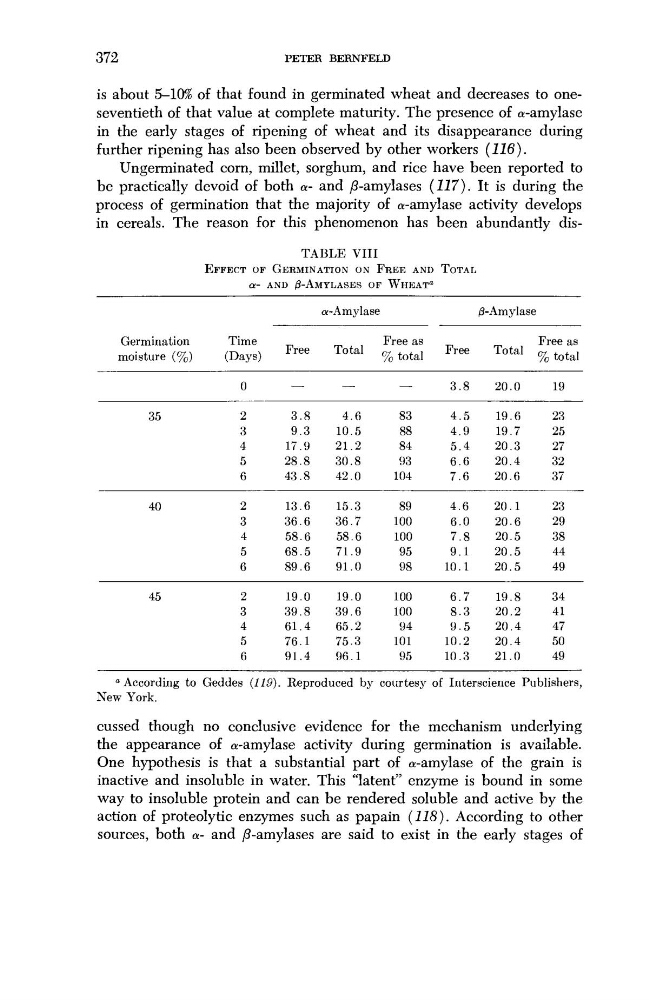
in cereals. The reason for this phenomenon has been abundantly disTABLE VIII
EFFECT OF GERMINATION ON FREE AND TOTAL
Germination
moisture (%)
35
40
45
Time
(Days)
0
2
3
4
5
6
2
3
4
5
6
2
3
4
5
6
Free
—
3.8
9.3
17.9
28.8
43.8
13.6
36.6
58.6
68.5
89.6
19.0
39.8
61.4
76.1
91.4
a-Amylase
Total
—
4.6
10.5
21.2
30.8
42.0
15.3
36.7
58.6
71.9
91.0
19.0
39.6
65.2
75.3
96.1
Free as
% total
—
83
88
84
93
104
89
100
100
95
98
100
100
94
101
95
Free
3.8
4.5
4.9
5.4
6.6
7.6
4.6
6.0
7.8
9.1
10.1
6.7
8.3
9.5
10.2
10.3
/3-Amylase
Total
20.0
19.6
19.7
20.3
20.4
20.6
20.1
20.6
20.5
20.5
20.5
19.8
20.2
20.4
20.4
21.0
Free as
% total
19
23
25
27
32
37
23
29
38
44
49
34
41
47
50
49
a According to Geddes (119). Reproduced by courtesy of Interscience Publishers,
New York.
cussed though no conclusive evidence for the mechanism underlying
the appearance of α-amylase activity during germination is available.
One hypothesis is that a substantial part of α-amylase of the grain is
inactive and insoluble in water. This "latent" enzyme is bound in some
way to insoluble protein and can be rendered soluble and active by the
action of proteolytic enzymes such as papain (118). According to other
sources, both a- and ß-amylases are said to exist in the early stages of
PETER BERNFELD
is about 5-10% of that found in germinated wheat and decreases to oneseventieth of that value at complete maturity. The presence of a-amylase
in the early stages of ripening of wheat and its disappearance during
further ripening has also been observed by other workers (116).
Ungerminated corn, millet, sorghum, and rice have been reported to
be practically devoid of both a- and ß-amylases (117). It is during the
process of germination that the majority of α-amylase activity develops
in cereals. The reason for this phenomenon has been abundantly disTABLE VIII
EFFECT OF GERMINATION ON FREE AND TOTAL
Germination
moisture (%)
35
40
45
Time
(Days)
0
2
3
4
5
6
2
3
4
5
6
2
3
4
5
6
Free
—
3.8
9.3
17.9
28.8
43.8
13.6
36.6
58.6
68.5
89.6
19.0
39.8
61.4
76.1
91.4
a-Amylase
Total
—
4.6
10.5
21.2
30.8
42.0
15.3
36.7
58.6
71.9
91.0
19.0
39.6
65.2
75.3
96.1
Free as
% total
—
83
88
84
93
104
89
100
100
95
98
100
100
94
101
95
Free
3.8
4.5
4.9
5.4
6.6
7.6
4.6
6.0
7.8
9.1
10.1
6.7
8.3
9.5
10.2
10.3
/3-Amylase
Total
20.0
19.6
19.7
20.3
20.4
20.6
20.1
20.6
20.5
20.5
20.5
19.8
20.2
20.4
20.4
21.0
Free as
% total
19
23
25
27
32
37
23
29
38
44
49
34
41
47
50
49
a According to Geddes (119). Reproduced by courtesy of Interscience Publishers,
New York.
cussed though no conclusive evidence for the mechanism underlying
the appearance of α-amylase activity during germination is available.
One hypothesis is that a substantial part of α-amylase of the grain is
inactive and insoluble in water. This "latent" enzyme is bound in some
way to insoluble protein and can be rendered soluble and active by the
action of proteolytic enzymes such as papain (118). According to other
sources, both a- and ß-amylases are said to exist in the early stages of