

8. POLYSACCHARIDASES
371
It is not exactly known whether these minute amounts of a-amylase
actually originate from the tissues or are released from microorganisms
growing there. Amylase-producing bacteria have, indeed, been observed
in the rumen of the sheep (107) and the cecum of the pig (108). Considerable amylase activity was observed in the bile of sheep, whereas
bovine bile contained only traces (103).
Honey has been found to contain amylase, and it has been demonstrated that this enzyme therein actually originates from the bee (109).
Amylase has been found in mollusks: it could be extracted from
styles of Meretrix luzoria and Mactra veneriformis (110).
In protozoa, amylase has been detected and localized in amebas
(111).
The role of amylase during embryonic development has been investigated repeatedly. Amylase activity has been found to be very high
in the egg of the toad (Bufo vulgaris) during cleavage, and to decrease
progressively until the end of embryonic life. This is followed by a rapid
increase in amylase at the beginning of larval life (112, 113).
b. a-Amylases in Higher Plants. The most important occurrence of
α-amylase in higher plants is in germinated cereals, where it is associated with considerable amounts of ß-amylase. Whereas the latter enzyme is present also in the ungerminated cereals, α-amylase activity is
practically absent at that stage, and the low amounts of α-amylase that
can be detected before germination are believed to be derived from the
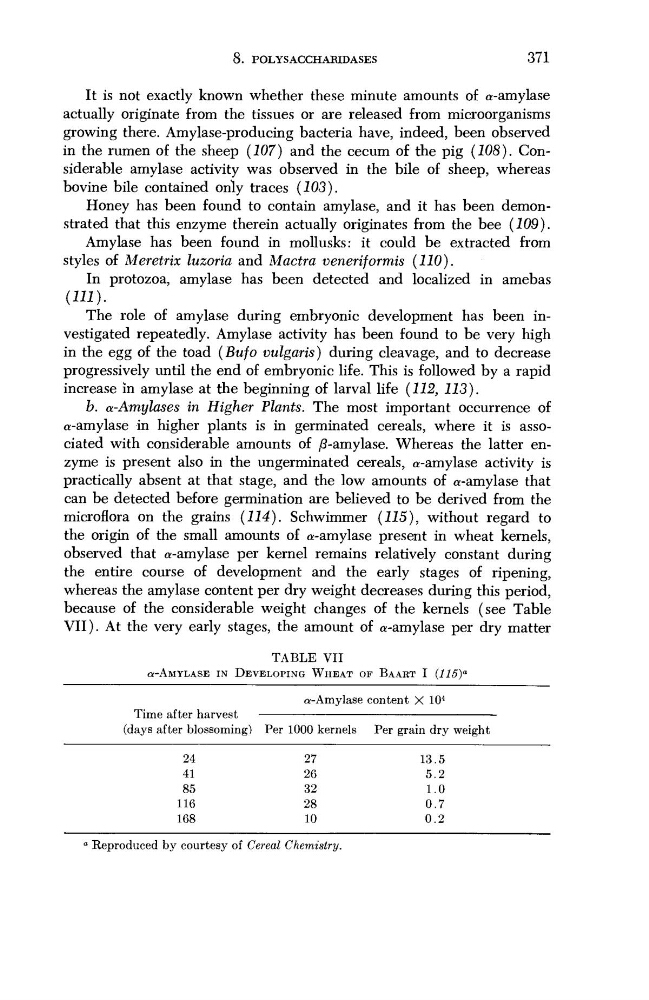
microflora on the grains (114). Schwimmer (115), without regard to
the origin of the small amounts of α-amylase present in wheat kernels,
observed that α-amylase per kernel remains relatively constant during
the entire course of development and the early stages of ripening,
whereas the amylase content per dry weight decreases during this period,
because of the considerable weight changes of the kernels (see Table
VII). At the very early stages, the amount of α-amylase per dry matter
TABLE VII
«-AMYLASE IN DEVELOPING WHEAT OF BAART I (115)
a
Time after harvest
(days after blossoming)
24
41
85
116
168
«-Amylase
Per 1000 kernels
27
26
32
28
10
content X 10
4
Per grain dry weight
13.5
5.2
1.0
0.7
0.2
α Reproduced by courtesy of Cereal Chemistry.
371
It is not exactly known whether these minute amounts of a-amylase
actually originate from the tissues or are released from microorganisms
growing there. Amylase-producing bacteria have, indeed, been observed
in the rumen of the sheep (107) and the cecum of the pig (108). Considerable amylase activity was observed in the bile of sheep, whereas
bovine bile contained only traces (103).
Honey has been found to contain amylase, and it has been demonstrated that this enzyme therein actually originates from the bee (109).
Amylase has been found in mollusks: it could be extracted from
styles of Meretrix luzoria and Mactra veneriformis (110).
In protozoa, amylase has been detected and localized in amebas
(111).
The role of amylase during embryonic development has been investigated repeatedly. Amylase activity has been found to be very high
in the egg of the toad (Bufo vulgaris) during cleavage, and to decrease
progressively until the end of embryonic life. This is followed by a rapid
increase in amylase at the beginning of larval life (112, 113).
b. a-Amylases in Higher Plants. The most important occurrence of
α-amylase in higher plants is in germinated cereals, where it is associated with considerable amounts of ß-amylase. Whereas the latter enzyme is present also in the ungerminated cereals, α-amylase activity is
practically absent at that stage, and the low amounts of α-amylase that
can be detected before germination are believed to be derived from the
microflora on the grains (114). Schwimmer (115), without regard to
the origin of the small amounts of α-amylase present in wheat kernels,
observed that α-amylase per kernel remains relatively constant during
the entire course of development and the early stages of ripening,
whereas the amylase content per dry weight decreases during this period,
because of the considerable weight changes of the kernels (see Table
VII). At the very early stages, the amount of α-amylase per dry matter
TABLE VII
«-AMYLASE IN DEVELOPING WHEAT OF BAART I (115)
a
Time after harvest
(days after blossoming)
24
41
85
116
168
«-Amylase
Per 1000 kernels
27
26
32
28
10
content X 10
4
Per grain dry weight
13.5
5.2
1.0
0.7
0.2
α Reproduced by courtesy of Cereal Chemistry.