

8. POLYSACCHARIDASES
369
(3). Blood amylase. In blood, amylase has been reported to occur
in the plasma, in erythrocytes, and in leukocytes. Wagner has shown
(83) that the enzyme in human white blood cells breaking down
glycogen is actually a phosphorylase, rather than an amylase as was
originally postulated by Willstätter and others (84, 85).
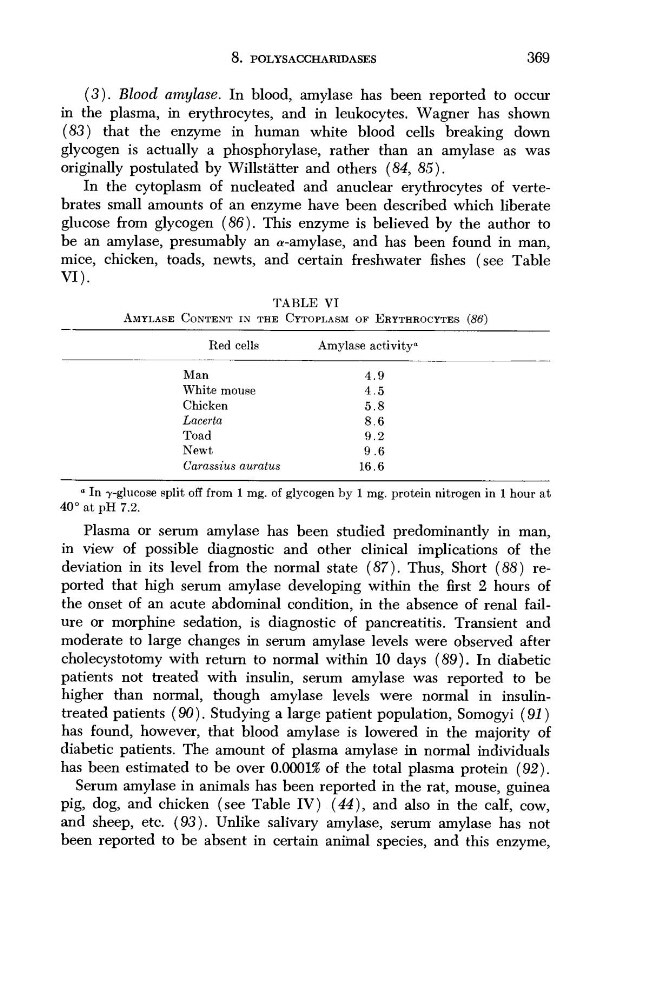
In the cytoplasm of nucleated and anuclear erythrocytes of vertebrates small amounts of an enzyme have been described which liberate
glucose from glycogen (86). This enzyme is believed by the author to
be an amylase, presumably an α-amylase, and has been found in man,
mice, chicken, toads, newts, and certain freshwater fishes (see Table
VI).
TABLE VI
AMYLASE CONTENT IN THE CYTOPLASM OF EKYTHROCYTES (86)
Red cells
Amylase activity
0
Man
4.9
White mouse
4.5
Chicken
5.8
Lacerta
8.6
Toad
9.2
Newt
9.6
Carassius auratus
16.6
° In 7-glucose split off from 1 mg. of glycogen by 1 mg. protein nitrogen in 1 hour at
40° at pH 7.2.
Plasma or serum amylase has been studied predominantly in man,
in view of possible diagnostic and other clinical implications of the
deviation in its level from the normal state (87). Thus, Short (88) reported that high serum amylase developing within the first 2 hours of
the onset of an acute abdominal condition, in the absence of renal failure or morphine sedation, is diagnostic of pancreatitis. Transient and
moderate to large changes in serum amylase levels were observed after
cholecystotomy with return to normal within 10 days (89). In diabetic
patients not treated with insulin, serum amylase was reported to be
higher than normal, though amylase levels were normal in insulintreated patients (90). Studying a large patient population, Somogyi (91)
has found, however, that blood amylase is lowered in the majority of
diabetic patients. The amount of plasma amylase in normal individuals
has been estimated to be over 0.0001% of the total plasma protein (92).
Serum amylase in animals has been reported in the rat, mouse, guinea
pig, dog, and chicken (see Table IV) (44), and also in the calf, cow,
and sheep, etc. (93). Unlike salivary amylase, serum amylase has not
been reported to be absent in certain animal species, and this enzyme,
369
(3). Blood amylase. In blood, amylase has been reported to occur
in the plasma, in erythrocytes, and in leukocytes. Wagner has shown
(83) that the enzyme in human white blood cells breaking down
glycogen is actually a phosphorylase, rather than an amylase as was
originally postulated by Willstätter and others (84, 85).
In the cytoplasm of nucleated and anuclear erythrocytes of vertebrates small amounts of an enzyme have been described which liberate
glucose from glycogen (86). This enzyme is believed by the author to
be an amylase, presumably an α-amylase, and has been found in man,
mice, chicken, toads, newts, and certain freshwater fishes (see Table
VI).
TABLE VI
AMYLASE CONTENT IN THE CYTOPLASM OF EKYTHROCYTES (86)
Red cells
Amylase activity
0
Man
4.9
White mouse
4.5
Chicken
5.8
Lacerta
8.6
Toad
9.2
Newt
9.6
Carassius auratus
16.6
° In 7-glucose split off from 1 mg. of glycogen by 1 mg. protein nitrogen in 1 hour at
40° at pH 7.2.
Plasma or serum amylase has been studied predominantly in man,
in view of possible diagnostic and other clinical implications of the
deviation in its level from the normal state (87). Thus, Short (88) reported that high serum amylase developing within the first 2 hours of
the onset of an acute abdominal condition, in the absence of renal failure or morphine sedation, is diagnostic of pancreatitis. Transient and
moderate to large changes in serum amylase levels were observed after
cholecystotomy with return to normal within 10 days (89). In diabetic
patients not treated with insulin, serum amylase was reported to be
higher than normal, though amylase levels were normal in insulintreated patients (90). Studying a large patient population, Somogyi (91)
has found, however, that blood amylase is lowered in the majority of
diabetic patients. The amount of plasma amylase in normal individuals
has been estimated to be over 0.0001% of the total plasma protein (92).
Serum amylase in animals has been reported in the rat, mouse, guinea
pig, dog, and chicken (see Table IV) (44), and also in the calf, cow,
and sheep, etc. (93). Unlike salivary amylase, serum amylase has not
been reported to be absent in certain animal species, and this enzyme,