

368
PETER BERNFELD
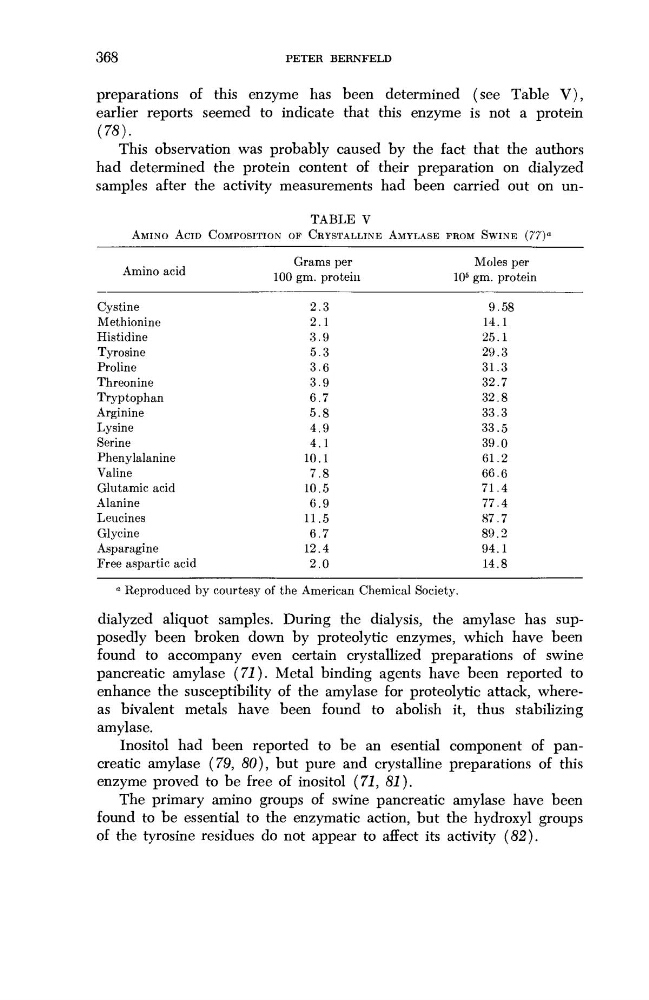
preparations of this enzyme has been determined (see Table V),
earlier reports seemed to indicate that this enzyme is not a protein
(78).
This observation was probably caused by the fact that the authors
had determined the protein content of their preparation on dialyzed
samples after the activity measurements had been carried out on unTABLE V
AMINO ACID COMPOSITION OF CRYSTALLINE AMYLASE FROM SWINE
(77)
a
Grams per
Moles per
Ammo acid
lQQ gm proteiu
w
gm
prote i n
Cystine
Methionine
Histidine
Tyrosine
Proline
Threonine
Tryptophan
Arginine
Lysine
Serine
Phenylalanine
Valine
Glutamic acid
Alanine
Leucines
Glycine
Asparagine
Free aspartic acid
2.3
2.1
3.9
5.3
3.6
3.9
6.7
5.8
4.9
4.1
10.1
7.8
10.5
6.9
11.5
6.7
12.4
2.0
9.58
14.1
25.1
29.3
31.3
32.7
32.8
33.3
33.5
39.0
61.2
66.6
71.4
77.4
87.7
89.2
94.1
14.8
a Reproduced by courtesy of the American Chemical Society.
dialyzed aliquot samples. During the dialysis, the amylase has supposedly been broken down by proteolytic enzymes, which have been
found to accompany even certain crystallized preparations of swine
pancreatic amylase (71). Metal binding agents have been reported to
enhance the susceptibility of the amylase for proteolytic attack, whereas bivalent metals have been found to abolish it, thus stabilizing
amylase.
Inositol had been reported to be an esential component of pancreatic amylase (79, 80), but pure and crystalline preparations of this
enzyme proved to be free of inositol (71, 81).
The primary amino groups of swine pancreatic amylase have been
found to be essential to the enzymatic action, but the hydroxyl groups
of the tyrosine residues do not appear to affect its activity (82).
PETER BERNFELD
preparations of this enzyme has been determined (see Table V),
earlier reports seemed to indicate that this enzyme is not a protein
(78).
This observation was probably caused by the fact that the authors
had determined the protein content of their preparation on dialyzed
samples after the activity measurements had been carried out on unTABLE V
AMINO ACID COMPOSITION OF CRYSTALLINE AMYLASE FROM SWINE
(77)
a
Grams per
Moles per
Ammo acid
lQQ gm proteiu
w
gm
prote i n
Cystine
Methionine
Histidine
Tyrosine
Proline
Threonine
Tryptophan
Arginine
Lysine
Serine
Phenylalanine
Valine
Glutamic acid
Alanine
Leucines
Glycine
Asparagine
Free aspartic acid
2.3
2.1
3.9
5.3
3.6
3.9
6.7
5.8
4.9
4.1
10.1
7.8
10.5
6.9
11.5
6.7
12.4
2.0
9.58
14.1
25.1
29.3
31.3
32.7
32.8
33.3
33.5
39.0
61.2
66.6
71.4
77.4
87.7
89.2
94.1
14.8
a Reproduced by courtesy of the American Chemical Society.
dialyzed aliquot samples. During the dialysis, the amylase has supposedly been broken down by proteolytic enzymes, which have been
found to accompany even certain crystallized preparations of swine
pancreatic amylase (71). Metal binding agents have been reported to
enhance the susceptibility of the amylase for proteolytic attack, whereas bivalent metals have been found to abolish it, thus stabilizing
amylase.
Inositol had been reported to be an esential component of pancreatic amylase (79, 80), but pure and crystalline preparations of this
enzyme proved to be free of inositol (71, 81).
The primary amino groups of swine pancreatic amylase have been
found to be essential to the enzymatic action, but the hydroxyl groups
of the tyrosine residues do not appear to affect its activity (82).