

356
PETER BERNFELD
I. Introduction
Polysaccharidases are defined as the enzymes that catalyze the
hydrolytic breakdown of polysaccharides into products of lower molecular weight yielding, after exhaustive action, usually mono-, di-, tri-, or
tetrasaccharides and frequently oligosaccharides or other polysaccharides
of various molecular weights. These enzymes are highly specific for
their respective substrates with regard to the chemical nature of the
monomeric sugar units involved, as well as with respect to chemical
and optical configurations of the glycosidic linkages to be hydrolyzed.
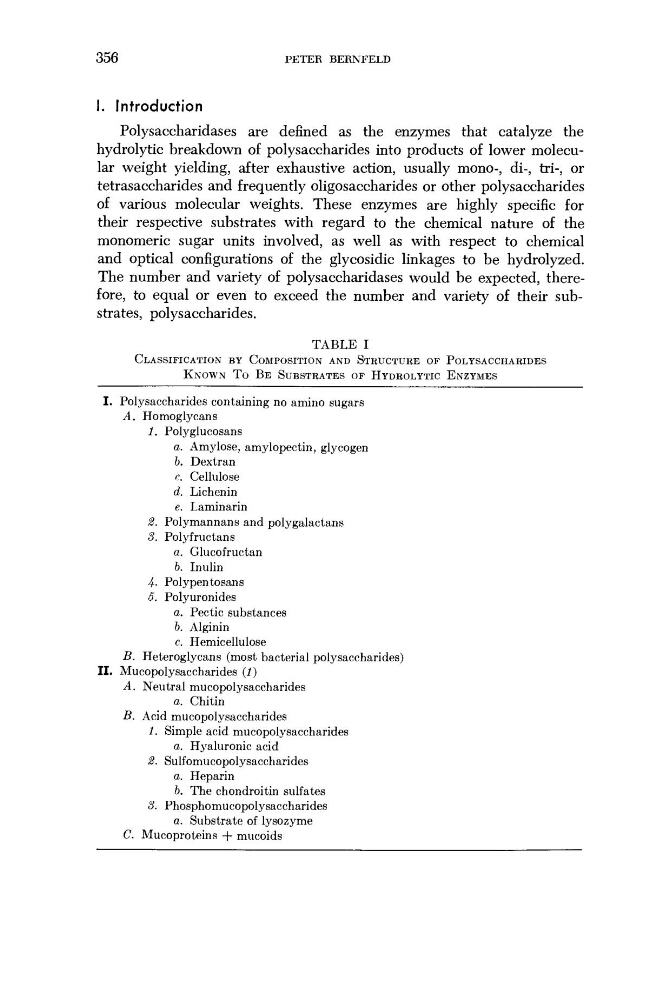
The number and variety of polysaccharidases would be expected, therefore, to equal or even to exceed the number and variety of their substrates, polysaccharides.
TABLE I
CLASSIFICATION BY COMPOSITION AND STRUCTURE OF POLYSACCHARIDES
KNOWN TO BE SUBSTRATES OF HYDROLYTIC ENZYMES
I. Polysaccharides containing no amino sugars
A. Homoglycans
1. Polyglucosans
a. Amylose, amylopectin, glycogen
b. Dextran
c. Cellulose
d. Lichenin
e. Laminarin
2. Polymannans and polygalactans
3. Polyfructans
a. Glucofructan
b. Inulin
4- Polypentosans
5. Polyuronides
a. Pectic substances
b. Alginin
c. Hemicellulose
B. Heteroglycans (most bacterial polysaccharides)
II. Mucopolysaccharides (1)
A. Neutral mucopolysaccharides
a. Chitin
B. Acid mucopolysaccharides
1. Simple acid mucopolysaccharides
a. Hyaluronic acid
2. Sulfomucopolysaccharides
a. Heparin
b. The chondroitin sulfates
3. Phosphomucopolysaccharides
a. Substrate of lysozyme
C. Mucoproteins + mucoids
PETER BERNFELD
I. Introduction
Polysaccharidases are defined as the enzymes that catalyze the
hydrolytic breakdown of polysaccharides into products of lower molecular weight yielding, after exhaustive action, usually mono-, di-, tri-, or
tetrasaccharides and frequently oligosaccharides or other polysaccharides
of various molecular weights. These enzymes are highly specific for
their respective substrates with regard to the chemical nature of the
monomeric sugar units involved, as well as with respect to chemical
and optical configurations of the glycosidic linkages to be hydrolyzed.
The number and variety of polysaccharidases would be expected, therefore, to equal or even to exceed the number and variety of their substrates, polysaccharides.
TABLE I
CLASSIFICATION BY COMPOSITION AND STRUCTURE OF POLYSACCHARIDES
KNOWN TO BE SUBSTRATES OF HYDROLYTIC ENZYMES
I. Polysaccharides containing no amino sugars
A. Homoglycans
1. Polyglucosans
a. Amylose, amylopectin, glycogen
b. Dextran
c. Cellulose
d. Lichenin
e. Laminarin
2. Polymannans and polygalactans
3. Polyfructans
a. Glucofructan
b. Inulin
4- Polypentosans
5. Polyuronides
a. Pectic substances
b. Alginin
c. Hemicellulose
B. Heteroglycans (most bacterial polysaccharides)
II. Mucopolysaccharides (1)
A. Neutral mucopolysaccharides
a. Chitin
B. Acid mucopolysaccharides
1. Simple acid mucopolysaccharides
a. Hyaluronic acid
2. Sulfomucopolysaccharides
a. Heparin
b. The chondroitin sulfates
3. Phosphomucopolysaccharides
a. Substrate of lysozyme
C. Mucoproteins + mucoids