

296
D. J. BELL
CH 2 OH
ι
CH 2 OH
I
CH 2 OH
1
1
c=o
C=0
1
HO—C—Η
HO—C—Η
J
HO—C—Η
J
Η—C—OH
j
HO—C—Η
J
HO—C—Η
j
H—C—OH
J
Η—C—OH
j
Η—C—OH
1
J
H—C—OH
J
H—C—OH
H—C—OH
J
CH 2 OH
j
CH 2 OH
J
H—C—OH
J
CH 2 OH
(XXXVII)
(XXXVIII)
(XXXIX)
CHO
CHO
CHO
J
HO—C—Η
j
H—C—OH
j
H—C—OH
j
HO—C—Η
j
H—C—OH
j
HO—C—Η
Η—C—OH
J
HO—C—Η
I
j
HO—C—Η
I
J
H—C—OH
HO—C—Η
Η—C—OH
J
HO—C—Η
J
Η—C—OH
J
H—C—OH
j
CH 2 OH
J
CH 2 OH
j
CH 2 OH
(XLII)
(XLI)
(XL)
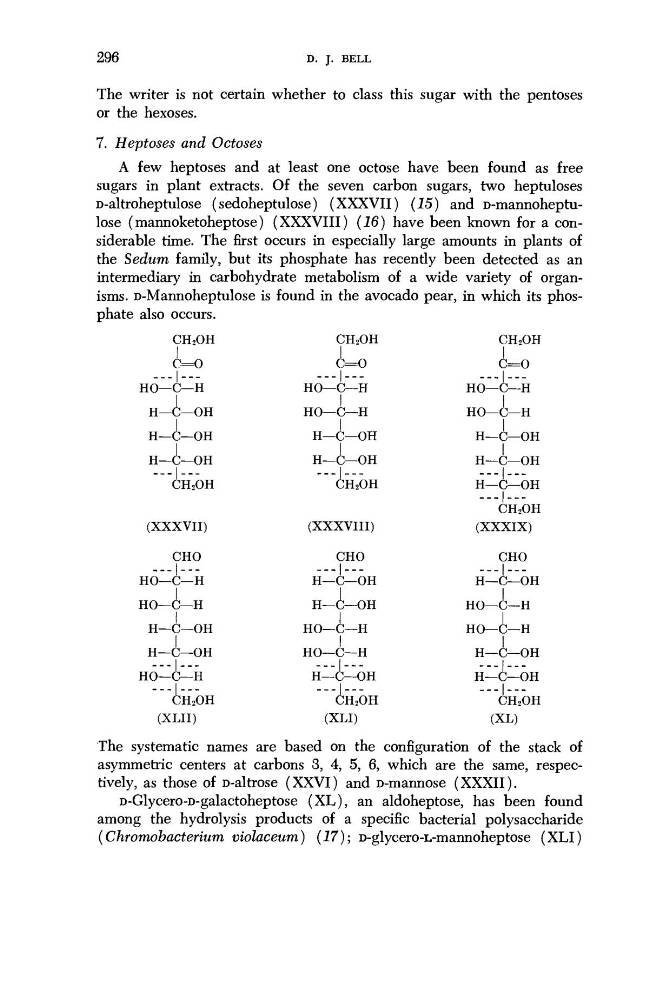
The systematic names are based on the configuration of the stack of
asymmetric centers at carbons 3, 4, 5, 6, which are the same, respectively, as those of D-altrose (XXVI) and D-mannose (XXXII).
D-Glycero-D-galactoheptose (XL), an aldoheptose, has been found
among the hydrolysis products of a specific bacterial polysaccharide
(Chromobacterium viohceum) (17); D-glycero-L-mannoheptose (XLI)
The writer is not certain whether to class this sugar with the pentoses
or the hexoses.
7. Heptoses and Octoses
A few heptoses and at least one octose have been found as free
sugars in plant extracts. Of the seven carbon sugars, two heptuloses
D-altroheptulose (sedoheptulose) (XXXVII) (15) and D-mannoheptulose (mannoketoheptose) (XXXVIII) (16) have been known for a considerable time. The first occurs in especially large amounts in plants of
the Sedum family, but its phosphate has recently been detected as an
intermediary in carbohydrate metabolism of a wide variety of organisms. D-Mannoheptulose is found in the avocado pear, in which its phosphate also occurs.
D. J. BELL
CH 2 OH
ι
CH 2 OH
I
CH 2 OH
1
1
c=o
C=0
1
HO—C—Η
HO—C—Η
J
HO—C—Η
J
Η—C—OH
j
HO—C—Η
J
HO—C—Η
j
H—C—OH
J
Η—C—OH
j
Η—C—OH
1
J
H—C—OH
J
H—C—OH
H—C—OH
J
CH 2 OH
j
CH 2 OH
J
H—C—OH
J
CH 2 OH
(XXXVII)
(XXXVIII)
(XXXIX)
CHO
CHO
CHO
J
HO—C—Η
j
H—C—OH
j
H—C—OH
j
HO—C—Η
j
H—C—OH
j
HO—C—Η
Η—C—OH
J
HO—C—Η
I
j
HO—C—Η
I
J
H—C—OH
HO—C—Η
Η—C—OH
J
HO—C—Η
J
Η—C—OH
J
H—C—OH
j
CH 2 OH
J
CH 2 OH
j
CH 2 OH
(XLII)
(XLI)
(XL)
The systematic names are based on the configuration of the stack of
asymmetric centers at carbons 3, 4, 5, 6, which are the same, respectively, as those of D-altrose (XXVI) and D-mannose (XXXII).
D-Glycero-D-galactoheptose (XL), an aldoheptose, has been found
among the hydrolysis products of a specific bacterial polysaccharide
(Chromobacterium viohceum) (17); D-glycero-L-mannoheptose (XLI)
The writer is not certain whether to class this sugar with the pentoses
or the hexoses.
7. Heptoses and Octoses
A few heptoses and at least one octose have been found as free
sugars in plant extracts. Of the seven carbon sugars, two heptuloses
D-altroheptulose (sedoheptulose) (XXXVII) (15) and D-mannoheptulose (mannoketoheptose) (XXXVIII) (16) have been known for a considerable time. The first occurs in especially large amounts in plants of
the Sedum family, but its phosphate has recently been detected as an
intermediary in carbohydrate metabolism of a wide variety of organisms. D-Mannoheptulose is found in the avocado pear, in which its phosphate also occurs.