

7. MONOSACCHARIDES AND OLIGOSACCHARIDES
295
5. Hexoses
The pentoses can be considered as being derived from the tetroses
by adding a Η—C—OH grouping to their stack of asymmetric systems; addition of a similar system to the stack of asymmetric systems
of the pentoses gives rise to the hexose series; each pentose yields two
hexoses depending upon whether the added system is right- or lefthanded. The D- and L-aldohexoses therefore consist of eight members
each and the D- and L-hexuloses, four each. Of all these substances only
a few have been so far found in nature. The D-family compounds are
set forth, arranged in epimeric pairs alongside their related ketoses
(XXV-XXVI); sugars that have been detected in natural environments
are marked with an asterisk.
6. Branched-Chain Hexoses
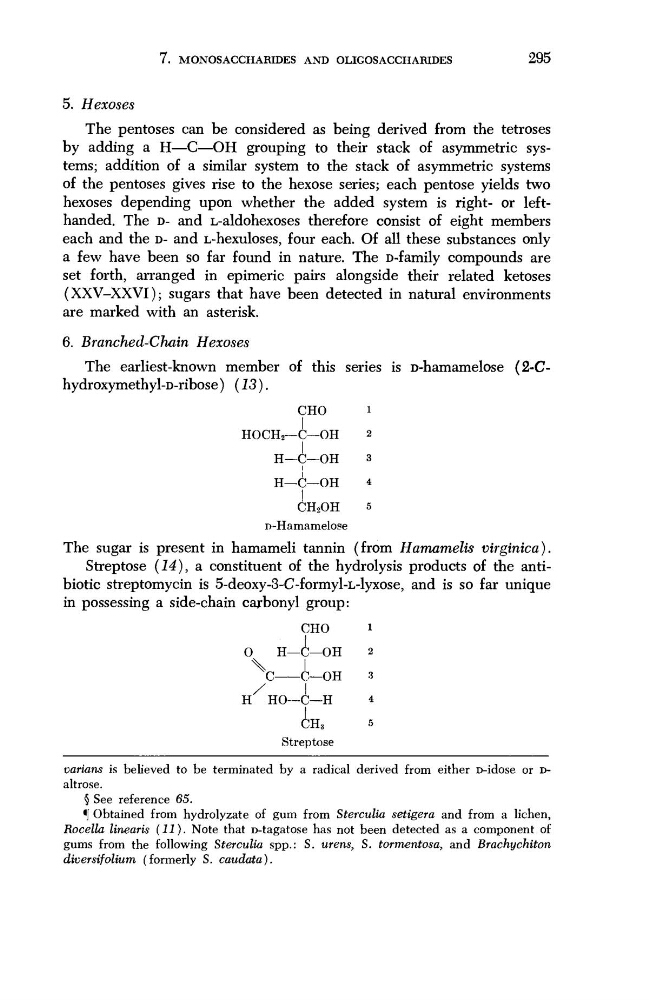
The earliest-known member of this series is D-hamamelose (2-Chydroxymethyl-D-ribose) (13).
CHO
1
j
HOCH 2 —C—OH
2
j
H—C—OH
CO
H—C—OH
4
CH 2 OH
5
D-Hamamelose
The sugar is present in hamameli tannin (from Hamamelis virginica).
Streptose (14), a constituent of the hydrolysis products of the antibiotic streptomycin is 5-deoxy-3-C-formyl-L-lyxose, and is so far unique
in possessing a side-chain carbonyl group:
CHO
1
J
0
H—C—OH
2
\
1
C
C OH
3
y
j
Η
HO—C—Η
I
4
CH 3
5
Streptose
varians is believed to be terminated by a radical derived from either D-idose or Daltrose.
§ See reference 65.
*J Obtained from hydrolyzate of gum from Sterculia setigera and from a lichen,
RoceUa linearis (11). Note that D-tagatose has not been detected as a component of
gums from the following Sterculia spp.: S. urens, S. tormentosa, and Brachychiton
diversifolium (formerly S. caudata).
295
5. Hexoses
The pentoses can be considered as being derived from the tetroses
by adding a Η—C—OH grouping to their stack of asymmetric systems; addition of a similar system to the stack of asymmetric systems
of the pentoses gives rise to the hexose series; each pentose yields two
hexoses depending upon whether the added system is right- or lefthanded. The D- and L-aldohexoses therefore consist of eight members
each and the D- and L-hexuloses, four each. Of all these substances only
a few have been so far found in nature. The D-family compounds are
set forth, arranged in epimeric pairs alongside their related ketoses
(XXV-XXVI); sugars that have been detected in natural environments
are marked with an asterisk.
6. Branched-Chain Hexoses
The earliest-known member of this series is D-hamamelose (2-Chydroxymethyl-D-ribose) (13).
CHO
1
j
HOCH 2 —C—OH
2
j
H—C—OH
CO
H—C—OH
4
CH 2 OH
5
D-Hamamelose
The sugar is present in hamameli tannin (from Hamamelis virginica).
Streptose (14), a constituent of the hydrolysis products of the antibiotic streptomycin is 5-deoxy-3-C-formyl-L-lyxose, and is so far unique
in possessing a side-chain carbonyl group:
CHO
1
J
0
H—C—OH
2
\
1
C
C OH
3
y
j
Η
HO—C—Η
I
4
CH 3
5
Streptose
varians is believed to be terminated by a radical derived from either D-idose or Daltrose.
§ See reference 65.
*J Obtained from hydrolyzate of gum from Sterculia setigera and from a lichen,
RoceUa linearis (11). Note that D-tagatose has not been detected as a component of
gums from the following Sterculia spp.: S. urens, S. tormentosa, and Brachychiton
diversifolium (formerly S. caudata).