

252
JOHN C. DITTMER
interesting range of species as follows: hen 69%, duck 75%, quail 74%,
peacock 82%, salmon 90%, prawn 90%, cod 62%, carp 88%, halibut 72%,
herring 42%, shark 100%.
For chicken eggs, Rhodes and Lea (102) report on a molar basis
73% phosphatidylcholine, 5.8% lysophosphatidylcholine, 15% phosphatidylethanolamine, 2.1% lysophosphatidylethanolamine, 2.5% sphingomyeKn,
and 0.6% inositol phosphatide. Plasmalogen is present in trace amounts,
0.9%; and there is evidence that a phospholipid containing threonine
may be present. Subsequent to this report, Carter et al. (10) reported
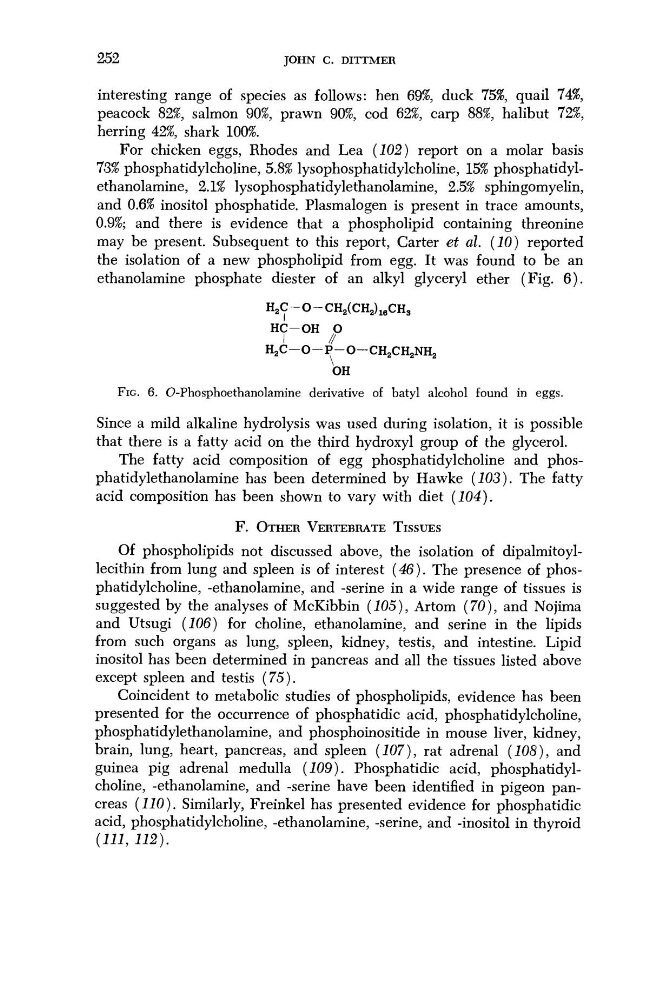
the isolation of a new phospholipid from egg. It was found to be an
ethanolamine phosphate diester of an alkyl glyceryl ether (Fig. 6).
H 2 C-0-CH 2 (CH 2 ) le CH 3
HC-OH O
I
//
H 2 C-0-P-0-CH 2 CH 2 NH 2
OH
FIG. 6. O-Phosphoethanolamine derivative of batyl alcohol found in eggs.
Since a mild alkaline hydrolysis was used during isolation, it is possible
that there is a fatty acid on the third hydroxyl group of the glycerol.
The fatty acid composition of egg phosphatidylcholine and phosphatidylethanolamine has been determined by Hawke (103). The fatty
acid composition has been shown to vary with diet (104).
F. OTHER VERTEBRATE TISSUES
Of phospholipids not discussed above, the isolation of dipalmitoyllecithin from lung and spleen is of interest (46). The presence of phosphatidylcholine, -ethanolamine, and -serine in a wide range of tissues is
suggested by the analyses of McKibbin (105), Artom (70), and Nojima
and Utsugi (106) for choline, ethanolamine, and serine in the lipids
from such organs as lung, spleen, kidney, testis, and intestine. Lipid
inositol has been determined in pancreas and all the tissues listed above
except spleen and testis (75).
Coincident to metabolic studies of phospholipids, evidence has been
presented for the occurrence of phosphatidic acid, phosphatidylcholine,
phosphatidylethanolamine, and phosphoinositide in mouse liver, kidney,
brain, lung, heart, pancreas, and spleen (107), rat adrenal (108), and
guinea pig adrenal medulla (109). Phosphatidic acid, phosphatidylcholine, -ethanolamine, and -serine have been identified in pigeon pancreas (110). Similarly, Freinkel has presented evidence for phosphatidic
acid, phosphatidylcholine, -ethanolamine, -serine, and -inositol in thyroid
(111, 112).
JOHN C. DITTMER
interesting range of species as follows: hen 69%, duck 75%, quail 74%,
peacock 82%, salmon 90%, prawn 90%, cod 62%, carp 88%, halibut 72%,
herring 42%, shark 100%.
For chicken eggs, Rhodes and Lea (102) report on a molar basis
73% phosphatidylcholine, 5.8% lysophosphatidylcholine, 15% phosphatidylethanolamine, 2.1% lysophosphatidylethanolamine, 2.5% sphingomyeKn,
and 0.6% inositol phosphatide. Plasmalogen is present in trace amounts,
0.9%; and there is evidence that a phospholipid containing threonine
may be present. Subsequent to this report, Carter et al. (10) reported
the isolation of a new phospholipid from egg. It was found to be an
ethanolamine phosphate diester of an alkyl glyceryl ether (Fig. 6).
H 2 C-0-CH 2 (CH 2 ) le CH 3
HC-OH O
I
//
H 2 C-0-P-0-CH 2 CH 2 NH 2
OH
FIG. 6. O-Phosphoethanolamine derivative of batyl alcohol found in eggs.
Since a mild alkaline hydrolysis was used during isolation, it is possible
that there is a fatty acid on the third hydroxyl group of the glycerol.
The fatty acid composition of egg phosphatidylcholine and phosphatidylethanolamine has been determined by Hawke (103). The fatty
acid composition has been shown to vary with diet (104).
F. OTHER VERTEBRATE TISSUES
Of phospholipids not discussed above, the isolation of dipalmitoyllecithin from lung and spleen is of interest (46). The presence of phosphatidylcholine, -ethanolamine, and -serine in a wide range of tissues is
suggested by the analyses of McKibbin (105), Artom (70), and Nojima
and Utsugi (106) for choline, ethanolamine, and serine in the lipids
from such organs as lung, spleen, kidney, testis, and intestine. Lipid
inositol has been determined in pancreas and all the tissues listed above
except spleen and testis (75).
Coincident to metabolic studies of phospholipids, evidence has been
presented for the occurrence of phosphatidic acid, phosphatidylcholine,
phosphatidylethanolamine, and phosphoinositide in mouse liver, kidney,
brain, lung, heart, pancreas, and spleen (107), rat adrenal (108), and
guinea pig adrenal medulla (109). Phosphatidic acid, phosphatidylcholine, -ethanolamine, and -serine have been identified in pigeon pancreas (110). Similarly, Freinkel has presented evidence for phosphatidic
acid, phosphatidylcholine, -ethanolamine, -serine, and -inositol in thyroid
(111, 112).