

1. FATTY ACID OCCURRENCE AND DISTRIBUTION
13
HO · PO · 0 · CH 2 · CH · CH 2 · 0 · PO · 0 · CH 2 · CH · CH 2 · 0 · PO · OH
I
I
I
I
I
00
OH
o
o
II
II
CH 2
CO-R
CO-R
CH 2
CH · O · CO · R
CH · O · CO · R
1
I
CH 2 · O · CO · R
CH 2 · O · CO · R
(VI)
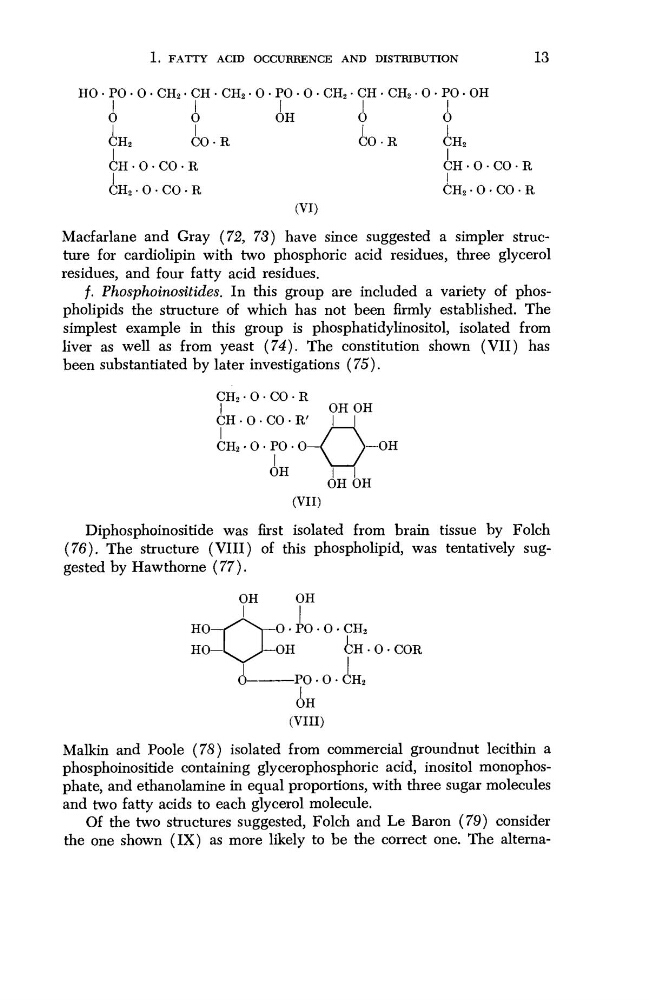
Macfarlane and Gray (72, 73) have since suggested a simpler structure for cardiolipin with two phosphoric acid residues, three glycerol
residues, and four fatty acid residues.
/. Phosphoinositides. In this group are included a variety of phospholipids the structure of which has not been firmly established. The
simplest example in this group is phosphatidylinositol, isolated from
liver as well as from yeast (74). The constitution shown (VII) has
been substantiated by later investigations (75).
-OH
Diphosphoinositide was first isolated from brain tissue by Folch
(76). The structure (VIII) of this phospholipid, was tentatively suggested by Hawthorne (77).
OH
OH
I
I
HO—^N—O · PO · O · CH 2
HO—I J—OH
^H · O · COR
CH 2
1
CH·
1
CH 2
•0
0•0
•CO
CO·
•PO
1
OH
•R
R'
•0OH OH
o
OH OH
(VII)
O-CI
O
PO · O · CH 2
AH
(VIII)
Malkin and Poole (78) isolated from commercial groundnut lecithin a
phosphoinositide containing glycerophosphoric acid, inositol monophosphate, and ethanolamine in equal proportions, with three sugar molecules
and two fatty acids to each glycerol molecule.
Of the two structures suggested, Folch and Le Baron (79) consider
the one shown (IX) as more likely to be the correct one. The alterna-
13
HO · PO · 0 · CH 2 · CH · CH 2 · 0 · PO · 0 · CH 2 · CH · CH 2 · 0 · PO · OH
I
I
I
I
I
00
OH
o
o
II
II
CH 2
CO-R
CO-R
CH 2
CH · O · CO · R
CH · O · CO · R
1
I
CH 2 · O · CO · R
CH 2 · O · CO · R
(VI)
Macfarlane and Gray (72, 73) have since suggested a simpler structure for cardiolipin with two phosphoric acid residues, three glycerol
residues, and four fatty acid residues.
/. Phosphoinositides. In this group are included a variety of phospholipids the structure of which has not been firmly established. The
simplest example in this group is phosphatidylinositol, isolated from
liver as well as from yeast (74). The constitution shown (VII) has
been substantiated by later investigations (75).
-OH
Diphosphoinositide was first isolated from brain tissue by Folch
(76). The structure (VIII) of this phospholipid, was tentatively suggested by Hawthorne (77).
OH
OH
I
I
HO—^N—O · PO · O · CH 2
HO—I J—OH
^H · O · COR
CH 2
1
CH·
1
CH 2
•0
0•0
•CO
CO·
•PO
1
OH
•R
R'
•0OH OH
o
OH OH
(VII)
O-CI
O
PO · O · CH 2
AH
(VIII)
Malkin and Poole (78) isolated from commercial groundnut lecithin a
phosphoinositide containing glycerophosphoric acid, inositol monophosphate, and ethanolamine in equal proportions, with three sugar molecules
and two fatty acids to each glycerol molecule.
Of the two structures suggested, Folch and Le Baron (79) consider
the one shown (IX) as more likely to be the correct one. The alterna-