

206
G. A. D. HASLEWOOD
together in a single plane at a water-fat interface. The hydroxyl groups
are often so distributed that hydration can readily occur, and this will
assist dispersion in the watery phase. The remainder of the molecule
will dissolve in the fatty phase, and so emulsification can easily be
brought about. A consequence of the molecular shape is that separate
nuclei will adhere to each other by van der Waals forces, and thus
clumping to form micelles occurs at .all except very great dilutions.
"Critical micellar concentrations" have in fact been measured for certain bile salts (2).
Bile salts are substances, derived from sterols available to animal
organisms, which have been perfected during evolution to assist in the
emulsification, hydrolysis, and absorption of fats. At least four distinct
chemical types fulfilling these conditions have been found in nature
and are described below.
B. TYPES OF BILE SALTS
1. C 27 (or C 28 ) AlcohoL·
The longest known substance in this group is scymnol, discovered by
Hammarsten in 1898 (3). It has been isolated after alkaline hydrolysis
of all elasmobranch bile examined, but has not yet been obtained from
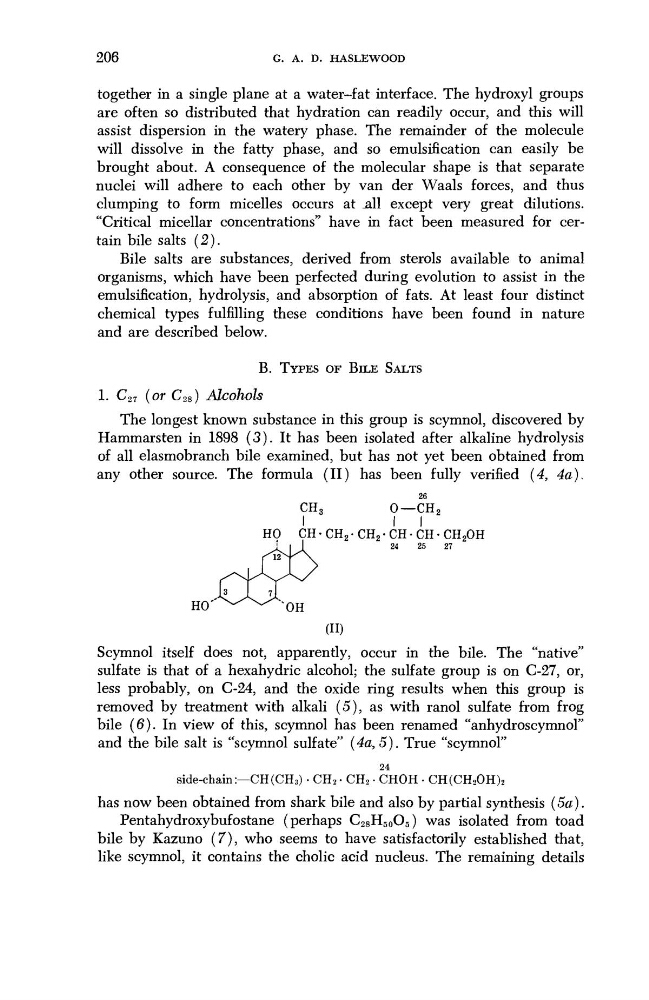
any other source. The formula (II) has been fully verified (4, 4a).
26
0—CH 2
I I
CH · CH 2 · CH 2 · CH · CH · CH 2 0H
(Π)
Scymnol itself does not, apparently, occur in the bile. The "native"
sulfate is that of a hexahydric alcohol; the sulfate group is on C-27, or,
less probably, on C-24, and the oxide ring results when this group is
removed by treatment with alkali (5), as with ranol sulfate from frog
bile (6). In view of this, scymnol has been renamed "anhydroscymnor
and the bile salt is "scymnol sulfate" (4a, 5). True "scymnol"
24
side-chain:—CH(CH 3 ) · CH 2 · CH 2 · CHOH · CH(CH 2 OH) 2
has now been obtained from shark bile and also by partial synthesis (5a).
Pentahydroxybufostane (perhaps CssHgoOs) was isolated from toad
bile by Kazuno (7), who seems to have satisfactorily established that,
like scymnol, it contains the cholic acid nucleus. The remaining details
G. A. D. HASLEWOOD
together in a single plane at a water-fat interface. The hydroxyl groups
are often so distributed that hydration can readily occur, and this will
assist dispersion in the watery phase. The remainder of the molecule
will dissolve in the fatty phase, and so emulsification can easily be
brought about. A consequence of the molecular shape is that separate
nuclei will adhere to each other by van der Waals forces, and thus
clumping to form micelles occurs at .all except very great dilutions.
"Critical micellar concentrations" have in fact been measured for certain bile salts (2).
Bile salts are substances, derived from sterols available to animal
organisms, which have been perfected during evolution to assist in the
emulsification, hydrolysis, and absorption of fats. At least four distinct
chemical types fulfilling these conditions have been found in nature
and are described below.
B. TYPES OF BILE SALTS
1. C 27 (or C 28 ) AlcohoL·
The longest known substance in this group is scymnol, discovered by
Hammarsten in 1898 (3). It has been isolated after alkaline hydrolysis
of all elasmobranch bile examined, but has not yet been obtained from
any other source. The formula (II) has been fully verified (4, 4a).
26
0—CH 2
I I
CH · CH 2 · CH 2 · CH · CH · CH 2 0H
(Π)
Scymnol itself does not, apparently, occur in the bile. The "native"
sulfate is that of a hexahydric alcohol; the sulfate group is on C-27, or,
less probably, on C-24, and the oxide ring results when this group is
removed by treatment with alkali (5), as with ranol sulfate from frog
bile (6). In view of this, scymnol has been renamed "anhydroscymnor
and the bile salt is "scymnol sulfate" (4a, 5). True "scymnol"
24
side-chain:—CH(CH 3 ) · CH 2 · CH 2 · CHOH · CH(CH 2 OH) 2
has now been obtained from shark bile and also by partial synthesis (5a).
Pentahydroxybufostane (perhaps CssHgoOs) was isolated from toad
bile by Kazuno (7), who seems to have satisfactorily established that,
like scymnol, it contains the cholic acid nucleus. The remaining details