

CHAPTER 4
Bile Salts: Structure, Distribution, and Possible Biological
Significance as a Species Character
G. A. D. HASLEWOOD
Guy's Hospital Medical School, London,
England
I. Structure
205
A. Introduction
205
B. Types of Bile Salts
206
II. Distribution
211
III. Bile Salts as a Species Character
211
A. General
211
B. Evolution of Bile Salts
223
C. Microbial Artifacts in the Bile
224
D. Use of the Chemical Nature of Bile Salts as a Species Character .
225
References
226
I. Structure
A. INTRODUCTION
The molecules of all bile salts are of the "detergent" type: that is to
say, they possess a hydrocarbon, fat-dissolving part and a polar, waterattracting portion. The "fatty" part consists of the bulk of the steroid
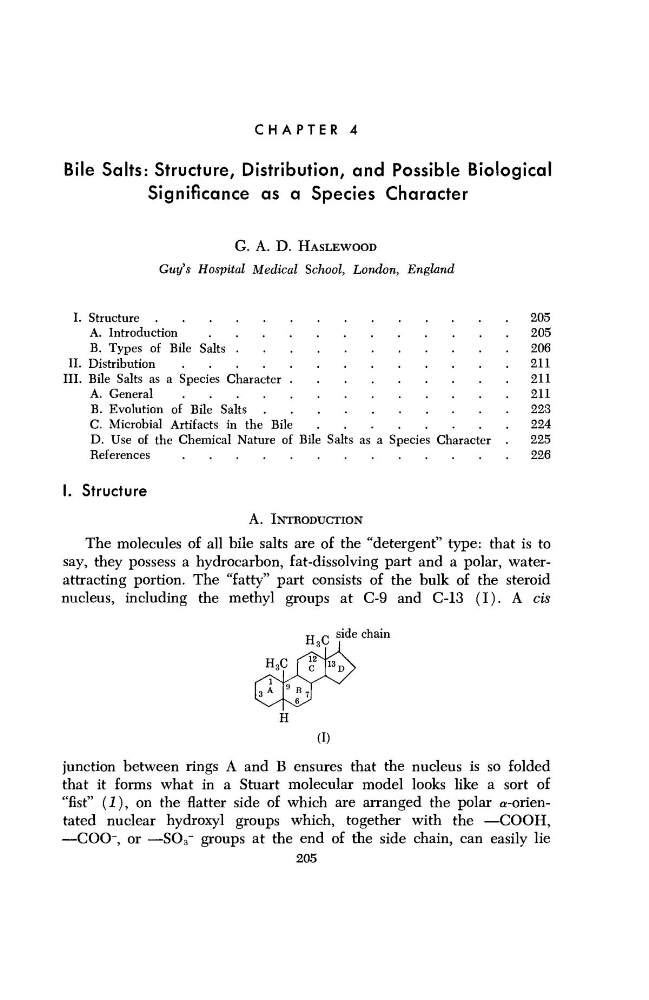
nucleus, including the methyl groups at C-9 and C-13 (I). A eis
u p side chain
junction between rings A and B ensures that the nucleus is so folded
that it forms what in a Stuart molecular model looks like a sort of
"fist" (I), on the flatter side of which are arranged the polar «-orientated nuclear hydroxyl groups which, together with the —COOH,
—COO~, or —S0 3 " groups at the end of the side chain, can easily lie
205
Bile Salts: Structure, Distribution, and Possible Biological
Significance as a Species Character
G. A. D. HASLEWOOD
Guy's Hospital Medical School, London,
England
I. Structure
205
A. Introduction
205
B. Types of Bile Salts
206
II. Distribution
211
III. Bile Salts as a Species Character
211
A. General
211
B. Evolution of Bile Salts
223
C. Microbial Artifacts in the Bile
224
D. Use of the Chemical Nature of Bile Salts as a Species Character .
225
References
226
I. Structure
A. INTRODUCTION
The molecules of all bile salts are of the "detergent" type: that is to
say, they possess a hydrocarbon, fat-dissolving part and a polar, waterattracting portion. The "fatty" part consists of the bulk of the steroid
nucleus, including the methyl groups at C-9 and C-13 (I). A eis
u p side chain
junction between rings A and B ensures that the nucleus is so folded
that it forms what in a Stuart molecular model looks like a sort of
"fist" (I), on the flatter side of which are arranged the polar «-orientated nuclear hydroxyl groups which, together with the —COOH,
—COO~, or —S0 3 " groups at the end of the side chain, can easily lie
205