

3. LIPIDS: STEROID METABOLISM
193
may be a stage in aldosterone biosynthesis. The significance of the 2-0methylations (2-methoxyestrone (142) and 2-methoxyestriol (143) have
been found in urine in man) is unknown but suggests that 2-hydroxylation may have some role other than biosynthetic. The interesting
observation has recently been made that, in vitro, adrenals of the nonfatty type, commonly found in ruminants, can introduce a 19-hydroxyl
I
H-C-OH
A
20aI
HO-C-H
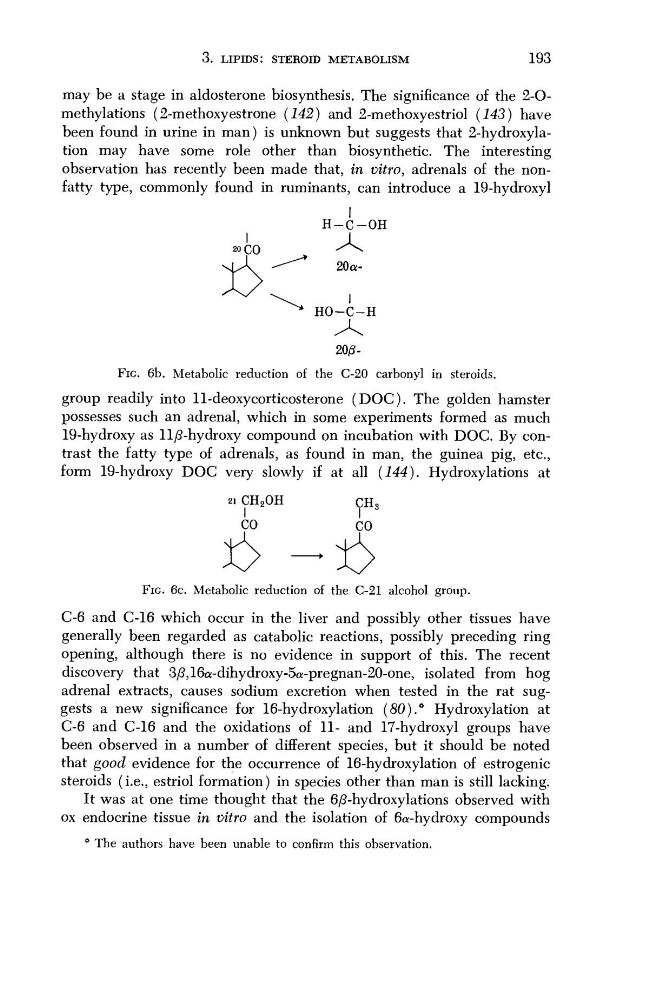
200FIG. 6b. Metabolic reduction of the C-20 carbonyl in steroids.
group readily into 11-deoxycorticosterone (DOC). The golden hamster
possesses such an adrenal, which in some experiments formed as much
19-hydroxy as 11/2-hydroxy compound on incubation with DOC. By contrast the fatty type of adrenals, as found in man, the guinea pig, etc.,
form 19-hydroxy DOC very slowly if at all (144). Hydroxylations at
2i CH 2 OH
CH 3
I
I
CO
CO
FIG. 6C. Metabolic reduction of the C-21 alcohol group.
C-6 and C-16 which occur in the liver and possibly other tissues have
generally been regarded as catabolic reactions, possibly preceding ring
opening, although there is no evidence in support of this. The recent
discovery that 3/?,16a-dihydroxy-5«-pregnan-20-one, isolated from hog
adrenal extracts, causes sodium excretion when tested in the rat suggests a new significance for 16-hydroxylation (80).* Hydroxylation at
C-6 and C-16 and the oxidations of 11- and 17-hydroxyl groups have
been observed in a number of different species, but it should be noted
that good evidence for the occurrence of 16-hydroxylation of estrogenic
steroids (i.e., estriol formation) in species other than man is still lacking.
It was at one time thought that the 6/?-hydroxylations observed with
ox endocrine tissue in vitro and the isolation of 6a-hydroxy compounds
* The authors have been unable to confirm this observation.
20 CO
193
may be a stage in aldosterone biosynthesis. The significance of the 2-0methylations (2-methoxyestrone (142) and 2-methoxyestriol (143) have
been found in urine in man) is unknown but suggests that 2-hydroxylation may have some role other than biosynthetic. The interesting
observation has recently been made that, in vitro, adrenals of the nonfatty type, commonly found in ruminants, can introduce a 19-hydroxyl
I
H-C-OH
A
20aI
HO-C-H
200FIG. 6b. Metabolic reduction of the C-20 carbonyl in steroids.
group readily into 11-deoxycorticosterone (DOC). The golden hamster
possesses such an adrenal, which in some experiments formed as much
19-hydroxy as 11/2-hydroxy compound on incubation with DOC. By contrast the fatty type of adrenals, as found in man, the guinea pig, etc.,
form 19-hydroxy DOC very slowly if at all (144). Hydroxylations at
2i CH 2 OH
CH 3
I
I
CO
CO
FIG. 6C. Metabolic reduction of the C-21 alcohol group.
C-6 and C-16 which occur in the liver and possibly other tissues have
generally been regarded as catabolic reactions, possibly preceding ring
opening, although there is no evidence in support of this. The recent
discovery that 3/?,16a-dihydroxy-5«-pregnan-20-one, isolated from hog
adrenal extracts, causes sodium excretion when tested in the rat suggests a new significance for 16-hydroxylation (80).* Hydroxylation at
C-6 and C-16 and the oxidations of 11- and 17-hydroxyl groups have
been observed in a number of different species, but it should be noted
that good evidence for the occurrence of 16-hydroxylation of estrogenic
steroids (i.e., estriol formation) in species other than man is still lacking.
It was at one time thought that the 6/?-hydroxylations observed with
ox endocrine tissue in vitro and the isolation of 6a-hydroxy compounds
* The authors have been unable to confirm this observation.
20 CO