

192
JAMES K. GRANT
by a number of factors including the presence of other sterols. Thus
ß-sitosterol is absorbed by rats, rabbits, and man and its presence inhibits cholesterol absorption in chickens, rats, and rabbits (108).
As already pointed out (Section I,C,2) the formation of bile acids is
the main metabolic pathway of cholesterol in the rat, but this need not
necessarily be the case in all species. Comparative studies are lacking.
E. METABOLISM OF STEROID HORMONES
1. General Aspects of Steroid Hormone Metabolism
The principal metabolic pathways of steroid hormones observed in
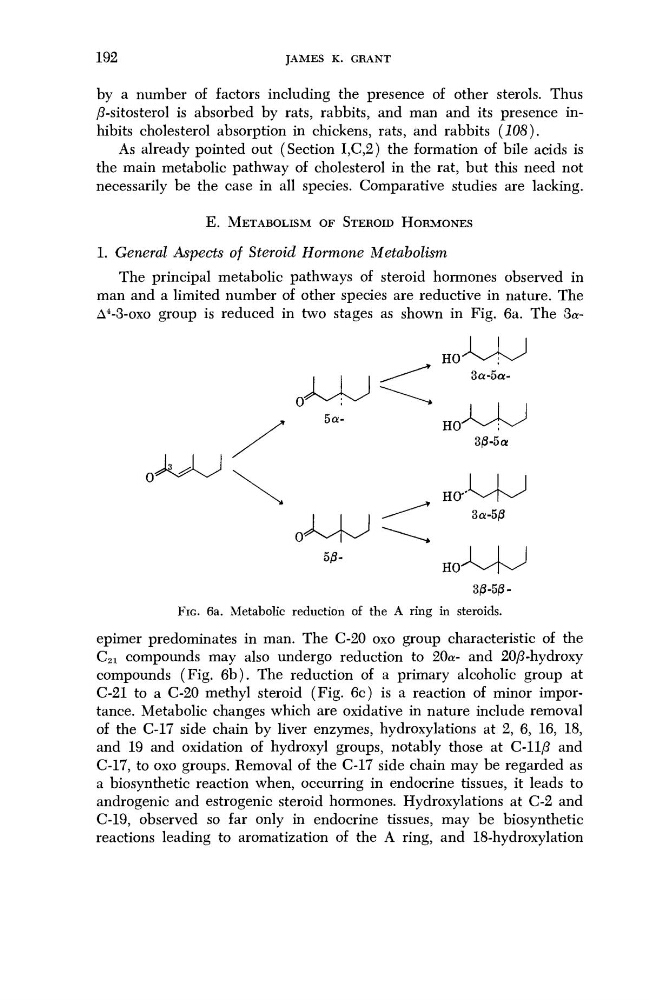
man and a limited number of other species are reductive in nature. The
Δ
4 -3-οχο group is reduced in two stages as shown in Fig. 6a. The 3aHO kXJ
JJU
5α„AAJ
HOHO""
XJU
30-5α
Sa-5ß
HO"
3/3-50FIG. 6a. Metabolie reduction of the A ring in steroids.
epimer predominates in man. The C-20 oxo group characteristic of the
C 2 i compounds may also undergo reduction to 20a- and 20/?-hydroxy
compounds (Fig. 6b). The reduction of a primary alcoholic group at
C-21 to a C-20 methyl steroid (Fig. 6c) is a reaction of minor importance. Metabolic changes which are oxidative in nature include removal
of the C-17 side chain by liver enzymes, hydroxylations at 2, 6, 16, 18,
and 19 and oxidation of hydroxyl groups, notably those at C-Uß and
C-17, to oxo groups. Removal of the C-17 side chain may be regarded as
a biosynthetic reaction when, occurring in endocrine tissues, it leads to
androgenic and estrogenic steroid hormones. Hydroxylations at C-2 and
C-19, observed so far only in endocrine tissues, may be biosynthetic
reactions leading to aromatization of the A ring, and 18-hydroxylation
JAMES K. GRANT
by a number of factors including the presence of other sterols. Thus
ß-sitosterol is absorbed by rats, rabbits, and man and its presence inhibits cholesterol absorption in chickens, rats, and rabbits (108).
As already pointed out (Section I,C,2) the formation of bile acids is
the main metabolic pathway of cholesterol in the rat, but this need not
necessarily be the case in all species. Comparative studies are lacking.
E. METABOLISM OF STEROID HORMONES
1. General Aspects of Steroid Hormone Metabolism
The principal metabolic pathways of steroid hormones observed in
man and a limited number of other species are reductive in nature. The
Δ
4 -3-οχο group is reduced in two stages as shown in Fig. 6a. The 3aHO kXJ
JJU
5α„AAJ
HOHO""
XJU
30-5α
Sa-5ß
HO"
3/3-50FIG. 6a. Metabolie reduction of the A ring in steroids.
epimer predominates in man. The C-20 oxo group characteristic of the
C 2 i compounds may also undergo reduction to 20a- and 20/?-hydroxy
compounds (Fig. 6b). The reduction of a primary alcoholic group at
C-21 to a C-20 methyl steroid (Fig. 6c) is a reaction of minor importance. Metabolic changes which are oxidative in nature include removal
of the C-17 side chain by liver enzymes, hydroxylations at 2, 6, 16, 18,
and 19 and oxidation of hydroxyl groups, notably those at C-Uß and
C-17, to oxo groups. Removal of the C-17 side chain may be regarded as
a biosynthetic reaction when, occurring in endocrine tissues, it leads to
androgenic and estrogenic steroid hormones. Hydroxylations at C-2 and
C-19, observed so far only in endocrine tissues, may be biosynthetic
reactions leading to aromatization of the A ring, and 18-hydroxylation