

178
JAMES K. GRANT
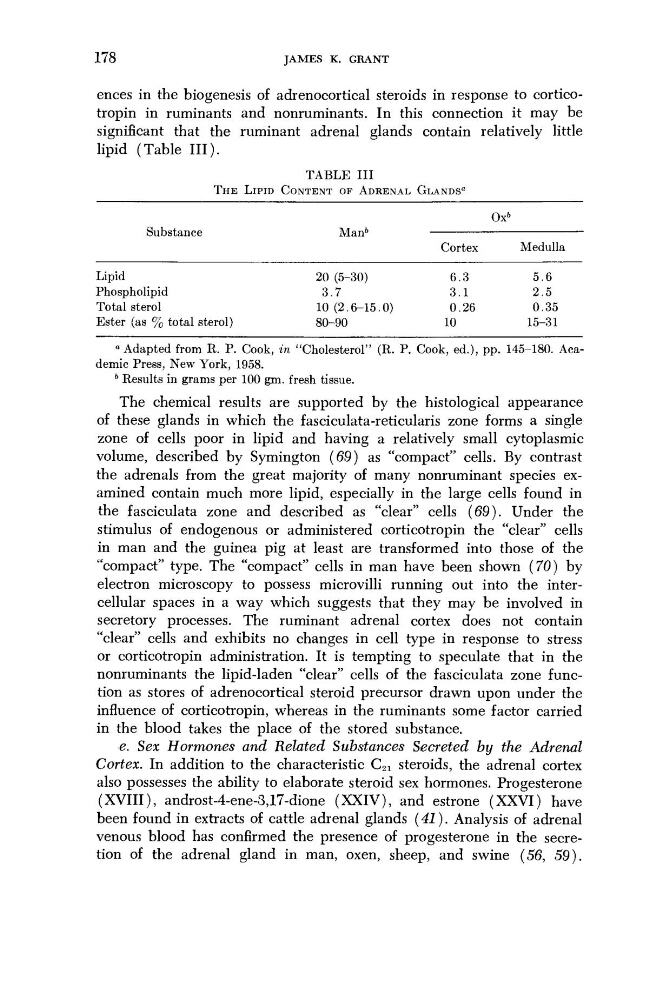
ences in the biogenesis of adrenocortical steroids in response to corticotropin in ruminants and nonruminants. In this connection it may be
significant that the ruminant adrenal glands contain relatively little
lipid (Table III).
TABLE III
THE LIPID CONTENT OF ADRENAL GLANDS
0
Substance
Lipid
Phospholipid
Total sterol
Ester (as % total sterol)
Man
6
20 (5-30)
3.7
10 (2.6-15.0)
80-90
Cortex
6.3
3.1
0.26
10
Ox
6
Medulla
5.6
2.5
0.35
15-31
«Adapted from R. P. Cook, in "Cholesterol" (R. P. Cook, ed.), pp. 145-180. Academic Press, New York, 1958.
b Results in grams per 100 gm. fresh tissue.
The chemical results are supported by the histological appearance
of these glands in which the fasciculata-reticularis zone forms a single
zone of cells poor in lipid and having a relatively small cytoplasmic
volume, described by Symington (69) as "compact" cells. By contrast
the adrenals from the great majority of many nonruminant species examined contain much more lipid, especially in the large cells found in
the fasciculata zone and described as "clear" cells (69). Under the
stimulus of endogenous or administered corticotropin the "clear" cells
in man and the guinea pig at least are transformed into those of the
"compact" type. The "compact" cells in man have been shown (70) by
electron microscopy to possess microvilli running out into the intercellular spaces in a way which suggests that they may be involved in
secretory processes. The ruminant adrenal cortex does not contain
"clear" cells and exhibits no changes in cell type in response to stress
or corticotropin administration. It is tempting to speculate that in the
nonruminants the lipid-laden "clear" cells of the fasciculata zone function as stores of adrenocortical steroid precursor drawn upon under the
influence of corticotropin, whereas in the ruminants some factor carried
in the blood takes the place of the stored substance.
e. Sex Hormones and Related Substances Secreted by the Adrenal
Cortex. In addition to the characteristic C 2i steroids, the adrenal cortex
also possesses the ability to elaborate steroid sex hormones. Progesterone
(XVIII), androst-4-ene-3,17-dione (XXIV), and estrone (XXVI) have
been found in extracts of cattle adrenal glands (41). Analysis of adrenal
venous blood has confirmed the presence of progesterone in the secretion of the adrenal gland in man, oxen, sheep, and swine (56, 59).
JAMES K. GRANT
ences in the biogenesis of adrenocortical steroids in response to corticotropin in ruminants and nonruminants. In this connection it may be
significant that the ruminant adrenal glands contain relatively little
lipid (Table III).
TABLE III
THE LIPID CONTENT OF ADRENAL GLANDS
0
Substance
Lipid
Phospholipid
Total sterol
Ester (as % total sterol)
Man
6
20 (5-30)
3.7
10 (2.6-15.0)
80-90
Cortex
6.3
3.1
0.26
10
Ox
6
Medulla
5.6
2.5
0.35
15-31
«Adapted from R. P. Cook, in "Cholesterol" (R. P. Cook, ed.), pp. 145-180. Academic Press, New York, 1958.
b Results in grams per 100 gm. fresh tissue.
The chemical results are supported by the histological appearance
of these glands in which the fasciculata-reticularis zone forms a single
zone of cells poor in lipid and having a relatively small cytoplasmic
volume, described by Symington (69) as "compact" cells. By contrast
the adrenals from the great majority of many nonruminant species examined contain much more lipid, especially in the large cells found in
the fasciculata zone and described as "clear" cells (69). Under the
stimulus of endogenous or administered corticotropin the "clear" cells
in man and the guinea pig at least are transformed into those of the
"compact" type. The "compact" cells in man have been shown (70) by
electron microscopy to possess microvilli running out into the intercellular spaces in a way which suggests that they may be involved in
secretory processes. The ruminant adrenal cortex does not contain
"clear" cells and exhibits no changes in cell type in response to stress
or corticotropin administration. It is tempting to speculate that in the
nonruminants the lipid-laden "clear" cells of the fasciculata zone function as stores of adrenocortical steroid precursor drawn upon under the
influence of corticotropin, whereas in the ruminants some factor carried
in the blood takes the place of the stored substance.
e. Sex Hormones and Related Substances Secreted by the Adrenal
Cortex. In addition to the characteristic C 2i steroids, the adrenal cortex
also possesses the ability to elaborate steroid sex hormones. Progesterone
(XVIII), androst-4-ene-3,17-dione (XXIV), and estrone (XXVI) have
been found in extracts of cattle adrenal glands (41). Analysis of adrenal
venous blood has confirmed the presence of progesterone in the secretion of the adrenal gland in man, oxen, sheep, and swine (56, 59).