

3. LIPIDS: STEROID METABOLISM
177
large vein. The method developed by Hechter's group involves cannulation of the vein through which the perfusing blood enters and laceration of the cortex for its outlet. With this procedure and corticotropin
in the blood, a rate of corticosteroid secretion of 387 μg. per gram of
gland per hour was achieved, whereas the rate was only 60 μξ. per
gram of gland per hour when perfusion was in the reverse direction, in
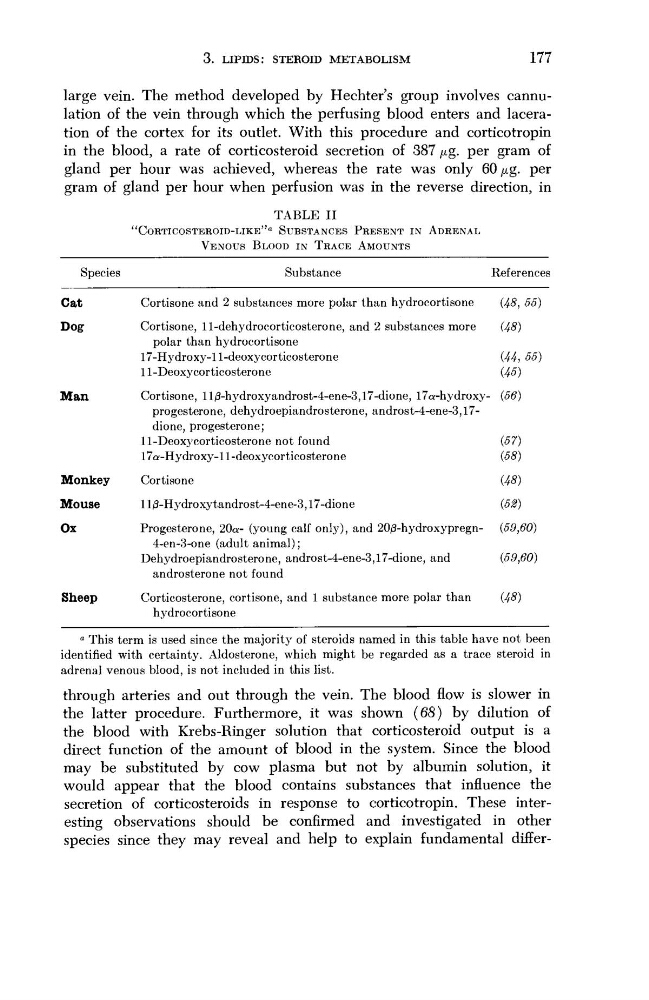
TABLE II
"CORTICOSTEROID-LIKE"
A
SUBSTANCES PRESENT IN ADRENAL
VENOUS BLOOD IN TRACE AMOUNTS
Species
Substance
References
Cat
Cortisone and 2 substances more polar than hydrocortisone
(48, 55)
Dog
Cortisone, 11-dehydrocorticosterone, and 2 substances more
(48)
polar than hydrocortisone
17-Hydroxy-ll-deoxycorticosterone
(44, 55)
11-Deoxycorticosterone
(45)
Man
Cortisone, ll/3-hydroxyandrost-4-ene-3,17-dione, 17«-hydroxy- (56)
progesterone, dehydroepiandrosterone, androst-4-ene-3,17dione, progesterone;
11-Deoxycorticosterone not found
(57)
17a-Hydroxy-l 1-deoxycorticosterone
(58)
Monkey
Cortisone
(48)
Mouse
llß-Hydroxytandrost-4-ene-3,17-dione
(52)
Ox
Progesterone, 20«- (young calf only), and 20/3-hydroxypregn(59,60)
4-en-3-one (adult animal);
Dehydroepiandrosterone, androst-4-ene-3,17-dione, and
(59,60)
androsterone not found
Sheep
Corticosterone, cortisone, and 1 substance more polar than
(48)
hydrocortisone
a This term is used since the majority of steroids named in this table have not been
identified with certainty. Aldosterone, which might be regarded as a trace steroid in
adrenal venous blood, is not included in this list.
through arteries and out through the vein. The blood flow is slower in
the latter procedure. Furthermore, it was shown (68) by dilution of
the blood with Krebs-Ringer solution that corticosteroid output is a
direct function of the amount of blood in the system. Since the blood
may be substituted by cow plasma but not by albumin solution, it
would appear that the blood contains substances that influence the
secretion of corticosteroids in response to corticotropin. These interesting observations should be confirmed and investigated in other
species since they may reveal and help to explain fundamental differ-
177
large vein. The method developed by Hechter's group involves cannulation of the vein through which the perfusing blood enters and laceration of the cortex for its outlet. With this procedure and corticotropin
in the blood, a rate of corticosteroid secretion of 387 μg. per gram of
gland per hour was achieved, whereas the rate was only 60 μξ. per
gram of gland per hour when perfusion was in the reverse direction, in
TABLE II
"CORTICOSTEROID-LIKE"
A
SUBSTANCES PRESENT IN ADRENAL
VENOUS BLOOD IN TRACE AMOUNTS
Species
Substance
References
Cat
Cortisone and 2 substances more polar than hydrocortisone
(48, 55)
Dog
Cortisone, 11-dehydrocorticosterone, and 2 substances more
(48)
polar than hydrocortisone
17-Hydroxy-ll-deoxycorticosterone
(44, 55)
11-Deoxycorticosterone
(45)
Man
Cortisone, ll/3-hydroxyandrost-4-ene-3,17-dione, 17«-hydroxy- (56)
progesterone, dehydroepiandrosterone, androst-4-ene-3,17dione, progesterone;
11-Deoxycorticosterone not found
(57)
17a-Hydroxy-l 1-deoxycorticosterone
(58)
Monkey
Cortisone
(48)
Mouse
llß-Hydroxytandrost-4-ene-3,17-dione
(52)
Ox
Progesterone, 20«- (young calf only), and 20/3-hydroxypregn(59,60)
4-en-3-one (adult animal);
Dehydroepiandrosterone, androst-4-ene-3,17-dione, and
(59,60)
androsterone not found
Sheep
Corticosterone, cortisone, and 1 substance more polar than
(48)
hydrocortisone
a This term is used since the majority of steroids named in this table have not been
identified with certainty. Aldosterone, which might be regarded as a trace steroid in
adrenal venous blood, is not included in this list.
through arteries and out through the vein. The blood flow is slower in
the latter procedure. Furthermore, it was shown (68) by dilution of
the blood with Krebs-Ringer solution that corticosteroid output is a
direct function of the amount of blood in the system. Since the blood
may be substituted by cow plasma but not by albumin solution, it
would appear that the blood contains substances that influence the
secretion of corticosteroids in response to corticotropin. These interesting observations should be confirmed and investigated in other
species since they may reveal and help to explain fundamental differ-