

2. STEROLS: STRUCTURE AND DISTRIBUTION
107
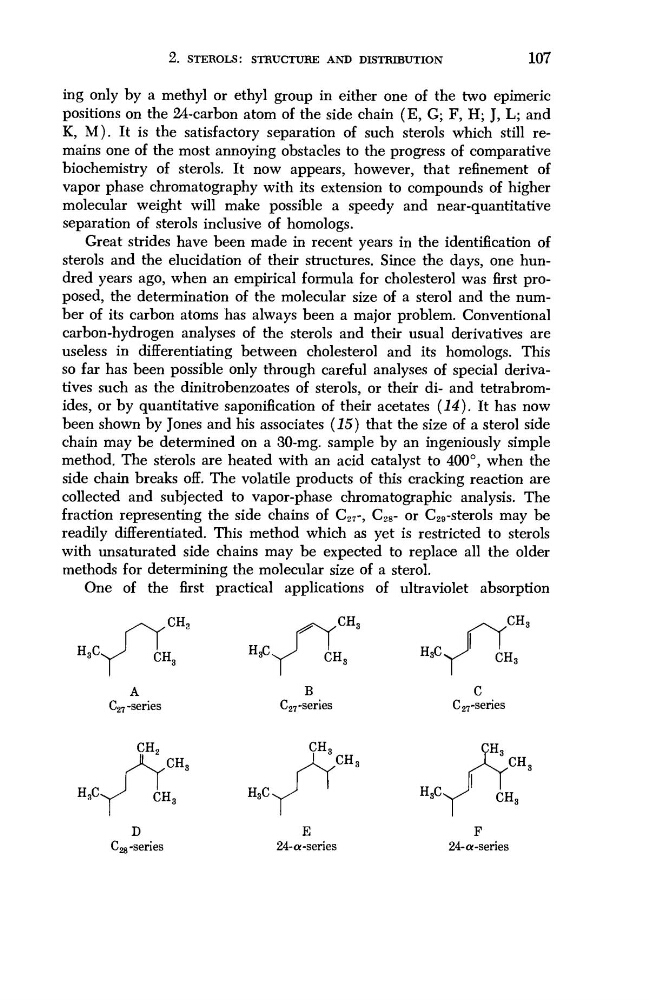
ing only by a methyl or ethyl group in either one of the two epimeric
positions on the 24-carbon atom of the side chain (E, G; F, H; J, L; and
K, M). It is the satisfactory separation of such sterols which still remains one of the most annoying obstacles to the progress of comparative
biochemistry of sterols. It now appears, however, that refinement of
vapor phase chromatography with its extension to compounds of higher
molecular weight will make possible a speedy and near-quantitative
separation of sterols inclusive of homologs.
Great strides have been made in recent years in the identification of
sterols and the elucidation of their structures. Since the days, one hundred years ago, when an empirical formula for cholesterol was first proposed, the determination of the molecular size of a sterol and the number of its carbon atoms has always been a major problem. Conventional
carbon-hydrogen analyses of the sterols and their usual derivatives are
useless in differentiating between cholesterol and its homologs. This
so far has been possible only through careful analyses of special derivatives such as the dinitrobenzoates of sterols, or their di- and tetrabromides, or by quantitative saponification of their acetates (14). It has now
been shown by Jones and his associates (15) that the size of a sterol side
chain may be determined on a 30-mg. sample by an ingeniously simple
method. The sterols are heated with an acid catalyst to 400°, when the
side chain breaks off. The volatile products of this cracking reaction are
collected and subjected to vapor-phase Chromatographie analysis. The
fraction representing the side chains of C 27 -, C 28 - or C 29 -sterols may be
readily differentiated. This method which as yet is restricted to sterols
with unsaturated side chains may be expected to replace all the older
methods for determining the molecular size of a sterol.
One of the first practical applications of ultraviolet absorption
H.C.
H*C
HoC
D
Co«-series
E
24-a-series
H*C
F
24-a-series
107
ing only by a methyl or ethyl group in either one of the two epimeric
positions on the 24-carbon atom of the side chain (E, G; F, H; J, L; and
K, M). It is the satisfactory separation of such sterols which still remains one of the most annoying obstacles to the progress of comparative
biochemistry of sterols. It now appears, however, that refinement of
vapor phase chromatography with its extension to compounds of higher
molecular weight will make possible a speedy and near-quantitative
separation of sterols inclusive of homologs.
Great strides have been made in recent years in the identification of
sterols and the elucidation of their structures. Since the days, one hundred years ago, when an empirical formula for cholesterol was first proposed, the determination of the molecular size of a sterol and the number of its carbon atoms has always been a major problem. Conventional
carbon-hydrogen analyses of the sterols and their usual derivatives are
useless in differentiating between cholesterol and its homologs. This
so far has been possible only through careful analyses of special derivatives such as the dinitrobenzoates of sterols, or their di- and tetrabromides, or by quantitative saponification of their acetates (14). It has now
been shown by Jones and his associates (15) that the size of a sterol side
chain may be determined on a 30-mg. sample by an ingeniously simple
method. The sterols are heated with an acid catalyst to 400°, when the
side chain breaks off. The volatile products of this cracking reaction are
collected and subjected to vapor-phase Chromatographie analysis. The
fraction representing the side chains of C 27 -, C 28 - or C 29 -sterols may be
readily differentiated. This method which as yet is restricted to sterols
with unsaturated side chains may be expected to replace all the older
methods for determining the molecular size of a sterol.
One of the first practical applications of ultraviolet absorption
H.C.
H*C
HoC
D
Co«-series
E
24-a-series
H*C
F
24-a-series