

106
WERNER BERGMANN
H 3 C CH3
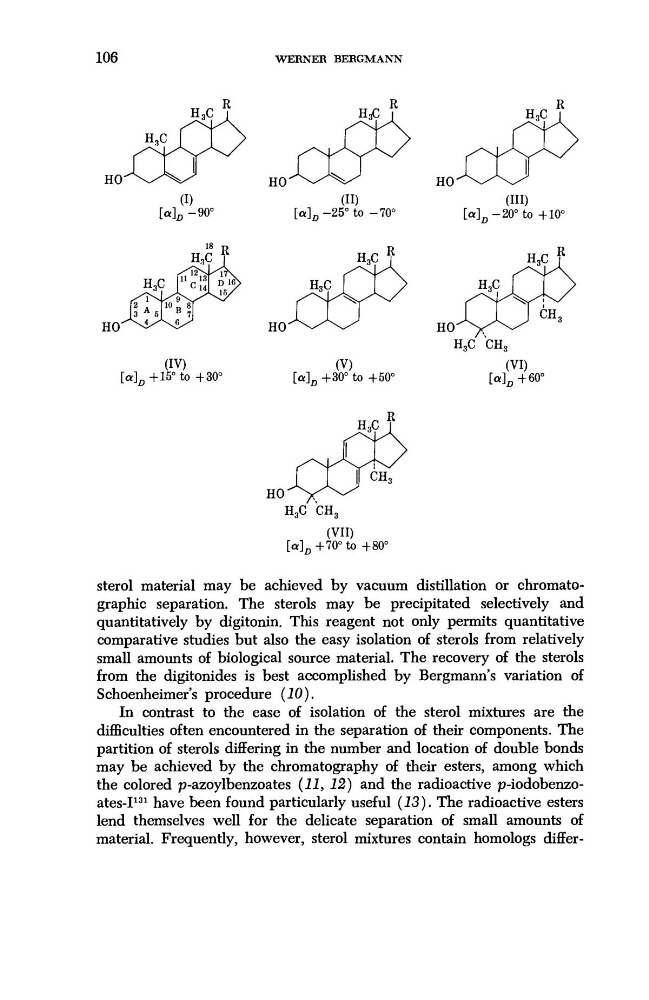
(IV)
(V)
(VI)
[a] D +15° to + 30°
[a] D +30° to + 50°
[a] D + 60°
(VII)
[a] D +70° to +80°
sterol material may be achieved by vacuum distillation or Chromatographie separation. The sterols may be precipitated selectively and
quantitatively by digitonin. This reagent not only permits quantitative
comparative studies but also the easy isolation of sterols from relatively
small amounts of biological source material. The recovery of the sterols
from the digitonides is best accomplished by Bergmann's variation of
Schoenheimer's procedure (10).
In contrast to the ease of isolation of the sterol mixtures are the
difficulties often encountered in the separation of their components. The
partition of sterols differing in the number and location of double bonds
may be achieved by the chromatography of their esters, among which
the colored p-azoylbenzoates (11, 12) and the radioactive p-iodobenzoates-I
131 have been found particularly useful (13). The radioactive esters
lend themselves well for the delicate separation of small amounts of
material. Frequently, however, sterol mixtures contain homologs differ-
WERNER BERGMANN
H 3 C CH3
(IV)
(V)
(VI)
[a] D +15° to + 30°
[a] D +30° to + 50°
[a] D + 60°
(VII)
[a] D +70° to +80°
sterol material may be achieved by vacuum distillation or Chromatographie separation. The sterols may be precipitated selectively and
quantitatively by digitonin. This reagent not only permits quantitative
comparative studies but also the easy isolation of sterols from relatively
small amounts of biological source material. The recovery of the sterols
from the digitonides is best accomplished by Bergmann's variation of
Schoenheimer's procedure (10).
In contrast to the ease of isolation of the sterol mixtures are the
difficulties often encountered in the separation of their components. The
partition of sterols differing in the number and location of double bonds
may be achieved by the chromatography of their esters, among which
the colored p-azoylbenzoates (11, 12) and the radioactive p-iodobenzoates-I
131 have been found particularly useful (13). The radioactive esters
lend themselves well for the delicate separation of small amounts of
material. Frequently, however, sterol mixtures contain homologs differ-