

64
HENRY EYRING, RICHARD P. BOYCE AND JOHN D. SPIKES
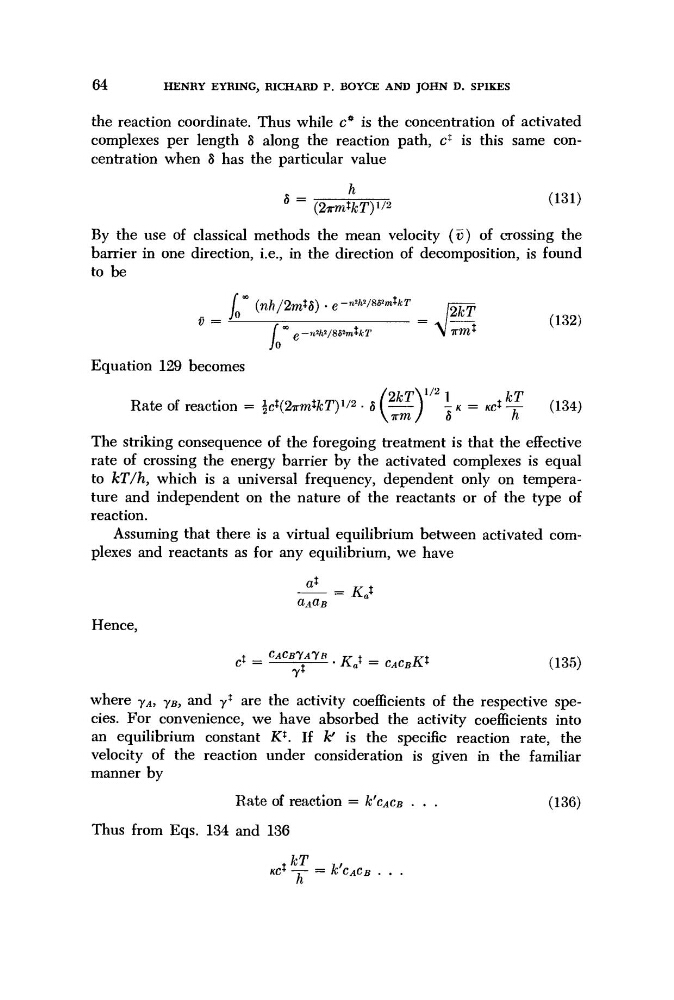
the reaction coordinate. Thus while c* is the concentration of activated
complexes per length δ along the reaction path, c
% is this same concentration when δ has the particular value
δ =
j2^mw
2
(131)
By the use of classical methods the mean velocity (v) of crossing the
barrier in one direction, i.e., in the direction of decomposition, is found
to be
V ~
f °° e -n*ty8ShntkT
" \ ™
X
Equation 129 becomes
Rate of reaction = icK2irmtkTy/
2
- δ ί ^-)
V -K = KC^
(134)
The striking consequence of the foregoing treatment is that the effective
rate of crossing the energy barrier by the activated complexes is equal
to kT/h, which is a universal frequency, dependent only on temperature and independent on the nature of the reactants or of the type of
reaction.
Assuming that there is a virtual equilibrium between activated complexes and reactants as for any equilibrium, we have
at
=KJ
CLAGB
Hence,
c% =
CACBTATB
m Ra%
=
CACBK%
(135)
where y A , ye, and γ* are the activity coefficients of the respective species. For convenience, we have absorbed the activity coefficients into
an equilibrium constant K
x . If hf is the specific reaction rate, the
velocity of the reaction under consideration is given in the familiar
manner by
Rate of reaction = WCACB ...
(136)
Thus from Eqs. 134 and 136
t "Ί
7 /
KC* -r- = k CACB . . .
h
HENRY EYRING, RICHARD P. BOYCE AND JOHN D. SPIKES
the reaction coordinate. Thus while c* is the concentration of activated
complexes per length δ along the reaction path, c
% is this same concentration when δ has the particular value
δ =
j2^mw
2
(131)
By the use of classical methods the mean velocity (v) of crossing the
barrier in one direction, i.e., in the direction of decomposition, is found
to be
V ~
f °° e -n*ty8ShntkT
" \ ™
X
Equation 129 becomes
Rate of reaction = icK2irmtkTy/
2
- δ ί ^-)
V -K = KC^
(134)
The striking consequence of the foregoing treatment is that the effective
rate of crossing the energy barrier by the activated complexes is equal
to kT/h, which is a universal frequency, dependent only on temperature and independent on the nature of the reactants or of the type of
reaction.
Assuming that there is a virtual equilibrium between activated complexes and reactants as for any equilibrium, we have
at
=KJ
CLAGB
Hence,
c% =
CACBTATB
m Ra%
=
CACBK%
(135)
where y A , ye, and γ* are the activity coefficients of the respective species. For convenience, we have absorbed the activity coefficients into
an equilibrium constant K
x . If hf is the specific reaction rate, the
velocity of the reaction under consideration is given in the familiar
manner by
Rate of reaction = WCACB ...
(136)
Thus from Eqs. 134 and 136
t "Ί
7 /
KC* -r- = k CACB . . .
h