

2. THERMODYNAMICS OF LIVING SYSTEMS
63
methods. The product of these quantities is equal to the reaction rate.
Consider a process involving the reactants A, B, etc., which form
the activated complex M* in the reaction:
A + B + - · · -* Mt+ Q + R^ Products
(128)
The superscript * will be used to designate the activated complex or its
thermodynamic parameters. For many reactions the species Q and R do
not occur, so that for brevity we will omit them hereafter. The rate of
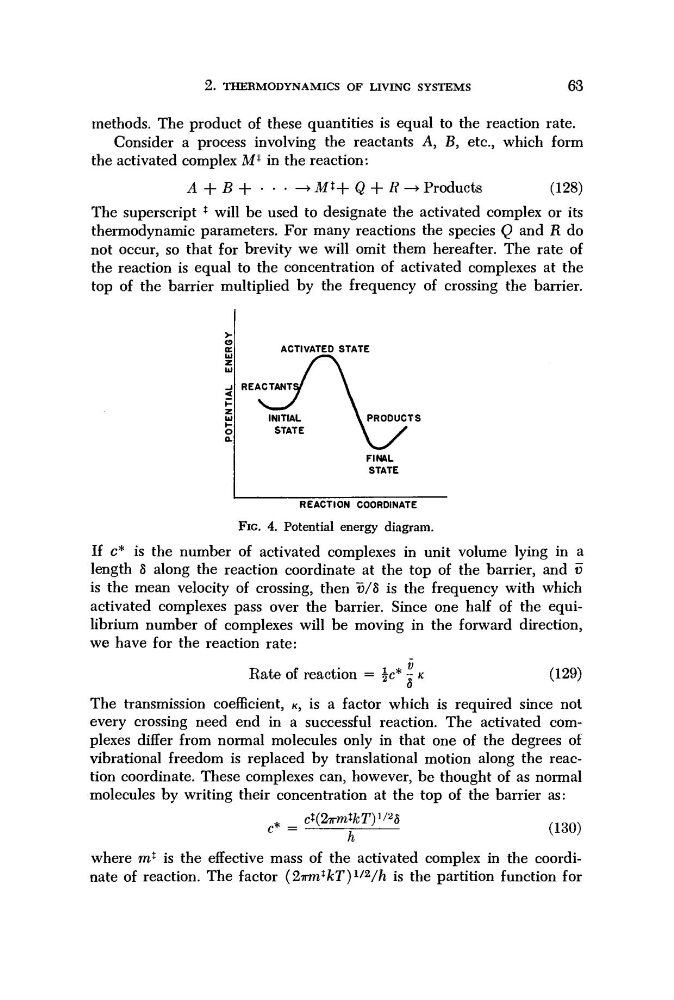
the reaction is equal to the concentration of activated complexes at the
top of the barrier multiplied by the frequency of crossing the barrier.
ACTIVATED STATE
REACTANTS/
INITIAL
STATE
\ PRODUCTS
FINAL
STATE
REACTION COORDINATE
FIG. 4. Potential energy diagram.
If c* is the number of activated complexes in unit volume lying in a
length δ along the reaction coordinate at the top of the barrier, and ϋ
is the mean velocity of crossing, then v/8 is the frequency with which
activated complexes pass over the barrier. Since one half of the equilibrium number of complexes will be moving in the forward direction,
we have for the reaction rate:
δ
(129)
The transmission coefficient, κ, is a factor which is required since not
every crossing need end in a successful reaction. The activated complexes differ from normal molecules only in that one of the degrees of
vibrational freedom is replaced by translational motion along the reaction coordinate. These complexes can, however, be thought of as normal
molecules by writing their concentration at the top of the barrier as:
c* = ϊ&ψν^
(130 )
where m
x is the effective mass of the activated complex in the coordinate of reaction. The factor {2Trm
% kT)
l/2 /h is the partition function for
63
methods. The product of these quantities is equal to the reaction rate.
Consider a process involving the reactants A, B, etc., which form
the activated complex M* in the reaction:
A + B + - · · -* Mt+ Q + R^ Products
(128)
The superscript * will be used to designate the activated complex or its
thermodynamic parameters. For many reactions the species Q and R do
not occur, so that for brevity we will omit them hereafter. The rate of
the reaction is equal to the concentration of activated complexes at the
top of the barrier multiplied by the frequency of crossing the barrier.
ACTIVATED STATE
REACTANTS/
INITIAL
STATE
\ PRODUCTS
FINAL
STATE
REACTION COORDINATE
FIG. 4. Potential energy diagram.
If c* is the number of activated complexes in unit volume lying in a
length δ along the reaction coordinate at the top of the barrier, and ϋ
is the mean velocity of crossing, then v/8 is the frequency with which
activated complexes pass over the barrier. Since one half of the equilibrium number of complexes will be moving in the forward direction,
we have for the reaction rate:
δ
(129)
The transmission coefficient, κ, is a factor which is required since not
every crossing need end in a successful reaction. The activated complexes differ from normal molecules only in that one of the degrees of
vibrational freedom is replaced by translational motion along the reaction coordinate. These complexes can, however, be thought of as normal
molecules by writing their concentration at the top of the barrier as:
c* = ϊ&ψν^
(130 )
where m
x is the effective mass of the activated complex in the coordinate of reaction. The factor {2Trm
% kT)
l/2 /h is the partition function for