

2. THERMODYNAMICS OF LIVING SYSTEMS
55
where rii is the number of moles of the ith. component. In an open
system we may consider dn iy the change in the number of moles of the
ith component, to be due to two sources: the part d e rii, supplied from
the exterior and ditii, the part due to changes inside the system. We
must also look at the expression which represents conservation of energy in an open system. It is clear that the First Law as stated for closed
systems must be modified to include exchange of matter with the exterior. Thus,
dE = άΦ- PdV
(96)
The function άΦ represents a resultant flow of energy per unit time
arising from exchange or transfer of heat and matter. The notation is
that used by Prigogine (11). Recall that
dni = Vid% = d e Ui + diUi
(97)
Gibb's formula then becomes
, c
άΦ PdV .PdV
VMW,
. A \
i
But
drii = d e Ui + \ Vi d£
i
Thus
dS — ψ
7
rp diUi
? m (i e Ui
i
άΦ
V / **" J
i A d£
/AON
= γ~ )~f
deUi + ~T^
^
98
)
i
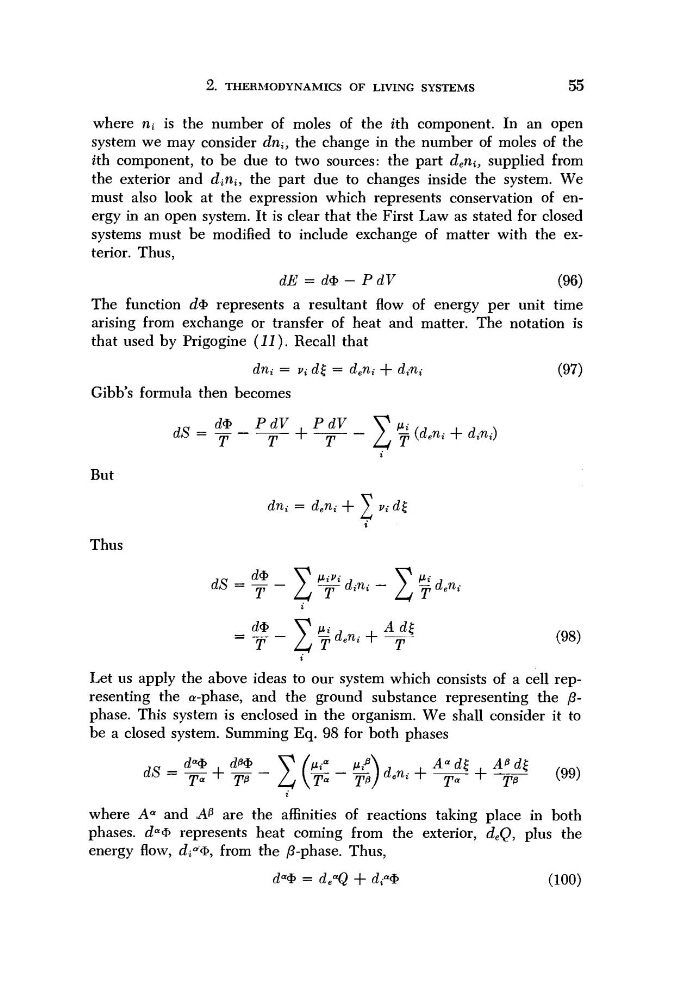
Let us apply the above ideas to our system which consists of a cell representing the «-phase, and the ground substance representing the β~
phase. This system is enclosed in the organism. We shall consider it to
be a closed system. Summing Eq. 98 for both phases
^Φ
^φ _ Υ /μ^ _ μ/\
Α°άξ
Aßdü
αο — ψα <~ ψβ
/_j\T
a
Τ0/
Τ
α
7
1
"
(99)
where A
a and A& are the affinities of reactions taking place in both
phases. ά
α Φ represents heat coming from the exterior, d e Q, plus the
energy flow, άι
α Φ, from the /?-phase. Thus,
ά
α Φ = d e
a Q + α {
α Φ
(100)
55
where rii is the number of moles of the ith. component. In an open
system we may consider dn iy the change in the number of moles of the
ith component, to be due to two sources: the part d e rii, supplied from
the exterior and ditii, the part due to changes inside the system. We
must also look at the expression which represents conservation of energy in an open system. It is clear that the First Law as stated for closed
systems must be modified to include exchange of matter with the exterior. Thus,
dE = άΦ- PdV
(96)
The function άΦ represents a resultant flow of energy per unit time
arising from exchange or transfer of heat and matter. The notation is
that used by Prigogine (11). Recall that
dni = Vid% = d e Ui + diUi
(97)
Gibb's formula then becomes
, c
άΦ PdV .PdV
VMW,
. A \
i
But
drii = d e Ui + \ Vi d£
i
Thus
dS — ψ
7
rp diUi
? m (i e Ui
i
άΦ
V / **" J
i A d£
/AON
= γ~ )~f
deUi + ~T^
^
98
)
i
Let us apply the above ideas to our system which consists of a cell representing the «-phase, and the ground substance representing the β~
phase. This system is enclosed in the organism. We shall consider it to
be a closed system. Summing Eq. 98 for both phases
^Φ
^φ _ Υ /μ^ _ μ/\
Α°άξ
Aßdü
αο — ψα <~ ψβ
/_j\T
a
Τ0/
Τ
α
7
1
"
(99)
where A
a and A& are the affinities of reactions taking place in both
phases. ά
α Φ represents heat coming from the exterior, d e Q, plus the
energy flow, άι
α Φ, from the /?-phase. Thus,
ά
α Φ = d e
a Q + α {
α Φ
(100)