

38
HENRY EYRING, RICHARD P. BOYCE AND JOHN D. SPIKES
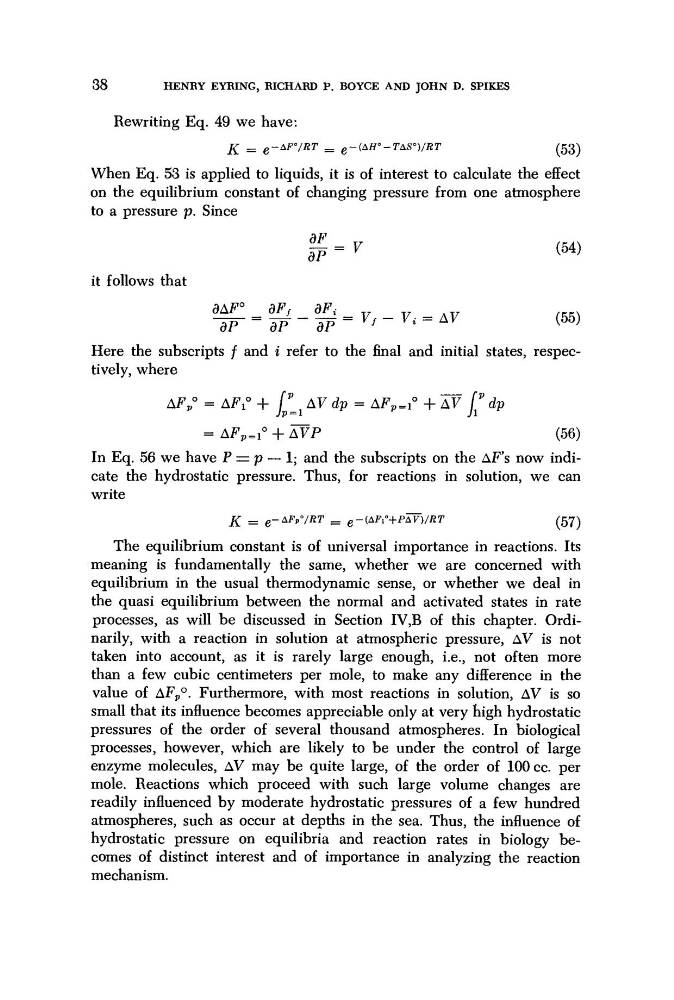
Rewriting Eq. 49 we have:
K = e -
AF °/
RT
= e -^H°-TAS°)/RT
(53)
When Eq. 53 is applied to liquids, it is of interest to calculate the effect
on the equilibrium constant of changing pressure from one atmosphere
to a pressure p. Since
jjp=V
(54)
it follows that
dAF° = dF f
dFj
dP ~ dP
dP
= V f -
Vi = AV
(55)
Here the subscripts / and i refer to the final and initial states, respectively, where
AF P ° = AFi° + [
P
AV dp = AF P=1 ° +ÄV [
P dp
Jp = l
Jl
= AF P=1 ° + ÄVP
(56)
In Eq. 56 we have P = p — 1; and the subscripts on the AF's now indicate the hydrostatic pressure. Thus, for reactions in solution, we can
write
K = e -
AFp0/RT
= 6 -(Δί
, ι
0 +ΡΔΪο/Α:τ
(57)
The equilibrium constant is of universal importance in reactions. Its
meaning is fundamentally the same, whether we are concerned with
equilibrium in the usual thermodynamic sense, or whether we deal in
the quasi equilibrium between the normal and activated states in rate
processes, as will be discussed in Section IV,B of this chapter. Ordinarily, with a reaction in solution at atmospheric pressure, AV is not
taken into account, as it is rarely large enough, i.e., not often more
than a few cubic centimeters per mole, to make any difference in the
value of AF P °. Furthermore, with most reactions in solution, AV is so
small that its influence becomes appreciable only at very high hydrostatic
pressures of the order of several thousand atmospheres. In biological
processes, however, which are likely to be under the control of large
enzyme molecules, AV may be quite large, of the order of 100 cc. per
mole. Reactions which proceed with such large volume changes are
readily influenced by moderate hydrostatic pressures of a few hundred
atmospheres, such as occur at depths in the sea. Thus, the influence of
hydrostatic pressure on equilibria and reaction rates in biology becomes of distinct interest and of importance in analyzing the reaction
mechanism.
HENRY EYRING, RICHARD P. BOYCE AND JOHN D. SPIKES
Rewriting Eq. 49 we have:
K = e -
AF °/
RT
= e -^H°-TAS°)/RT
(53)
When Eq. 53 is applied to liquids, it is of interest to calculate the effect
on the equilibrium constant of changing pressure from one atmosphere
to a pressure p. Since
jjp=V
(54)
it follows that
dAF° = dF f
dFj
dP ~ dP
dP
= V f -
Vi = AV
(55)
Here the subscripts / and i refer to the final and initial states, respectively, where
AF P ° = AFi° + [
P
AV dp = AF P=1 ° +ÄV [
P dp
Jp = l
Jl
= AF P=1 ° + ÄVP
(56)
In Eq. 56 we have P = p — 1; and the subscripts on the AF's now indicate the hydrostatic pressure. Thus, for reactions in solution, we can
write
K = e -
AFp0/RT
= 6 -(Δί
, ι
0 +ΡΔΪο/Α:τ
(57)
The equilibrium constant is of universal importance in reactions. Its
meaning is fundamentally the same, whether we are concerned with
equilibrium in the usual thermodynamic sense, or whether we deal in
the quasi equilibrium between the normal and activated states in rate
processes, as will be discussed in Section IV,B of this chapter. Ordinarily, with a reaction in solution at atmospheric pressure, AV is not
taken into account, as it is rarely large enough, i.e., not often more
than a few cubic centimeters per mole, to make any difference in the
value of AF P °. Furthermore, with most reactions in solution, AV is so
small that its influence becomes appreciable only at very high hydrostatic
pressures of the order of several thousand atmospheres. In biological
processes, however, which are likely to be under the control of large
enzyme molecules, AV may be quite large, of the order of 100 cc. per
mole. Reactions which proceed with such large volume changes are
readily influenced by moderate hydrostatic pressures of a few hundred
atmospheres, such as occur at depths in the sea. Thus, the influence of
hydrostatic pressure on equilibria and reaction rates in biology becomes of distinct interest and of importance in analyzing the reaction
mechanism.