

2. THERMODYNAMICS OF LIVING SYSTEMS
37
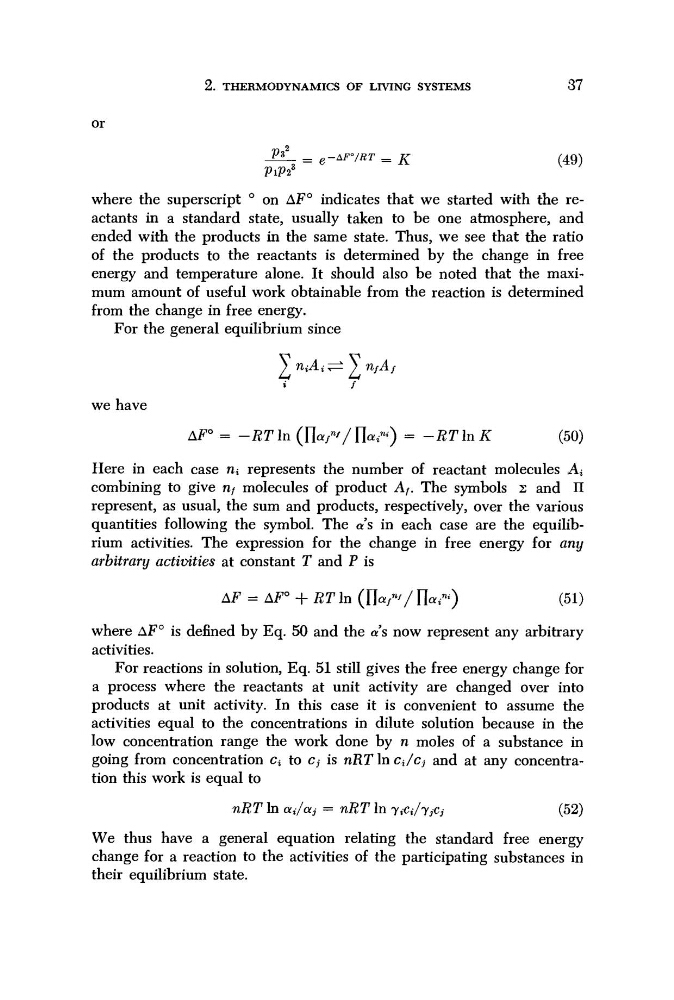
or
JEl_ = e -AF-/RT = K
(49)
PlP2*
where the superscript ° on AF° indicates that we started with the reactants in a standard state, usually taken to be one atmosphere, and
ended with the products in the same state. Thus, we see that the ratio
of the products to the reactants is determined by the change in free
energy and temperature alone. It should also be noted that the maximum amount of useful work obtainable from the reaction is determined
from the change in free energy.
For the general equilibrium since
UiAi^± y n f Af
f
we have
AF° = -AT In (Πα/
η/ /Πα<
Λί ) = -RT In K
(50)
Here in each case n\ represents the number of reactant molecules A%
combining to give n f molecules of product A f . The symbols Σ and Π
represent, as usual, the sum and products, respectively, over the various
quantities following the symbol. The as in each case are the equilibrium activities. The expression for the change in free energy for any
arbitrary activities at constant T and P is
AF = AF° + RT In (Π«/
η/ / Πα<
η<
)
(51)
where AF° is defined by Eq. 50 and the a's now represent any arbitrary
activities.
For reactions in solution, Eq. 51 still gives the free energy change for
a process where the reactants at unit activity are changed over into
products at unit activity. In this case it is convenient to assume the
activities equal to the concentrations in dilute solution because in the
low concentration range the work done by n moles of a substance in
going from concentration Cj to Cj is nRT In CI/CJ and at any concentration this work is equal to
nRT In οα/α 3 - = nRT In yid/jjCj
(52)
We thus have a general equation relating the standard free energy
change for a reaction to the activities of the participating substances in
their equilibrium state.
Σ
37
or
JEl_ = e -AF-/RT = K
(49)
PlP2*
where the superscript ° on AF° indicates that we started with the reactants in a standard state, usually taken to be one atmosphere, and
ended with the products in the same state. Thus, we see that the ratio
of the products to the reactants is determined by the change in free
energy and temperature alone. It should also be noted that the maximum amount of useful work obtainable from the reaction is determined
from the change in free energy.
For the general equilibrium since
UiAi^± y n f Af
f
we have
AF° = -AT In (Πα/
η/ /Πα<
Λί ) = -RT In K
(50)
Here in each case n\ represents the number of reactant molecules A%
combining to give n f molecules of product A f . The symbols Σ and Π
represent, as usual, the sum and products, respectively, over the various
quantities following the symbol. The as in each case are the equilibrium activities. The expression for the change in free energy for any
arbitrary activities at constant T and P is
AF = AF° + RT In (Π«/
η/ / Πα<
η<
)
(51)
where AF° is defined by Eq. 50 and the a's now represent any arbitrary
activities.
For reactions in solution, Eq. 51 still gives the free energy change for
a process where the reactants at unit activity are changed over into
products at unit activity. In this case it is convenient to assume the
activities equal to the concentrations in dilute solution because in the
low concentration range the work done by n moles of a substance in
going from concentration Cj to Cj is nRT In CI/CJ and at any concentration this work is equal to
nRT In οα/α 3 - = nRT In yid/jjCj
(52)
We thus have a general equation relating the standard free energy
change for a reaction to the activities of the participating substances in
their equilibrium state.
Σ