

496
MARY BELLE ALLEN
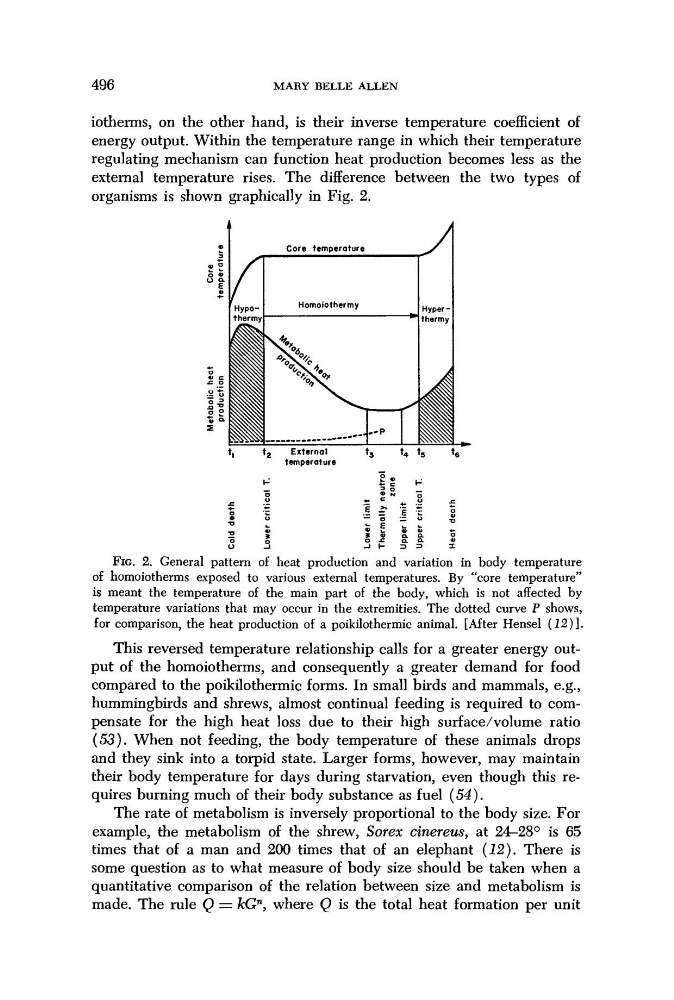
iotherms, on the other hand, is their inverse temperature coeflBcient of
energy output. Within the temperature range in which their temperature
regulating mechanism can function heat production becomes less as the
external temperature rises. The difference between the two types of
organisms is shown graphically in Fig. 2.
temperature
■a
V
»
u
φ £
to
o
o -c
a. a.
a>
O
_J
-J
»3
Z3
X
FIG. 2. General pattern of heat production and variation in body temperature
of homoiotherms exposed to various external temperatures. By "core temperature"
is meant the temperature of the main part of the body, which is not affected by
temperature variations that may occur in the extremities. The dotted curve F shows,
for comparison, the heat production of a poikilothermic animal. [After Hensel (12)].
This reversed temperature relationship calls for a greater energy output of the homoiotherms, and consequently a greater demand for food
compared to the poikilothermic forms. In small birds and mammals, e.g.,
hummingbirds and shrews, almost continual feeding is required to compensate for the high heat loss due to their high surface/volume ratio
(53). When not feeding, the body temperature of these animals drops
and they sink into a torpid state. Larger forms, however, may maintain
their body temperature for days during starvation, even though this requires burning much of their body substance as fuel (54).
The rate of metabolism is inversely proportional to the body size. For
example, the metabolism of the shrew, Sorex cinereus, at 24-28° is 65
times that of a man and 200 times that of an elephant (12). There is
some question as to what measure of body size should be taken when a
quantitative comparison of the relation between size and metabolism is
made. The rule Q = kG
n , where Q is the total heat formation per unit
MARY BELLE ALLEN
iotherms, on the other hand, is their inverse temperature coeflBcient of
energy output. Within the temperature range in which their temperature
regulating mechanism can function heat production becomes less as the
external temperature rises. The difference between the two types of
organisms is shown graphically in Fig. 2.
temperature
■a
V
»
u
φ £
to
o
o -c
a. a.
a>
O
_J
-J
»3
Z3
X
FIG. 2. General pattern of heat production and variation in body temperature
of homoiotherms exposed to various external temperatures. By "core temperature"
is meant the temperature of the main part of the body, which is not affected by
temperature variations that may occur in the extremities. The dotted curve F shows,
for comparison, the heat production of a poikilothermic animal. [After Hensel (12)].
This reversed temperature relationship calls for a greater energy output of the homoiotherms, and consequently a greater demand for food
compared to the poikilothermic forms. In small birds and mammals, e.g.,
hummingbirds and shrews, almost continual feeding is required to compensate for the high heat loss due to their high surface/volume ratio
(53). When not feeding, the body temperature of these animals drops
and they sink into a torpid state. Larger forms, however, may maintain
their body temperature for days during starvation, even though this requires burning much of their body substance as fuel (54).
The rate of metabolism is inversely proportional to the body size. For
example, the metabolism of the shrew, Sorex cinereus, at 24-28° is 65
times that of a man and 200 times that of an elephant (12). There is
some question as to what measure of body size should be taken when a
quantitative comparison of the relation between size and metabolism is
made. The rule Q = kG
n , where Q is the total heat formation per unit