

2. THERMODYNAMICS OF LIVING SYSTEMS
31
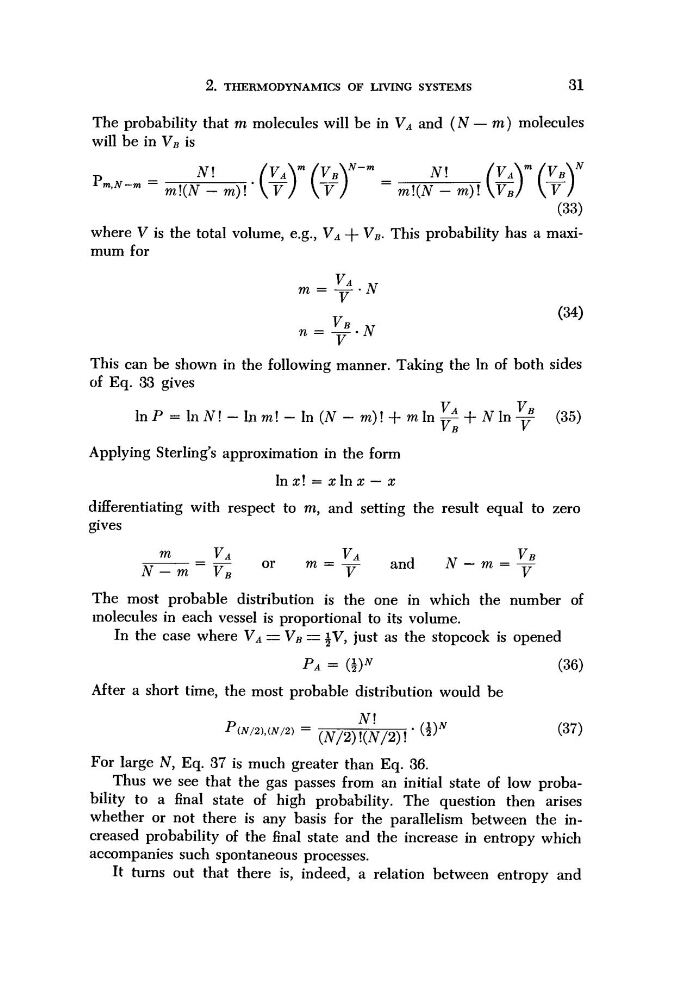
The probability that m molecules will be in V A and (IV — m) molecules
will be in V B is
■ m,N—m —
n
(vA
m
(vA"-"
1
N\
(VAY (νλ
λ
-m)\'\v)
\V )
m\(N - m)\\V B )
\V )
m\(N
(33)
where V is the total volume, e.g., V A + V B . This probability has a maximum for
V * AT
v B
(34)
This can be shown in the following manner. Taking the In of both sides
of Eq. 33 gives
In P = In N\ - In ml - In (N - m)! + m In ^ + N In ^
(35)
v B
y
Applying Sterling's approximation in the form
In x \ — x In x — x
diflFerentiating with respect to m, and setting the result equal to zero
gives
T7
= ΨΓ
or
m = -ψτ
and
N — m = -^r
N - m
V B
V
V
The most probable distribution is the one in which the number of
molecules in each vessel is proportional to its volume.
In the case where V A = V B = JV, just as the stopcock is opened
PA = (i)
N
(36)
After a short time, the most probable distribution would be
i\n
Ρ(Ν/2)ΛΝ/2)
= ( N/2 )\(N/2)l'
^
)N
(37)
For large N, Eq. 37 is much greater than Eq. 36.
Thus we see that the gas passes from an initial state of low probability to a final state of high probability. The question then arises
whether or not there is any basis for the parallelism between the increased probability of the final state and the increase in entropy which
accompanies such spontaneous processes.
It turns out that there is, indeed, a relation between entropy and
31
The probability that m molecules will be in V A and (IV — m) molecules
will be in V B is
■ m,N—m —
n
(vA
m
(vA"-"
1
N\
(VAY (νλ
λ
-m)\'\v)
\V )
m\(N - m)\\V B )
\V )
m\(N
(33)
where V is the total volume, e.g., V A + V B . This probability has a maximum for
V * AT
v B
(34)
This can be shown in the following manner. Taking the In of both sides
of Eq. 33 gives
In P = In N\ - In ml - In (N - m)! + m In ^ + N In ^
(35)
v B
y
Applying Sterling's approximation in the form
In x \ — x In x — x
diflFerentiating with respect to m, and setting the result equal to zero
gives
T7
= ΨΓ
or
m = -ψτ
and
N — m = -^r
N - m
V B
V
V
The most probable distribution is the one in which the number of
molecules in each vessel is proportional to its volume.
In the case where V A = V B = JV, just as the stopcock is opened
PA = (i)
N
(36)
After a short time, the most probable distribution would be
i\n
Ρ(Ν/2)ΛΝ/2)
= ( N/2 )\(N/2)l'
^
)N
(37)
For large N, Eq. 37 is much greater than Eq. 36.
Thus we see that the gas passes from an initial state of low probability to a final state of high probability. The question then arises
whether or not there is any basis for the parallelism between the increased probability of the final state and the increase in entropy which
accompanies such spontaneous processes.
It turns out that there is, indeed, a relation between entropy and