

30
HENRY EYRING, RICHARD P. BOYCE AND JOHN D. SPIKES
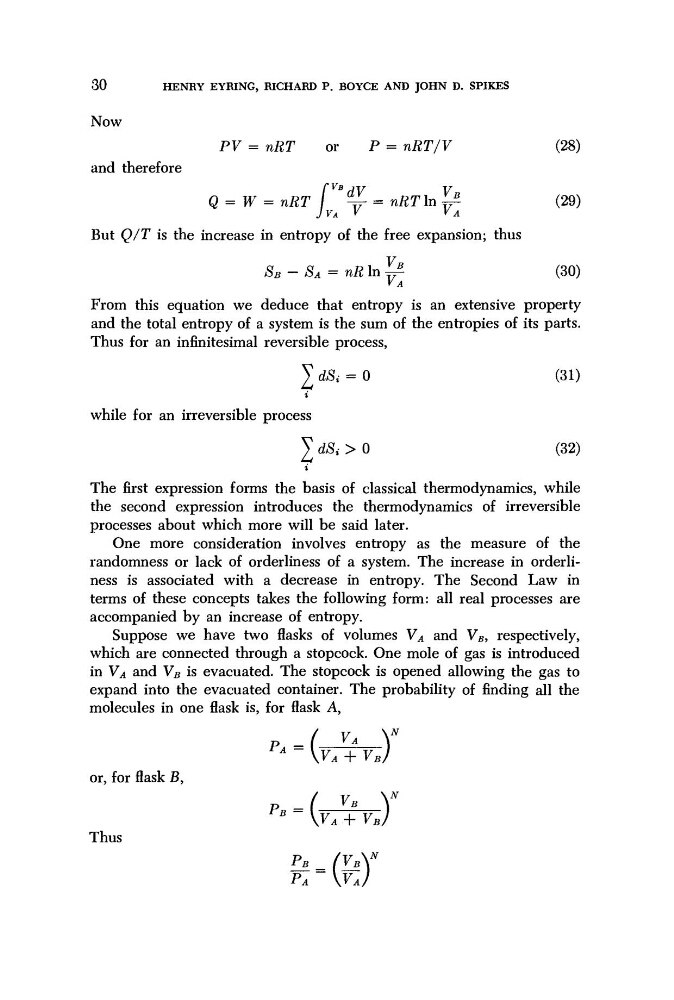
Now
PV = nRT
or
P = nRT/V
(28)
and therefore
Q = W = nRT I
B ^r = nRTln ^
(29)
JVA
V
VA
But Q/T is the increase in entropy of the free expansion; thus
8B ~ S A = nR In ^
(30)
V A
From this equation we deduce that entropy is an extensive property
and the total entropy of a system is the sum of the entropies of its parts.
Thus for an infinitesimal reversible process,
Σ
dSi = 0
(31)
while for an irreversible process
£ dSi > 0
(32)
i
The first expression forms the basis of classical thermodynamics, while
the second expression introduces the thermodynamics of irreversible
processes about which more will be said later.
One more consideration involves entropy as the measure of the
randomness or lack of orderliness of a system. The increase in orderliness is associated with a decrease in entropy. The Second Law in
terms of these concepts takes the following form: all real processes are
accompanied by an increase of entropy.
Suppose we have two flasks of volumes V A and V B> respectively,
which are connected through a stopcock. One mole of gas is introduced
in V A and V B is evacuated. The stopcock is opened allowing the gas to
expand into the evacuated container. The probability of finding all the
molecules in one flask is, for flask A,
or, for flask B,
Thus
(
v
* Y
A
~ \VA + V B J
( VB
Y
B
\VA + V B )
PB =
(VBY
PA
\VAJ
HENRY EYRING, RICHARD P. BOYCE AND JOHN D. SPIKES
Now
PV = nRT
or
P = nRT/V
(28)
and therefore
Q = W = nRT I
B ^r = nRTln ^
(29)
JVA
V
VA
But Q/T is the increase in entropy of the free expansion; thus
8B ~ S A = nR In ^
(30)
V A
From this equation we deduce that entropy is an extensive property
and the total entropy of a system is the sum of the entropies of its parts.
Thus for an infinitesimal reversible process,
Σ
dSi = 0
(31)
while for an irreversible process
£ dSi > 0
(32)
i
The first expression forms the basis of classical thermodynamics, while
the second expression introduces the thermodynamics of irreversible
processes about which more will be said later.
One more consideration involves entropy as the measure of the
randomness or lack of orderliness of a system. The increase in orderliness is associated with a decrease in entropy. The Second Law in
terms of these concepts takes the following form: all real processes are
accompanied by an increase of entropy.
Suppose we have two flasks of volumes V A and V B> respectively,
which are connected through a stopcock. One mole of gas is introduced
in V A and V B is evacuated. The stopcock is opened allowing the gas to
expand into the evacuated container. The probability of finding all the
molecules in one flask is, for flask A,
or, for flask B,
Thus
(
v
* Y
A
~ \VA + V B J
( VB
Y
B
\VA + V B )
PB =
(VBY
PA
\VAJ