

476
ERIC E. CONN
Because of the reactivity of 1,2-naphthoquinone in these reactions and
the widespread occurrence of naphthoquinones in nature, Wosilait et al.
speculated that these compounds may be naturally occurring carriers in
the transfer of electrons from respiratory substrates to oxygen (249).
The possible role of the phenol oxidases in plant respiration has been
discussed (224, 226, 245, 249). There is little evidence to support polyphenol oxidase as a terminal oxidase in plants, even through a carrier
system between DPNH or TPNH and the quinones exists. The tissue
which has been studied most is the potato tuber in which polyphenol
oxidase is abundantly present. However, in 1950 Goddard and Holden
demonstrated that there was a sufficient amount of cytochrome oxidase
in homogenates of potato tuber to account for the respiration of the
intact tissue (250).
Again, as with ascorbic acid oxidase, the affinity of the phenol
oxidases for 0 2 apparently is low, and it is suggested that this enzyme
may instead be involved in electron transfer to some acceptor besides
0 2 (224). The need for more detailed studies on the properties of the
purified enzyme has been emphasized.
C. FLAVOPROTEINS
The role of flavoproteins in the respiration of the facultative anaerobe
Streptococcus faecalis has been examined in some detail by Dolin (122,
124, 251, 252). The electron transfer in this organism is of interest since
this bacterium is lacking in the cytochromes and catalase. The absence
of catalase is particularly interesting, since this introduces the possibility
of H 2 0 2 accumulation as a result of flavoprotein interaction with 0 2 .
Under anaerobic conditions the oxidation of DPNH in these organisms
is coupled to the reduction of pyruvate with the formation of lactate.
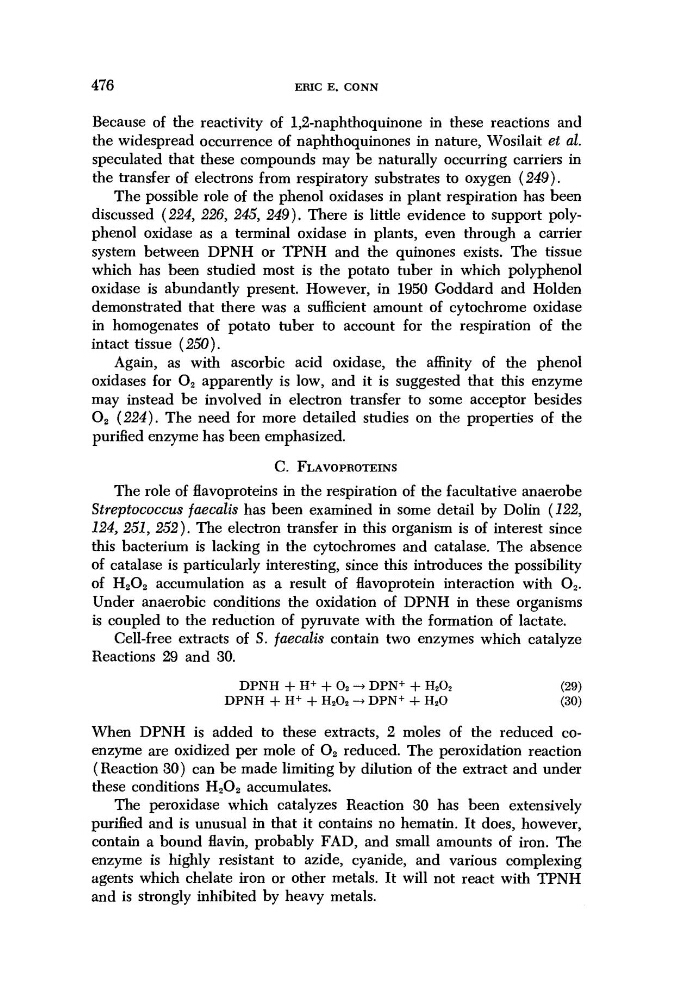
Cell-free extracts of S. faecalis contain two enzymes which catalyze
Reactions 29 and 30.
DPNH + H+ + 0 2 -> DPN+ + H 2 0 2
(29)
DPNH + H
+ + H 2 0 2 -► DPN+ + H 2 0
(30)
When DPNH is added to these extracts, 2 moles of the reduced coenzyme are oxidized per mole of 0 2 reduced. The peroxidation reaction
(Reaction 30) can be made limiting by dilution of the extract and under
these conditions H 2 0 2 accumulates.
The peroxidase which catalyzes Reaction 30 has been extensively
purified and is unusual in that it contains no hematin. It does, however,
contain a bound flavin, probably FAD, and small amounts of iron. The
enzyme is highly resistant to azide, cyanide, and various complexing
agents which chelate iron or other metals. It will not react with TPNH
and is strongly inhibited by heavy metals.
ERIC E. CONN
Because of the reactivity of 1,2-naphthoquinone in these reactions and
the widespread occurrence of naphthoquinones in nature, Wosilait et al.
speculated that these compounds may be naturally occurring carriers in
the transfer of electrons from respiratory substrates to oxygen (249).
The possible role of the phenol oxidases in plant respiration has been
discussed (224, 226, 245, 249). There is little evidence to support polyphenol oxidase as a terminal oxidase in plants, even through a carrier
system between DPNH or TPNH and the quinones exists. The tissue
which has been studied most is the potato tuber in which polyphenol
oxidase is abundantly present. However, in 1950 Goddard and Holden
demonstrated that there was a sufficient amount of cytochrome oxidase
in homogenates of potato tuber to account for the respiration of the
intact tissue (250).
Again, as with ascorbic acid oxidase, the affinity of the phenol
oxidases for 0 2 apparently is low, and it is suggested that this enzyme
may instead be involved in electron transfer to some acceptor besides
0 2 (224). The need for more detailed studies on the properties of the
purified enzyme has been emphasized.
C. FLAVOPROTEINS
The role of flavoproteins in the respiration of the facultative anaerobe
Streptococcus faecalis has been examined in some detail by Dolin (122,
124, 251, 252). The electron transfer in this organism is of interest since
this bacterium is lacking in the cytochromes and catalase. The absence
of catalase is particularly interesting, since this introduces the possibility
of H 2 0 2 accumulation as a result of flavoprotein interaction with 0 2 .
Under anaerobic conditions the oxidation of DPNH in these organisms
is coupled to the reduction of pyruvate with the formation of lactate.
Cell-free extracts of S. faecalis contain two enzymes which catalyze
Reactions 29 and 30.
DPNH + H+ + 0 2 -> DPN+ + H 2 0 2
(29)
DPNH + H
+ + H 2 0 2 -► DPN+ + H 2 0
(30)
When DPNH is added to these extracts, 2 moles of the reduced coenzyme are oxidized per mole of 0 2 reduced. The peroxidation reaction
(Reaction 30) can be made limiting by dilution of the extract and under
these conditions H 2 0 2 accumulates.
The peroxidase which catalyzes Reaction 30 has been extensively
purified and is unusual in that it contains no hematin. It does, however,
contain a bound flavin, probably FAD, and small amounts of iron. The
enzyme is highly resistant to azide, cyanide, and various complexing
agents which chelate iron or other metals. It will not react with TPNH
and is strongly inhibited by heavy metals.