

10. ELECTRON TRANSPORT AND OXIDATIVE PHOSPHORYLATION
475
dehydroascorbic acid will not serve to oxidize DPNH. Therefore, an
intermediate oxidation product "monodehydroascorbic acid" (a semiquinone) has been postulated (Reaction 25).
Ascorbic acid oxidase
A A + J O2
> Monodehydroascorbate
(25)
It is further postulated that the monodehydroascorbate in turn is reduced
by DPNH in the presence of the enzyme found in yeast, peas, and other
plants (Reaction 26).
DPNH + H+ + Monodehydroascorbate -> DPN+ + AA
(26)
It is interesting to note that Cu
2+ and Fe
2+ can replace ascorbic acid
oxidase in Reaction 25 in catalyzing the formation of the reactive intermediate. The significance, if any, of this reaction in plant respiration
is unknown.
B. PHENOL OXIDASES
The phenol oxidases which catalyze the oxidation of phenolic compounds to their corresponding quinones are widely distributed in nature
(245, 246). Quinones thus formed in turn can be reduced nonenzymically
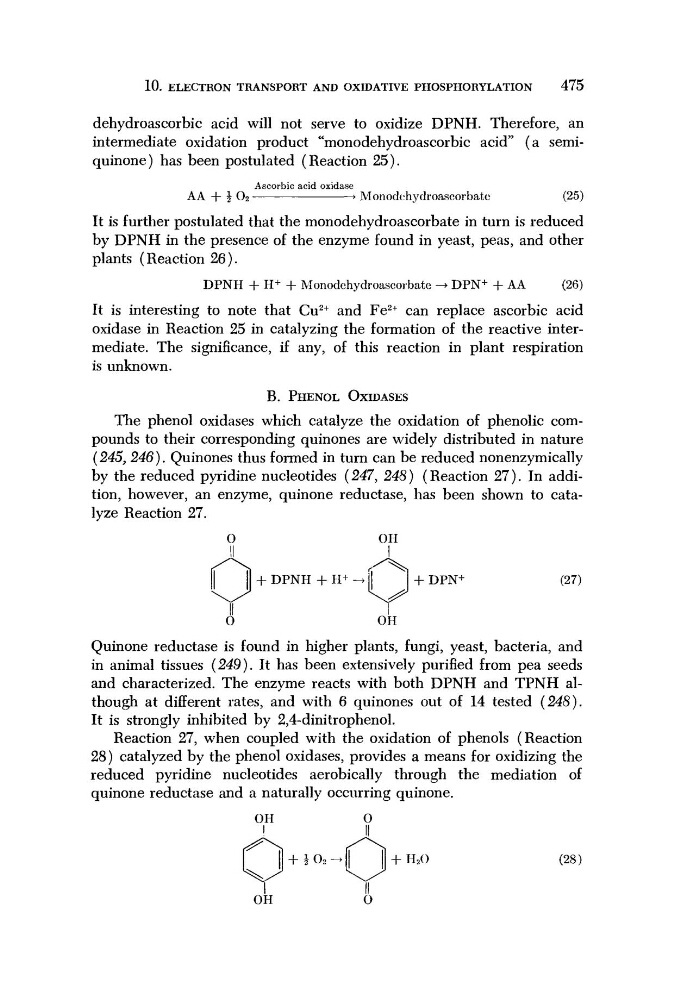
by the reduced pyridine nucleotides (247, 248) (Reaction 27). In addition, however, an enzyme, quinone reductase, has been shown to catalyze Reaction 27.
O
OH
' + DPN+
(27)
f
I + DPNH + H+ -> (j
]
V
V
O
OH
Quinone reductase is found in higher plants, fungi, yeast, bacteria, and
in animal tissues (249). It has been extensively purified from pea seeds
and characterized. The enzyme reacts with both DPNH and TPNH although at different rates, and with 6 quinones out of 14 tested (248).
It is strongly inhibited by 2,4-dinitrophenol.
Reaction 27, when coupled with the oxidation of phenols (Reaction
28) catalyzed by the phenol oxidases, provides a means for oxidizing the
reduced pyridine nucleotides aerobically through the mediation of
quinone reductase and a naturally occurring quinone.
|| + iO,-|
|| + H 2 0
(28)
OH
475
dehydroascorbic acid will not serve to oxidize DPNH. Therefore, an
intermediate oxidation product "monodehydroascorbic acid" (a semiquinone) has been postulated (Reaction 25).
Ascorbic acid oxidase
A A + J O2
> Monodehydroascorbate
(25)
It is further postulated that the monodehydroascorbate in turn is reduced
by DPNH in the presence of the enzyme found in yeast, peas, and other
plants (Reaction 26).
DPNH + H+ + Monodehydroascorbate -> DPN+ + AA
(26)
It is interesting to note that Cu
2+ and Fe
2+ can replace ascorbic acid
oxidase in Reaction 25 in catalyzing the formation of the reactive intermediate. The significance, if any, of this reaction in plant respiration
is unknown.
B. PHENOL OXIDASES
The phenol oxidases which catalyze the oxidation of phenolic compounds to their corresponding quinones are widely distributed in nature
(245, 246). Quinones thus formed in turn can be reduced nonenzymically
by the reduced pyridine nucleotides (247, 248) (Reaction 27). In addition, however, an enzyme, quinone reductase, has been shown to catalyze Reaction 27.
O
OH
' + DPN+
(27)
f
I + DPNH + H+ -> (j
]
V
V
O
OH
Quinone reductase is found in higher plants, fungi, yeast, bacteria, and
in animal tissues (249). It has been extensively purified from pea seeds
and characterized. The enzyme reacts with both DPNH and TPNH although at different rates, and with 6 quinones out of 14 tested (248).
It is strongly inhibited by 2,4-dinitrophenol.
Reaction 27, when coupled with the oxidation of phenols (Reaction
28) catalyzed by the phenol oxidases, provides a means for oxidizing the
reduced pyridine nucleotides aerobically through the mediation of
quinone reductase and a naturally occurring quinone.
|| + iO,-|
|| + H 2 0
(28)
OH