

10. ELECTRON TRANSPORT AND OXIDATIVE PHOSPHORYLATION
469
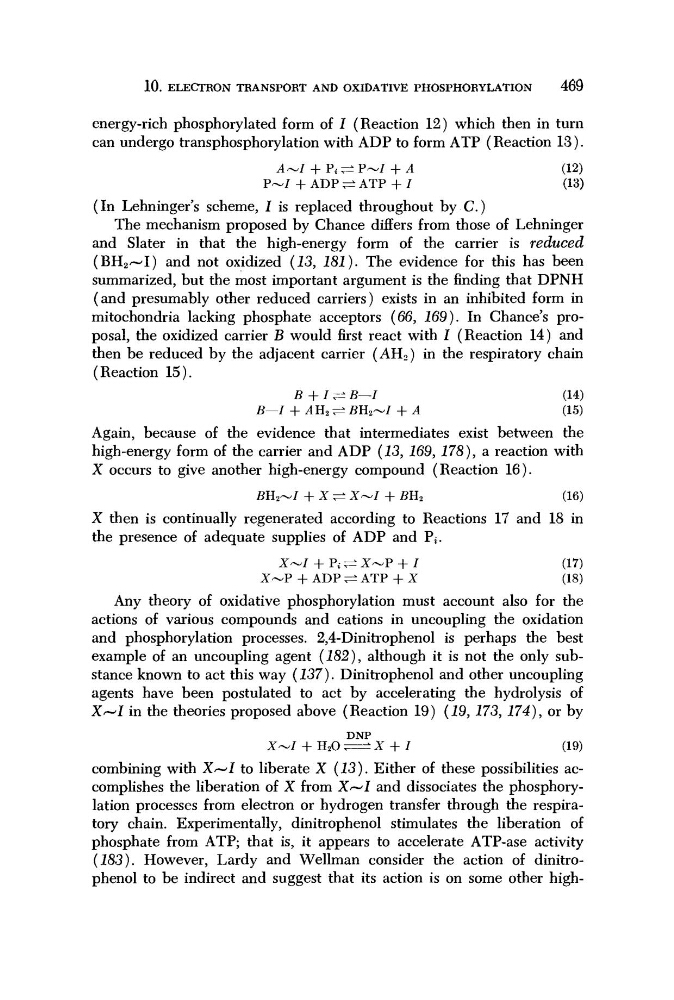
energy-rich phosphorylated form of I (Reaction 12) which then in turn
can undergo transphosphorylation with ADP to form ATP (Reaction 13).
A~I + Pi ^ P~/ + A
(12)
P~J + ADP ;=± ATP + /
(13)
(In Lehninger's scheme, I is replaced throughout by C.)
The mechanism proposed by Chance differs from those of Lehninger
and Slater in that the high-energy form of the carrier is reduced
(BH 2 ^I) and not oxidized (13, 181). The evidence for this has been
summarized, but the most important argument is the finding that DPNH
(and presumably other reduced carriers) exists in an inhibited form in
mitochondria lacking phosphate acceptors (66, 169). In Chance's proposal, the oxidized carrier B would first react with I (Reaction 14) and
then be reduced by the adjacent carrier (AH 2 ) in the respiratory chain
(Reaction 15).
B + / ^± B—I
(14)
B—I + AH 2 ;=± £H 2 ~/ + A
(15)
Again, because of the evidence that intermediates exist between the
high-energy form of the carrier and ADP (13, 169, 178), a reaction with
X occurs to give another high-energy compound (Reaction 16).
ΒΉ 2 ~Ι + X^± X~I + 5H 2
(16)
X then is continually regenerated according to Reactions 17 and 18 in
the presence of adequate supplies of ADP and Pi.
X~I + Pi ^ X~ P + /
(17)
X~P + ADP ;=± ATP + X
(18)
Any theory of oxidative phosphorylation must account also for the
actions of various compounds and cations in uncoupling the oxidation
and phosphorylation processes. 2,4-Dinitrophenol is perhaps the best
example of an uncoupling agent (182), although it is not the only substance known to act this way (137). Dinitrophenol and other uncoupling
agents have been postulated to act by accelerating the hydrolysis of
X^I in the theories proposed above (Reaction 19) (19, 173, 174), or by
DNP
X~I + H 2 0 ;=± X + /
(19)
combining with X^l to liberate X (13). Either of these possibilities accomplishes the liberation of X from X^I and dissociates the phosphorylation processes from electron or hydrogen transfer through the respiratory chain. Experimentally, dinitrophenol stimulates the liberation of
phosphate from ATP; that is, it appears to accelerate ATP-ase activity
(183). However, Lardy and Wellman consider the action of dinitrophenol to be indirect and suggest that its action is on some other high-
469
energy-rich phosphorylated form of I (Reaction 12) which then in turn
can undergo transphosphorylation with ADP to form ATP (Reaction 13).
A~I + Pi ^ P~/ + A
(12)
P~J + ADP ;=± ATP + /
(13)
(In Lehninger's scheme, I is replaced throughout by C.)
The mechanism proposed by Chance differs from those of Lehninger
and Slater in that the high-energy form of the carrier is reduced
(BH 2 ^I) and not oxidized (13, 181). The evidence for this has been
summarized, but the most important argument is the finding that DPNH
(and presumably other reduced carriers) exists in an inhibited form in
mitochondria lacking phosphate acceptors (66, 169). In Chance's proposal, the oxidized carrier B would first react with I (Reaction 14) and
then be reduced by the adjacent carrier (AH 2 ) in the respiratory chain
(Reaction 15).
B + / ^± B—I
(14)
B—I + AH 2 ;=± £H 2 ~/ + A
(15)
Again, because of the evidence that intermediates exist between the
high-energy form of the carrier and ADP (13, 169, 178), a reaction with
X occurs to give another high-energy compound (Reaction 16).
ΒΉ 2 ~Ι + X^± X~I + 5H 2
(16)
X then is continually regenerated according to Reactions 17 and 18 in
the presence of adequate supplies of ADP and Pi.
X~I + Pi ^ X~ P + /
(17)
X~P + ADP ;=± ATP + X
(18)
Any theory of oxidative phosphorylation must account also for the
actions of various compounds and cations in uncoupling the oxidation
and phosphorylation processes. 2,4-Dinitrophenol is perhaps the best
example of an uncoupling agent (182), although it is not the only substance known to act this way (137). Dinitrophenol and other uncoupling
agents have been postulated to act by accelerating the hydrolysis of
X^I in the theories proposed above (Reaction 19) (19, 173, 174), or by
DNP
X~I + H 2 0 ;=± X + /
(19)
combining with X^l to liberate X (13). Either of these possibilities accomplishes the liberation of X from X^I and dissociates the phosphorylation processes from electron or hydrogen transfer through the respiratory chain. Experimentally, dinitrophenol stimulates the liberation of
phosphate from ATP; that is, it appears to accelerate ATP-ase activity
(183). However, Lardy and Wellman consider the action of dinitrophenol to be indirect and suggest that its action is on some other high-