

468
ERIC E. CONN
of ATP (13, 137, 170, 171). As a result theories have been proposed by
the leading workers in this field and these have undergone modification
or elaboration. Those proposed by Slater (170, 172, 173) and Lehninger
(137, 174) differ in one respect from that advocated by Chance (13,
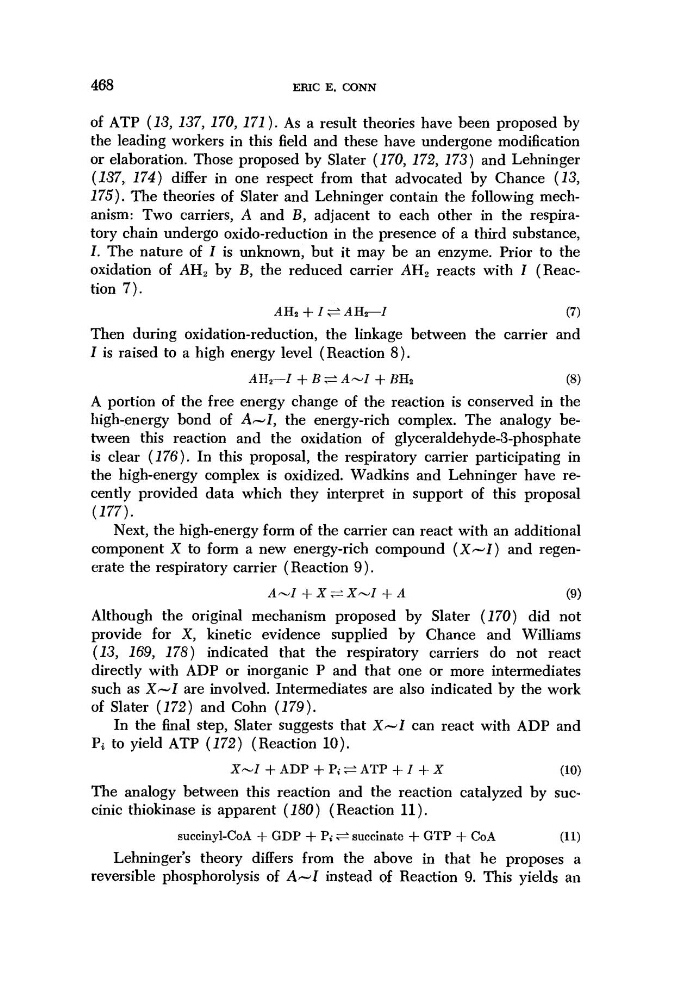
175). The theories of Slater and Lehninger contain the following mechanism: Two carriers, A and B, adjacent to each other in the respiratory chain undergo oxido-reduction in the presence of a third substance,
I. The nature of I is unknown, but it may be an enzyme. Prior to the
oxidation of AH 2 by B, the reduced carrier AH 2 reacts with I (Reaction 7).
AH 2 + / ;=± ΑΗ 2 —/
(7)
Then during oxidation-reduction, the linkage between the carrier and
I is raised to a high energy level (Reaction 8).
ΑΉ 2 —I + B τ± Α~Ι + £H 2
(8)
A portion of the free energy change of the reaction is conserved in the
high-energy bond of A^I, the energy-rich complex. The analogy between this reaction and the oxidation of glyceraldehyde-3-phosphate
is clear (176). In this proposal, the respiratory carrier participating in
the high-energy complex is oxidized. Wadkins and Lehninger have recently provided data which they interpret in support of this proposal
(177).
Next, the high-energy form of the carrier can react with an additional
component X to form a new energy-rich compound (X^I)
and regenerate the respiratory carrier (Reaction 9).
A~I +X^tX~I
+ A
(9)
Although the original mechanism proposed by Slater (170) did not
provide for X, kinetic evidence supplied by Chance and Williams
(13, 169, 178) indicated that the respiratory carriers do not react
directly with ADP or inorganic P and that one or more intermediates
such as X^I are involved. Intermediates are also indicated by the work
of Slater (172) and Cohn (179).
In the final step, Slater suggests that X^l can react with ADP and
Pi to yield ATP (172) (Reaction 10).
X~I + ADP + P t ^ ATP + / + X
(10)
The analogy between this reaction and the reaction catalyzed by succinic thiokinase is apparent (180) (Reaction 11).
succinyl-CoA + GDP + P* ^ succinate + GTP + CoA
(11)
Lehninger's theory differs from the above in that he proposes a
reversible phosphorolysis of A^l instead of Reaction 9. This yields an
ERIC E. CONN
of ATP (13, 137, 170, 171). As a result theories have been proposed by
the leading workers in this field and these have undergone modification
or elaboration. Those proposed by Slater (170, 172, 173) and Lehninger
(137, 174) differ in one respect from that advocated by Chance (13,
175). The theories of Slater and Lehninger contain the following mechanism: Two carriers, A and B, adjacent to each other in the respiratory chain undergo oxido-reduction in the presence of a third substance,
I. The nature of I is unknown, but it may be an enzyme. Prior to the
oxidation of AH 2 by B, the reduced carrier AH 2 reacts with I (Reaction 7).
AH 2 + / ;=± ΑΗ 2 —/
(7)
Then during oxidation-reduction, the linkage between the carrier and
I is raised to a high energy level (Reaction 8).
ΑΉ 2 —I + B τ± Α~Ι + £H 2
(8)
A portion of the free energy change of the reaction is conserved in the
high-energy bond of A^I, the energy-rich complex. The analogy between this reaction and the oxidation of glyceraldehyde-3-phosphate
is clear (176). In this proposal, the respiratory carrier participating in
the high-energy complex is oxidized. Wadkins and Lehninger have recently provided data which they interpret in support of this proposal
(177).
Next, the high-energy form of the carrier can react with an additional
component X to form a new energy-rich compound (X^I)
and regenerate the respiratory carrier (Reaction 9).
A~I +X^tX~I
+ A
(9)
Although the original mechanism proposed by Slater (170) did not
provide for X, kinetic evidence supplied by Chance and Williams
(13, 169, 178) indicated that the respiratory carriers do not react
directly with ADP or inorganic P and that one or more intermediates
such as X^I are involved. Intermediates are also indicated by the work
of Slater (172) and Cohn (179).
In the final step, Slater suggests that X^l can react with ADP and
Pi to yield ATP (172) (Reaction 10).
X~I + ADP + P t ^ ATP + / + X
(10)
The analogy between this reaction and the reaction catalyzed by succinic thiokinase is apparent (180) (Reaction 11).
succinyl-CoA + GDP + P* ^ succinate + GTP + CoA
(11)
Lehninger's theory differs from the above in that he proposes a
reversible phosphorolysis of A^l instead of Reaction 9. This yields an