

386
CLAUDE FROMAGEOT AND JACQUES C. SENEZ
are evolutionary remnants of particular interest to comparative biochemistry.
3. Heterotrophic Bacteria
Numerous chemo-heterotrophic bacteria which are strict or facultative anaerobes possess a hydrogenase and can oxidize H 2 or, on the
contrary, liberate molecular hydrogen from various organic substrates
(Table IX). Some of these reactions are strongly exothermic, but none
of them are used by these heterotrophic microorganisms as an energy
source for growth and hence it will suffice here to mention only those
most important for comparative biochemistry; a more complete description is given in the significant general review by Gest (127).
Among the reactions listed in Table IX, the so-called "phosphoroclastic" decarboxylation of pyruvate is one of the most interesting. It is carried out by most of the saccharolytic species of Clostridia, or strictly
anaerobic sporulated bacteria, and in particular by Clostridium butylicum (145) and by the nitrogen-fixing species C. pasteurianum
(146).
The reversibility of this process was demonstrated by the isotopic incorporation of C0 2 into the carboxyl group of pyruvate (147) and by
the inhibitory effect of high partial pressures of H 2 on the decarboxylation of this keto acid. At first, the participation of hydrogenase was
questioned because the cells of C. butylicum cannot reduce methylene
blue in an H 2 atmosphere and thus appear to lack this enzyme. Later,
however, a very active hydrogenase was demonstrated in C. acetobutylicum, which carries out this reaction, and even in C. butylicum itself
by Peck and Gest (148) with a new assay method based on the liberation of H 2 from reduced methyl viologen. The phosphoroclastic reaction
has also been found in other bacteria possessing an active hydrogenase,
especially in Micrococcus lactilyticus (Veillonella gazogenes)
(127)
and D. desulfuricans (149, 150).
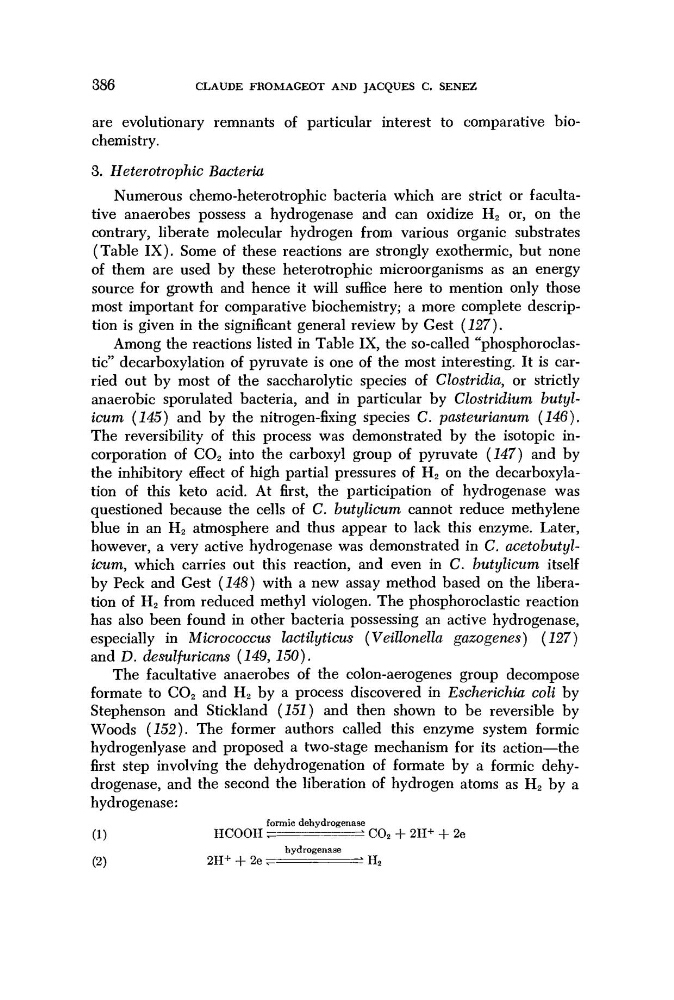
The facultative anaerobes of the colon-aerogenes group decompose
formate to C0 2 and H 2 by a process discovered in Escherichia coli by
Stephenson and Stickland (I5I) and then shown to be reversible by
Woods (152). The former authors called this enzyme system formic
hydrogenlyase and proposed a two-stage mechanism for its action—the
first step involving the dehydrogenation of formate by a formic dehydrogenase, and the second the liberation of hydrogen atoms as H 2 by a
hydrogenase:
formic dehydrogenase
(1)
HCOOH ^===± C0 2 + 2H+ + 2e
hydrogenase
(2)
2H+ + 2e ^
=± H 2
CLAUDE FROMAGEOT AND JACQUES C. SENEZ
are evolutionary remnants of particular interest to comparative biochemistry.
3. Heterotrophic Bacteria
Numerous chemo-heterotrophic bacteria which are strict or facultative anaerobes possess a hydrogenase and can oxidize H 2 or, on the
contrary, liberate molecular hydrogen from various organic substrates
(Table IX). Some of these reactions are strongly exothermic, but none
of them are used by these heterotrophic microorganisms as an energy
source for growth and hence it will suffice here to mention only those
most important for comparative biochemistry; a more complete description is given in the significant general review by Gest (127).
Among the reactions listed in Table IX, the so-called "phosphoroclastic" decarboxylation of pyruvate is one of the most interesting. It is carried out by most of the saccharolytic species of Clostridia, or strictly
anaerobic sporulated bacteria, and in particular by Clostridium butylicum (145) and by the nitrogen-fixing species C. pasteurianum
(146).
The reversibility of this process was demonstrated by the isotopic incorporation of C0 2 into the carboxyl group of pyruvate (147) and by
the inhibitory effect of high partial pressures of H 2 on the decarboxylation of this keto acid. At first, the participation of hydrogenase was
questioned because the cells of C. butylicum cannot reduce methylene
blue in an H 2 atmosphere and thus appear to lack this enzyme. Later,
however, a very active hydrogenase was demonstrated in C. acetobutylicum, which carries out this reaction, and even in C. butylicum itself
by Peck and Gest (148) with a new assay method based on the liberation of H 2 from reduced methyl viologen. The phosphoroclastic reaction
has also been found in other bacteria possessing an active hydrogenase,
especially in Micrococcus lactilyticus (Veillonella gazogenes)
(127)
and D. desulfuricans (149, 150).
The facultative anaerobes of the colon-aerogenes group decompose
formate to C0 2 and H 2 by a process discovered in Escherichia coli by
Stephenson and Stickland (I5I) and then shown to be reversible by
Woods (152). The former authors called this enzyme system formic
hydrogenlyase and proposed a two-stage mechanism for its action—the
first step involving the dehydrogenation of formate by a formic dehydrogenase, and the second the liberation of hydrogen atoms as H 2 by a
hydrogenase:
formic dehydrogenase
(1)
HCOOH ^===± C0 2 + 2H+ + 2e
hydrogenase
(2)
2H+ + 2e ^
=± H 2