

8. REACTIONS OF INORGANIC SUBSTANCES
369
in this reaction sequence and the identity of the pertinent enzymes are
still largely hypothetical. The intermediary formation of hydroxylamine
(NH 2 OH) has long been questioned in view of the pronounced toxicity
of this compound for Nitrosomonas. But Lees (75) found that NH 2 OH
is oxidized by this organism as rapidly as NH 4
+ , as long as its concentration remains below 1.5 mg. nitrogen per milliliter. Further experimental
proof of the participation of NH 2 OH in this sequence was furnished by
Hof man and Lees (76) who found that NH 2 OH accumulates in cultures of Nitrosomonas when the formation of nitrite is inhibited by
hydrazine.
The next stage, where the degree of oxidation of nitrogen is represented by (NOH), is of very great importance for the metabolism of
inorganic nitrogen in general. This is, in effect, the stage in the reduction of nitrate where the bifurcation occurs which divides the pathway
leading to ammonia and that leading to gaseous nitrogen, i.e., to denitrification proper. Despite its importance, this stage is completely unknown at this time. Klyuver and Donker (74) have pointed out that the
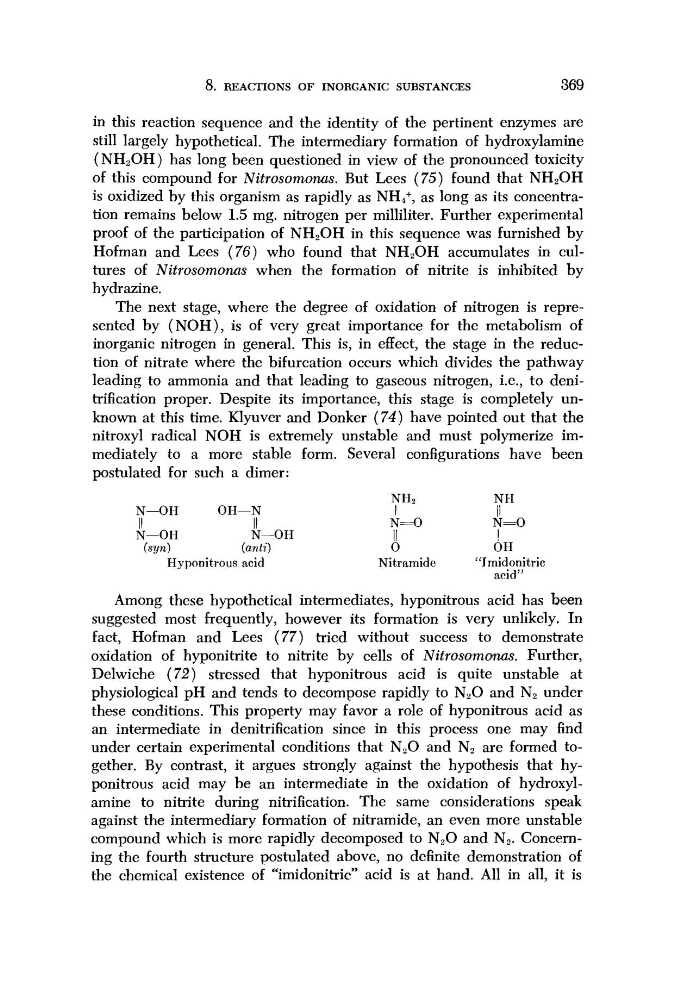
nitroxyl radical NOH is extremely unstable and must polymerize immediately to a more stable form. Several configurations have been
postulated for such a dimer:
N—OH
OH—N
II
II
N—OH
N—OH
(syn)
(anti)
Hyponitrous acid
NH 2
1
N=0
II
0
Nitramide
NH
II
N=0
1
OH
"Jmidonitric
acid"
Among these hypothetical intermediates, hyponitrous acid has been
suggested most frequently, however its formation is very unlikely. In
fact, Hof man and Lees (77) tried without success to demonstrate
oxidation of hyponitrite to nitrite by cells of Nitrosomonas. Further,
Delwiche (72) stressed that hyponitrous acid is quite unstable at
physiological pH and tends to decompose rapidly to N 2 0 and N 2 under
these conditions. This property may favor a role of hyponitrous acid as
an intermediate in denitrification since in this process one may find
under certain experimental conditions that N 2 0 and N 2 are formed together. By contrast, it argues strongly against the hypothesis that hyponitrous acid may be an intermediate in the oxidation of hydroxylamine to nitrite during nitrification. The same considerations speak
against the intermediary formation of nitramide, an even more unstable
compound which is more rapidly decomposed to N 2 0 and N 2 . Concerning the fourth structure postulated above, no definite demonstration of
the chemical existence of "imidonitric" acid is at hand. All in all, it is
369
in this reaction sequence and the identity of the pertinent enzymes are
still largely hypothetical. The intermediary formation of hydroxylamine
(NH 2 OH) has long been questioned in view of the pronounced toxicity
of this compound for Nitrosomonas. But Lees (75) found that NH 2 OH
is oxidized by this organism as rapidly as NH 4
+ , as long as its concentration remains below 1.5 mg. nitrogen per milliliter. Further experimental
proof of the participation of NH 2 OH in this sequence was furnished by
Hof man and Lees (76) who found that NH 2 OH accumulates in cultures of Nitrosomonas when the formation of nitrite is inhibited by
hydrazine.
The next stage, where the degree of oxidation of nitrogen is represented by (NOH), is of very great importance for the metabolism of
inorganic nitrogen in general. This is, in effect, the stage in the reduction of nitrate where the bifurcation occurs which divides the pathway
leading to ammonia and that leading to gaseous nitrogen, i.e., to denitrification proper. Despite its importance, this stage is completely unknown at this time. Klyuver and Donker (74) have pointed out that the
nitroxyl radical NOH is extremely unstable and must polymerize immediately to a more stable form. Several configurations have been
postulated for such a dimer:
N—OH
OH—N
II
II
N—OH
N—OH
(syn)
(anti)
Hyponitrous acid
NH 2
1
N=0
II
0
Nitramide
NH
II
N=0
1
OH
"Jmidonitric
acid"
Among these hypothetical intermediates, hyponitrous acid has been
suggested most frequently, however its formation is very unlikely. In
fact, Hof man and Lees (77) tried without success to demonstrate
oxidation of hyponitrite to nitrite by cells of Nitrosomonas. Further,
Delwiche (72) stressed that hyponitrous acid is quite unstable at
physiological pH and tends to decompose rapidly to N 2 0 and N 2 under
these conditions. This property may favor a role of hyponitrous acid as
an intermediate in denitrification since in this process one may find
under certain experimental conditions that N 2 0 and N 2 are formed together. By contrast, it argues strongly against the hypothesis that hyponitrous acid may be an intermediate in the oxidation of hydroxylamine to nitrite during nitrification. The same considerations speak
against the intermediary formation of nitramide, an even more unstable
compound which is more rapidly decomposed to N 2 0 and N 2 . Concerning the fourth structure postulated above, no definite demonstration of
the chemical existence of "imidonitric" acid is at hand. All in all, it is