

368
CLAUDE FROMAGEOT AND JACQUES C. SENEZ
Isenberg et al. (68) isolated an actinomycete which oxidizes NH 4
+
rapidly to nitrite and Schmidt (69) found that the mold Aspergillus
flavus produces significant quantities of nitrite and nitrate in peptone
broth cultures. The origin of the nitrate has not been clearly established. This may involve the mineralization of organic nitrogen in the
form of ammonia, which might then be oxidized to nitrite and further
to nitrate. But Eyler and Schmidt (70) demonstrated very recently that
A. flavus produces free nitrite and nitrate only on media where the
nitrogen source is proteinaceous, namely yeast extract, peptones, and
casein. The organism develops well on ammonium sulfate but without
producing nitrite or nitrate. These observations suggest that nitrite and
nitrate produced in the cultures of certain heterotrophs are not formed
by the oxidation of free ammonium ion but by way of organic compounds of as yet undefined nature.
The amounts of nitrate found in cultures of the most active heterotrophs do not exceed a few micrograms per milliliter and are much
lower than those obtained in cultures of Nitrobacter. However, according to Fischer et al. (71), the heterotrophic nitrifiers in soil are so
numerous that their activity may constitute an appreciable factor in the
nitrogen cycle in nature.
B. BIOCHEMISTRY OF NITRIFICATION
The biochemistry of nitrification has been analyzed recently by Lees
(14), Quastel and Scholefield (48), Delwiche (72), and Nason and
Takahashi (73). The extensive literature on this subject actually reveals how little is known about the metabolic pathways of this important process. The slow progress in this area can doubtless be attributed in large measure to the lack of techniques which would permit
the cultivation of nitrifying bacteria in quantities sufficient for the application of current methods of bacterial biochemistry.
During the oxidation of ammonium ion to nitrate, the valence of
the nitrogen atom changes from —3 to +5, corresponding to the loss of
8 electrons. Since biological oxidations generally involve the loss of one
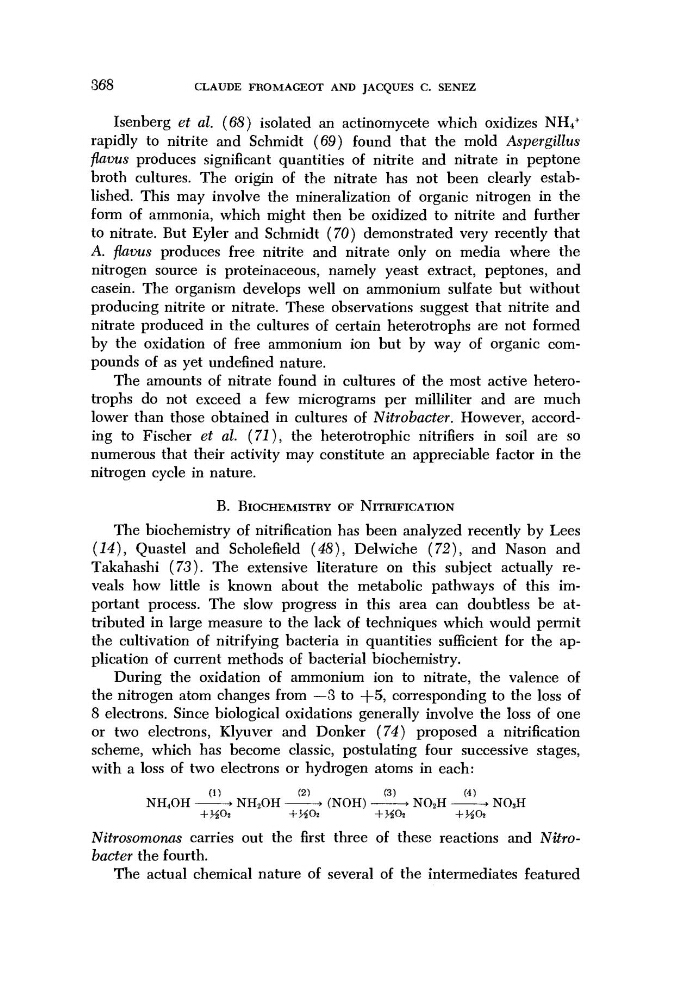
or two electrons, Klyuver and Donker (74) proposed a nitrification
scheme, which has become classic, postulating four successive stages,
with a loss of two electrons or hydrogen atoms in each:
(1)
(2)
(3)
(4)
NH 4 OH
> NH 2 OH
> (NOH)
> N0 2 H
> ΝΟ3Η
+ΗΟ2
+KO2
+HO2
+ΚΟ2
Nitrosomonas carries out the first three of these reactions and Nitrobacter the fourth.
The actual chemical nature of several of the intermediates featured
CLAUDE FROMAGEOT AND JACQUES C. SENEZ
Isenberg et al. (68) isolated an actinomycete which oxidizes NH 4
+
rapidly to nitrite and Schmidt (69) found that the mold Aspergillus
flavus produces significant quantities of nitrite and nitrate in peptone
broth cultures. The origin of the nitrate has not been clearly established. This may involve the mineralization of organic nitrogen in the
form of ammonia, which might then be oxidized to nitrite and further
to nitrate. But Eyler and Schmidt (70) demonstrated very recently that
A. flavus produces free nitrite and nitrate only on media where the
nitrogen source is proteinaceous, namely yeast extract, peptones, and
casein. The organism develops well on ammonium sulfate but without
producing nitrite or nitrate. These observations suggest that nitrite and
nitrate produced in the cultures of certain heterotrophs are not formed
by the oxidation of free ammonium ion but by way of organic compounds of as yet undefined nature.
The amounts of nitrate found in cultures of the most active heterotrophs do not exceed a few micrograms per milliliter and are much
lower than those obtained in cultures of Nitrobacter. However, according to Fischer et al. (71), the heterotrophic nitrifiers in soil are so
numerous that their activity may constitute an appreciable factor in the
nitrogen cycle in nature.
B. BIOCHEMISTRY OF NITRIFICATION
The biochemistry of nitrification has been analyzed recently by Lees
(14), Quastel and Scholefield (48), Delwiche (72), and Nason and
Takahashi (73). The extensive literature on this subject actually reveals how little is known about the metabolic pathways of this important process. The slow progress in this area can doubtless be attributed in large measure to the lack of techniques which would permit
the cultivation of nitrifying bacteria in quantities sufficient for the application of current methods of bacterial biochemistry.
During the oxidation of ammonium ion to nitrate, the valence of
the nitrogen atom changes from —3 to +5, corresponding to the loss of
8 electrons. Since biological oxidations generally involve the loss of one
or two electrons, Klyuver and Donker (74) proposed a nitrification
scheme, which has become classic, postulating four successive stages,
with a loss of two electrons or hydrogen atoms in each:
(1)
(2)
(3)
(4)
NH 4 OH
> NH 2 OH
> (NOH)
> N0 2 H
> ΝΟ3Η
+ΗΟ2
+KO2
+HO2
+ΚΟ2
Nitrosomonas carries out the first three of these reactions and Nitrobacter the fourth.
The actual chemical nature of several of the intermediates featured