

362
CLAUDE FROMAGEOT AND JACQUES C. SENEZ
by this organism to yield oxaloacetate by an enzymatic process identical
with the Pomerantz reaction (28). Therefore, a double mechanism
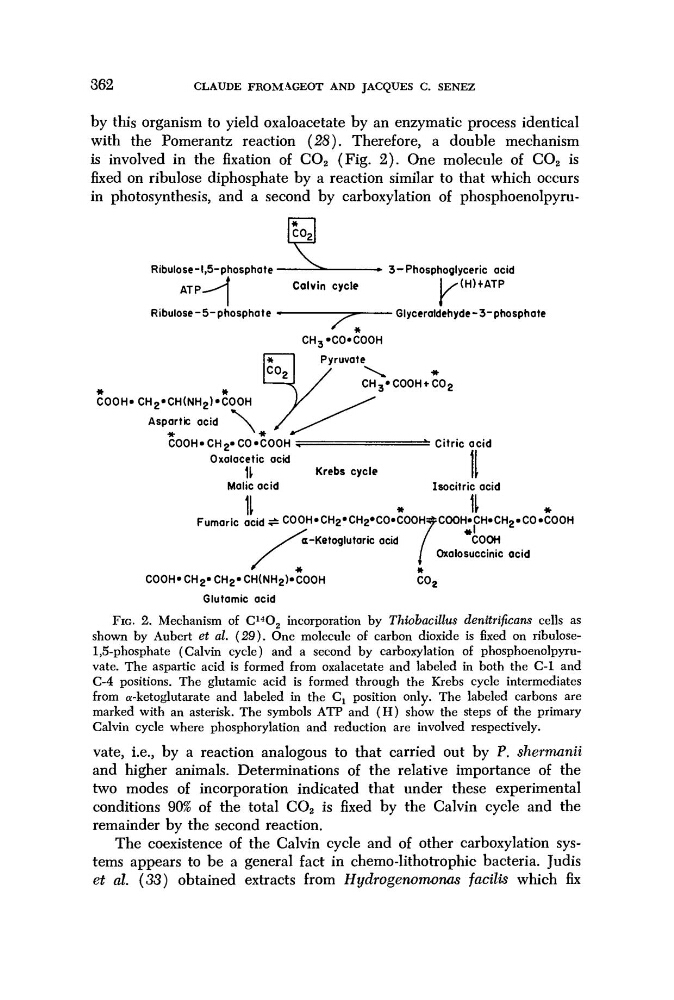
is involved in the fixation of C0 2 (Fig. 2). One molecule of C0 2 is
fixed on ribulose diphosphate by a reaction similar to that which occurs
in photosynthesis, and a second by carboxylation of phosphoenolpyruco 2
Ribulose-l,5-phosphate
^
+ 3-Phosphoglyceric acid
ATP-^f
Calvin cycle
|/(H)+ATP
Ribulose-5-phosphate
^
r
■ Glyceraldehyde-3-phosphate
CH3«C0»C00H
Pyruvate
COOH· CH2
# CH(NH2)»COOH
Aspartic acid
\^
C00H»CH2»C0»C00H
=
Oxalacetic acid
\[
Krebs cycle
Malic acid
CH3«COOHtC02
Citric acid
lsocitric acid
Fumaric acid ^ C00H«CH2»CH2*C0»C00H^C0OH»CH»CH2«CO«CO0H
a-Ketoglutaric acid
COOH
Oxalosuccinic acid
COOH· CH2· CH2· CH(NH2)»C00H
Glutamic acid
FIG. 2. Mechanism of C
14 0 2 incorporation by Thiobacillus denitrificans cells as
shown by Aubert et al. (29). One molecule of carbon dioxide is fixed on ribulose1,5-phosphate (Calvin cycle) and a second by carboxylation of phosphoenolpyruvate. The aspartic acid is formed from oxalacetate and labeled in both the C-1 and
C-4 positions. The glutamic acid is formed through the Krebs cycle intermediates
from α-ketoglutarate and labeled in the C x position only. The labeled carbons are
marked with an asterisk. The symbols ATP and (H) show the steps of the primary
Calvin cycle where phosphorylation and reduction are involved respectively.
vate, i.e., by a reaction analogous to that carried out by P. shermanii
and higher animals. Determinations of the relative importance of the
two modes of incorporation indicated that under these experimental
conditions 90% of the total C0 2 is fixed by the Calvin cycle and the
remainder by the second reaction.
The coexistence of the Calvin cycle and of other carboxylation systems appears to be a general fact in chemo-lithotrophic bacteria. Judis
et al. (33) obtained extracts from Hydrogenomonas facilis which fix
CLAUDE FROMAGEOT AND JACQUES C. SENEZ
by this organism to yield oxaloacetate by an enzymatic process identical
with the Pomerantz reaction (28). Therefore, a double mechanism
is involved in the fixation of C0 2 (Fig. 2). One molecule of C0 2 is
fixed on ribulose diphosphate by a reaction similar to that which occurs
in photosynthesis, and a second by carboxylation of phosphoenolpyruco 2
Ribulose-l,5-phosphate
^
+ 3-Phosphoglyceric acid
ATP-^f
Calvin cycle
|/(H)+ATP
Ribulose-5-phosphate
^
r
■ Glyceraldehyde-3-phosphate
CH3«C0»C00H
Pyruvate
COOH· CH2
# CH(NH2)»COOH
Aspartic acid
\^
C00H»CH2»C0»C00H
=
Oxalacetic acid
\[
Krebs cycle
Malic acid
CH3«COOHtC02
Citric acid
lsocitric acid
Fumaric acid ^ C00H«CH2»CH2*C0»C00H^C0OH»CH»CH2«CO«CO0H
a-Ketoglutaric acid
COOH
Oxalosuccinic acid
COOH· CH2· CH2· CH(NH2)»C00H
Glutamic acid
FIG. 2. Mechanism of C
14 0 2 incorporation by Thiobacillus denitrificans cells as
shown by Aubert et al. (29). One molecule of carbon dioxide is fixed on ribulose1,5-phosphate (Calvin cycle) and a second by carboxylation of phosphoenolpyruvate. The aspartic acid is formed from oxalacetate and labeled in both the C-1 and
C-4 positions. The glutamic acid is formed through the Krebs cycle intermediates
from α-ketoglutarate and labeled in the C x position only. The labeled carbons are
marked with an asterisk. The symbols ATP and (H) show the steps of the primary
Calvin cycle where phosphorylation and reduction are involved respectively.
vate, i.e., by a reaction analogous to that carried out by P. shermanii
and higher animals. Determinations of the relative importance of the
two modes of incorporation indicated that under these experimental
conditions 90% of the total C0 2 is fixed by the Calvin cycle and the
remainder by the second reaction.
The coexistence of the Calvin cycle and of other carboxylation systems appears to be a general fact in chemo-lithotrophic bacteria. Judis
et al. (33) obtained extracts from Hydrogenomonas facilis which fix