

8. REACTIONS OF INORGANIC SUBSTANCES
361
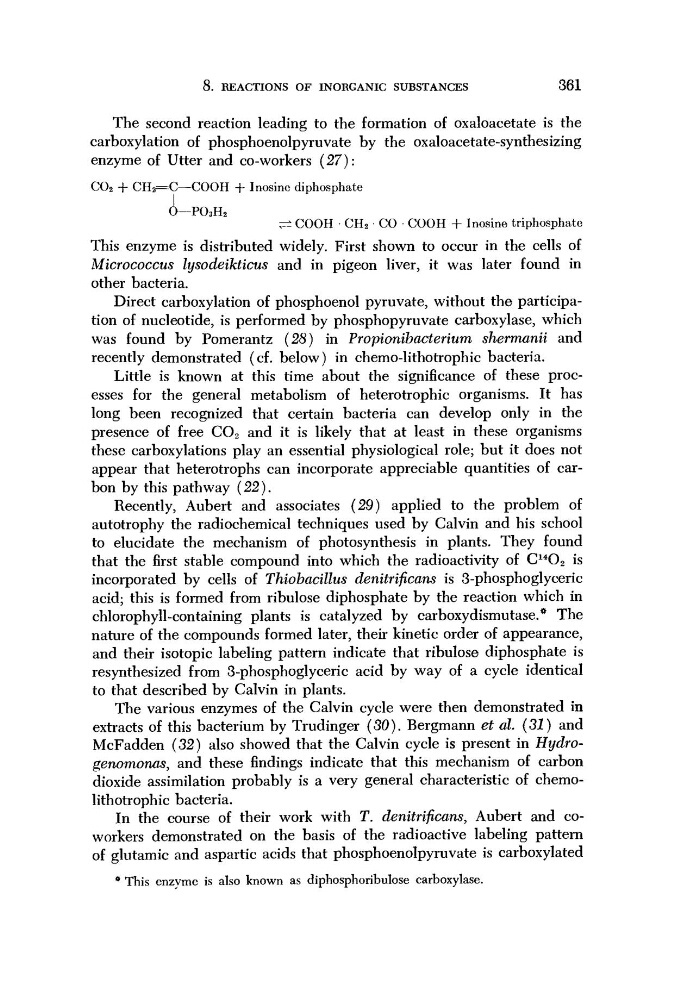
The second reaction leading to the formation of oxaloacetate is the
carboxylation of phosphoenolpyruvate by the oxaloacetate-synthesizing
enzyme of Utter and co-workers (27):
C0 2 + CH 2 =C—COOH + Inosine diphosphate
O—P0 3 H 2
^± COOH · CH 2 · CO · COOH + Inosine triphosphate
This enzyme is distributed widely. First shown to occur in the cells of
Micrococcus lysodeikticus and in pigeon liver, it was later found in
other bacteria.
Direct carboxylation of phosphoenol pyruvate, without the participation of nucleotide, is performed by phosphopyruvate carboxylase, which
was found by Pomerantz (28) in Propionibacterium shermanii and
recently demonstrated (cf. below) in chemo-lithotrophic bacteria.
Little is known at this time about the significance of these processes for the general metabolism of heterotrophic organisms. It has
long been recognized that certain bacteria can develop only in the
presence of free C0 2 and it is likely that at least in these organisms
these carboxylations play an essential physiological role; but it does not
appear that heterotrophs can incorporate appreciable quantities of carbon by this pathway (22).
Recently, Aubert and associates (29) applied to the problem of
autotrophy the radiochemical techniques used by Calvin and his school
to elucidate the mechanism of photosynthesis in plants. They found
that the first stable compound into which the radioactivity of C
14 0 2 is
incorporated by cells of Thiobacillus denitrificans is 3-phosphoglyceric
acid; this is formed from ribulose diphosphate by the reaction which in
chlorophyll-containing plants is catalyzed by carboxydismutase.* The
nature of the compounds formed later, their kinetic order of appearance,
and their isotopic labeling pattern indicate that ribulose diphosphate is
resynthesized from 3-phosphoglyceric acid by way of a cycle identical
to that described by Calvin in plants.
The various enzymes of the Calvin cycle were then demonstrated in
extracts of this bacterium by Trudinger (30). Bergmann et dl. (31) and
McFadden (32) also showed that the Calvin cycle is present in Hydrogenomonas, and these findings indicate that this mechanism of carbon
dioxide assimilation probably is a very general characteristic of chemolithotrophic bacteria.
In the course of their work with T. denitrificans, Aubert and coworkers demonstrated on the basis of the radioactive labeling pattern
of glutamic and aspartic acids that phosphoenolpyruvate is carboxylated
* This enzyme is also known as diphosphoribulose carboxylase.
361
The second reaction leading to the formation of oxaloacetate is the
carboxylation of phosphoenolpyruvate by the oxaloacetate-synthesizing
enzyme of Utter and co-workers (27):
C0 2 + CH 2 =C—COOH + Inosine diphosphate
O—P0 3 H 2
^± COOH · CH 2 · CO · COOH + Inosine triphosphate
This enzyme is distributed widely. First shown to occur in the cells of
Micrococcus lysodeikticus and in pigeon liver, it was later found in
other bacteria.
Direct carboxylation of phosphoenol pyruvate, without the participation of nucleotide, is performed by phosphopyruvate carboxylase, which
was found by Pomerantz (28) in Propionibacterium shermanii and
recently demonstrated (cf. below) in chemo-lithotrophic bacteria.
Little is known at this time about the significance of these processes for the general metabolism of heterotrophic organisms. It has
long been recognized that certain bacteria can develop only in the
presence of free C0 2 and it is likely that at least in these organisms
these carboxylations play an essential physiological role; but it does not
appear that heterotrophs can incorporate appreciable quantities of carbon by this pathway (22).
Recently, Aubert and associates (29) applied to the problem of
autotrophy the radiochemical techniques used by Calvin and his school
to elucidate the mechanism of photosynthesis in plants. They found
that the first stable compound into which the radioactivity of C
14 0 2 is
incorporated by cells of Thiobacillus denitrificans is 3-phosphoglyceric
acid; this is formed from ribulose diphosphate by the reaction which in
chlorophyll-containing plants is catalyzed by carboxydismutase.* The
nature of the compounds formed later, their kinetic order of appearance,
and their isotopic labeling pattern indicate that ribulose diphosphate is
resynthesized from 3-phosphoglyceric acid by way of a cycle identical
to that described by Calvin in plants.
The various enzymes of the Calvin cycle were then demonstrated in
extracts of this bacterium by Trudinger (30). Bergmann et dl. (31) and
McFadden (32) also showed that the Calvin cycle is present in Hydrogenomonas, and these findings indicate that this mechanism of carbon
dioxide assimilation probably is a very general characteristic of chemolithotrophic bacteria.
In the course of their work with T. denitrificans, Aubert and coworkers demonstrated on the basis of the radioactive labeling pattern
of glutamic and aspartic acids that phosphoenolpyruvate is carboxylated
* This enzyme is also known as diphosphoribulose carboxylase.