

8. REACTIONS OF INORGANIC SUBSTANCES
349
fraction of the total energy changes of heterotrophic organisms; it is not
yet known whether this energy is available for biosynthetic functions.
Biochemical reactions yielding free energy from inorganic substrates
are essentially oxidative and, by analogy with the nutritional nomenclature of bacteria, it is convenient to call them litho-oxidations. As in
the case of biological oxidations of organic substances, they can be
represented by the general equation
Z>H 2 + A -> D + AR 2 + energy
where DH 2 and D are the initial and final states of an hydrogen or electron donor, and A and AH 2 are the oxidized and reduced forms of an
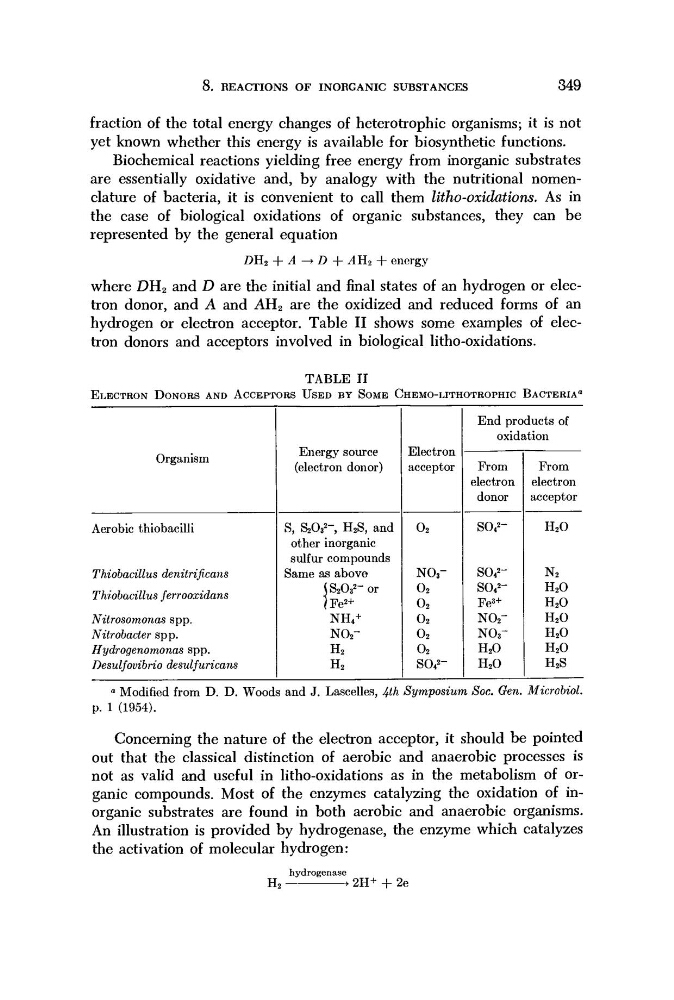
hydrogen or electron acceptor. Table II shows some examples of electron donors and acceptors involved in biological litho-oxidations.
TABLE II
ELECTRON DONORS AND ACCEPTORS USED BY SOME CHEMO-LITHOTROPHIC BACTERIA
0
Organism
Aerobic thiobacilli
Thiobacillus denitrificans
Thiobacillus ferrooxidans
Nitrosomonas spp.
Nitrobacter spp.
Hydrogenomonas spp.
Desulfovibrio desulfuricans
Energy source
(electron donor)
S, S 2 0 3
2 - H 2 S, and
other inorganic
sulfur compounds
Same as above
(S 2 0 3
2 -or
/Fe
2+
NH 4
+
NOr
H 2
H 2
Electron
acceptor
o 2
NO3o 2
o 2
o 2
o 2
o 2
S0 4
2 -
End products of
oxidation
From
electron
donor
S0 4
2 -
S0 4
2 "
S0 4
2 -
Fe
3+
N0 2 -
NO3H 2 0
H 2 0
From
electron
acceptor
H 2 0
N 2
H 2 0
H 2 0
H 2 0
H 2 0
H 2 0
H 2 S
a Modified from D. D. Woods and J. Lascelles, Ifii Symposium Soc. Gen. Microbiol.
p. 1 (1954).
Concerning the nature of the electron acceptor, it should be pointed
out that the classical distinction of aerobic and anaerobic processes is
not as valid and useful in litho-oxidations as in the metabolism of organic compounds. Most of the enzymes catalyzing the oxidation of inorganic substrates are found in both aerobic and anaerobic organisms.
An illustration is provided by hydrogenase, the enzyme which catalyzes
the activation of molecular hydrogen:
hydrogenase
H 2
> 2H
+ + 2e
349
fraction of the total energy changes of heterotrophic organisms; it is not
yet known whether this energy is available for biosynthetic functions.
Biochemical reactions yielding free energy from inorganic substrates
are essentially oxidative and, by analogy with the nutritional nomenclature of bacteria, it is convenient to call them litho-oxidations. As in
the case of biological oxidations of organic substances, they can be
represented by the general equation
Z>H 2 + A -> D + AR 2 + energy
where DH 2 and D are the initial and final states of an hydrogen or electron donor, and A and AH 2 are the oxidized and reduced forms of an
hydrogen or electron acceptor. Table II shows some examples of electron donors and acceptors involved in biological litho-oxidations.
TABLE II
ELECTRON DONORS AND ACCEPTORS USED BY SOME CHEMO-LITHOTROPHIC BACTERIA
0
Organism
Aerobic thiobacilli
Thiobacillus denitrificans
Thiobacillus ferrooxidans
Nitrosomonas spp.
Nitrobacter spp.
Hydrogenomonas spp.
Desulfovibrio desulfuricans
Energy source
(electron donor)
S, S 2 0 3
2 - H 2 S, and
other inorganic
sulfur compounds
Same as above
(S 2 0 3
2 -or
/Fe
2+
NH 4
+
NOr
H 2
H 2
Electron
acceptor
o 2
NO3o 2
o 2
o 2
o 2
o 2
S0 4
2 -
End products of
oxidation
From
electron
donor
S0 4
2 -
S0 4
2 "
S0 4
2 -
Fe
3+
N0 2 -
NO3H 2 0
H 2 0
From
electron
acceptor
H 2 0
N 2
H 2 0
H 2 0
H 2 0
H 2 0
H 2 0
H 2 S
a Modified from D. D. Woods and J. Lascelles, Ifii Symposium Soc. Gen. Microbiol.
p. 1 (1954).
Concerning the nature of the electron acceptor, it should be pointed
out that the classical distinction of aerobic and anaerobic processes is
not as valid and useful in litho-oxidations as in the metabolism of organic compounds. Most of the enzymes catalyzing the oxidation of inorganic substrates are found in both aerobic and anaerobic organisms.
An illustration is provided by hydrogenase, the enzyme which catalyzes
the activation of molecular hydrogen:
hydrogenase
H 2
> 2H
+ + 2e