

7. THE DISTRIBUTION AND EVOLUTION OF VISUAL SYSTEMS
333
Crescitelli's animals, however, were newly metamorphosed from the
larval condition, on their journey downstream, whereas mine had been
at the other end of their life cycle, mature animals migrating upstream
from the ocean to spawn. In the following year, on collecting animals
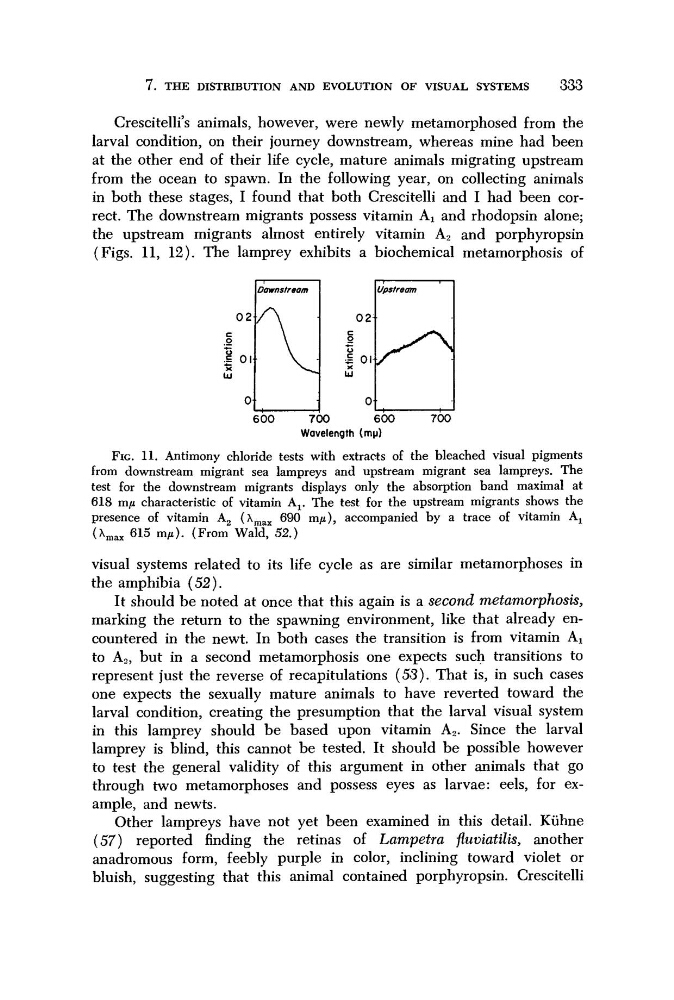
in both these stages, I found that both Crescitelli and I had been correct. The downstream migrants possess vitamin A ± and rhodopsin alone;
the upstream migrants almost entirely vitamin A 2 and porphyropsin
(Figs. 11, 12). The lamprey exhibits a biochemical metamorphosis of
600
700
600
700
Wavelength (mp)
FIG. 11. Antimony chloride tests with extracts of the bleached visual pigments
from downstream migrant sea lampreys and upstream migrant sea lampreys. The
test for the downstream migrants displays only the absorption band maximal at
618 m/i characteristic of vitamin A x . The test for the upstream migrants shows the
presence of vitamin A 2 (X max 690 τημ), accompanied by a trace of vitamin A x
(X max 615 πιμ). (From Wald, 52.)
visual systems related to its life cycle as are similar metamorphoses in
the amphibia (52).
It should be noted at once that this again is a second metamorphosis,
marking the return to the spawning environment, like that already encountered in the newt. In both cases the transition is from vitamin A x
to A 2 , but in a second metamorphosis one expects such transitions to
represent just the reverse of recapitulations (53). That is, in such cases
one expects the sexually mature animals to have reverted toward the
larval condition, creating the presumption that the larval visual system
in this lamprey should be based upon vitamin A 2 . Since the larval
lamprey is blind, this cannot be tested. It should be possible however
to test the general validity of this argument in other animals that go
through two metamorphoses and possess eyes as larvae: eels, for example, and newts.
Other lampreys have not yet been examined in this detail. Kühne
(57) reported finding the retinas of Lampetra fluviatilis, another
anadromous form, feebly purple in color, inclining toward violet or
bluish, suggesting that this animal contained porphyropsin. Crescitelli
333
Crescitelli's animals, however, were newly metamorphosed from the
larval condition, on their journey downstream, whereas mine had been
at the other end of their life cycle, mature animals migrating upstream
from the ocean to spawn. In the following year, on collecting animals
in both these stages, I found that both Crescitelli and I had been correct. The downstream migrants possess vitamin A ± and rhodopsin alone;
the upstream migrants almost entirely vitamin A 2 and porphyropsin
(Figs. 11, 12). The lamprey exhibits a biochemical metamorphosis of
600
700
600
700
Wavelength (mp)
FIG. 11. Antimony chloride tests with extracts of the bleached visual pigments
from downstream migrant sea lampreys and upstream migrant sea lampreys. The
test for the downstream migrants displays only the absorption band maximal at
618 m/i characteristic of vitamin A x . The test for the upstream migrants shows the
presence of vitamin A 2 (X max 690 τημ), accompanied by a trace of vitamin A x
(X max 615 πιμ). (From Wald, 52.)
visual systems related to its life cycle as are similar metamorphoses in
the amphibia (52).
It should be noted at once that this again is a second metamorphosis,
marking the return to the spawning environment, like that already encountered in the newt. In both cases the transition is from vitamin A x
to A 2 , but in a second metamorphosis one expects such transitions to
represent just the reverse of recapitulations (53). That is, in such cases
one expects the sexually mature animals to have reverted toward the
larval condition, creating the presumption that the larval visual system
in this lamprey should be based upon vitamin A 2 . Since the larval
lamprey is blind, this cannot be tested. It should be possible however
to test the general validity of this argument in other animals that go
through two metamorphoses and possess eyes as larvae: eels, for example, and newts.
Other lampreys have not yet been examined in this detail. Kühne
(57) reported finding the retinas of Lampetra fluviatilis, another
anadromous form, feebly purple in color, inclining toward violet or
bluish, suggesting that this animal contained porphyropsin. Crescitelli