

7. THE DISTRIBUTION AND EVOLUTION OF VISUAL SYSTEMS
331
Since all these patterns are genetic, one can hardly avoid asking
whether this distribution has some connection with phylogeny. This is
always a dangerous question, but worth asking if only for the stimulation it affords.
Many paleontologists agree that the vertebrate stock arose in fresh
water. The whole of vertebrate evolution, from this point of view, may
be regarded as involving occasional migrations from this ancestral environment in two directions: to the sea, to produce the marine fishes;
and to land, to yield the reptiles, birds, and mammals. Interpolated
between freshwater and marine fishes are the euryhaline forms. Interpolated between freshwater fishes and land vertebrates are the amphibia.
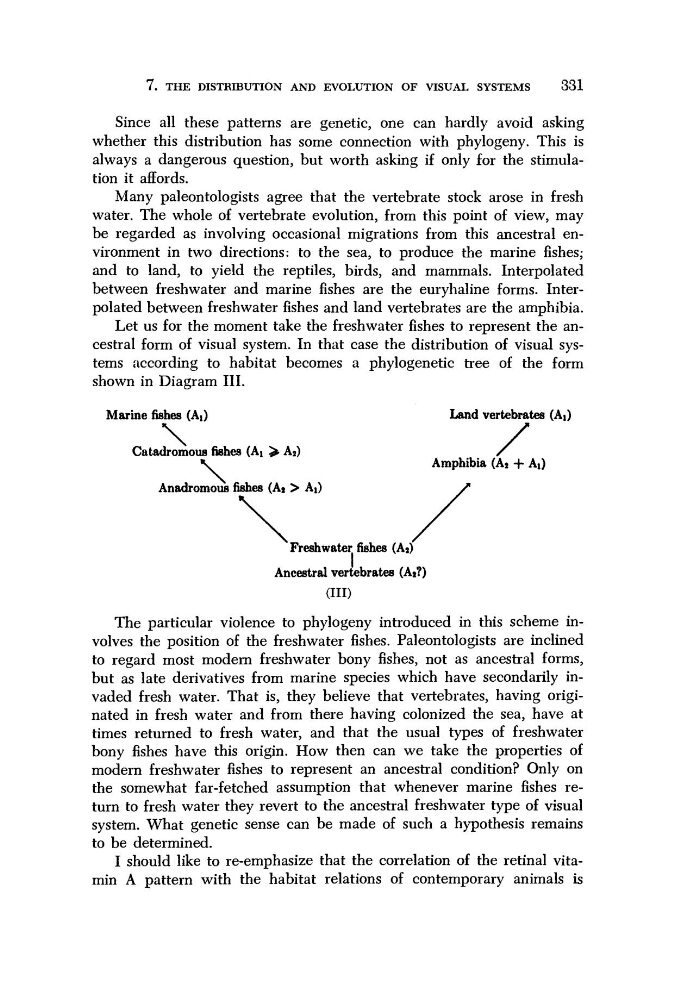
Let us for the moment take the freshwater fishes to represent the ancestral form of visual system. In that case the distribution of visual systems according to habitat becomes a phylogenetic tree of the form
shown in Diagram III.
Marine fishes (A t )
Land vertebrates (A t )
\
Catadromous fishes (Ai > A 2 )
V
Amphibia (A* + Ai)
Anadromous fishes (A* > Ai)
>■
Freshwater fishes (A 2 )
Ancestral vertebrates (Aj?)
(Ill)
The particular violence to phylogeny introduced in this scheme involves the position of the freshwater fishes. Paleontologists are inclined
to regard most modern freshwater bony fishes, not as ancestral forms,
but as late derivatives from marine species which have secondarily invaded fresh water. That is, they believe that vertebrates, having originated in fresh water and from there having colonized the sea, have at
times returned to fresh water, and that the usual types of freshwater
bony fishes have this origin. How then can we take the properties of
modern freshwater fishes to represent an ancestral condition? Only on
the somewhat far-fetched assumption that whenever marine fishes return to fresh water they revert to the ancestral freshwater type of visual
system. What genetic sense can be made of such a hypothesis remains
to be determined.
I should like to re-emphasize that the correlation of the retinal vitamin A pattern with the habitat relations of contemporary animals is
/
\
331
Since all these patterns are genetic, one can hardly avoid asking
whether this distribution has some connection with phylogeny. This is
always a dangerous question, but worth asking if only for the stimulation it affords.
Many paleontologists agree that the vertebrate stock arose in fresh
water. The whole of vertebrate evolution, from this point of view, may
be regarded as involving occasional migrations from this ancestral environment in two directions: to the sea, to produce the marine fishes;
and to land, to yield the reptiles, birds, and mammals. Interpolated
between freshwater and marine fishes are the euryhaline forms. Interpolated between freshwater fishes and land vertebrates are the amphibia.
Let us for the moment take the freshwater fishes to represent the ancestral form of visual system. In that case the distribution of visual systems according to habitat becomes a phylogenetic tree of the form
shown in Diagram III.
Marine fishes (A t )
Land vertebrates (A t )
\
Catadromous fishes (Ai > A 2 )
V
Amphibia (A* + Ai)
Anadromous fishes (A* > Ai)
>■
Freshwater fishes (A 2 )
Ancestral vertebrates (Aj?)
(Ill)
The particular violence to phylogeny introduced in this scheme involves the position of the freshwater fishes. Paleontologists are inclined
to regard most modern freshwater bony fishes, not as ancestral forms,
but as late derivatives from marine species which have secondarily invaded fresh water. That is, they believe that vertebrates, having originated in fresh water and from there having colonized the sea, have at
times returned to fresh water, and that the usual types of freshwater
bony fishes have this origin. How then can we take the properties of
modern freshwater fishes to represent an ancestral condition? Only on
the somewhat far-fetched assumption that whenever marine fishes return to fresh water they revert to the ancestral freshwater type of visual
system. What genetic sense can be made of such a hypothesis remains
to be determined.
I should like to re-emphasize that the correlation of the retinal vitamin A pattern with the habitat relations of contemporary animals is
/
\