

7. THE DISTRIBUTION AND EVOLUTION OF VISUAL SYSTEMS
315
pigeon, which are best characterized; that of cyanopsin is for the synthetic product (12); it lies close to the maximum spectral sensitivity of
cone vision in the Greek tortoise and the tench, as measured by Granit
(13).
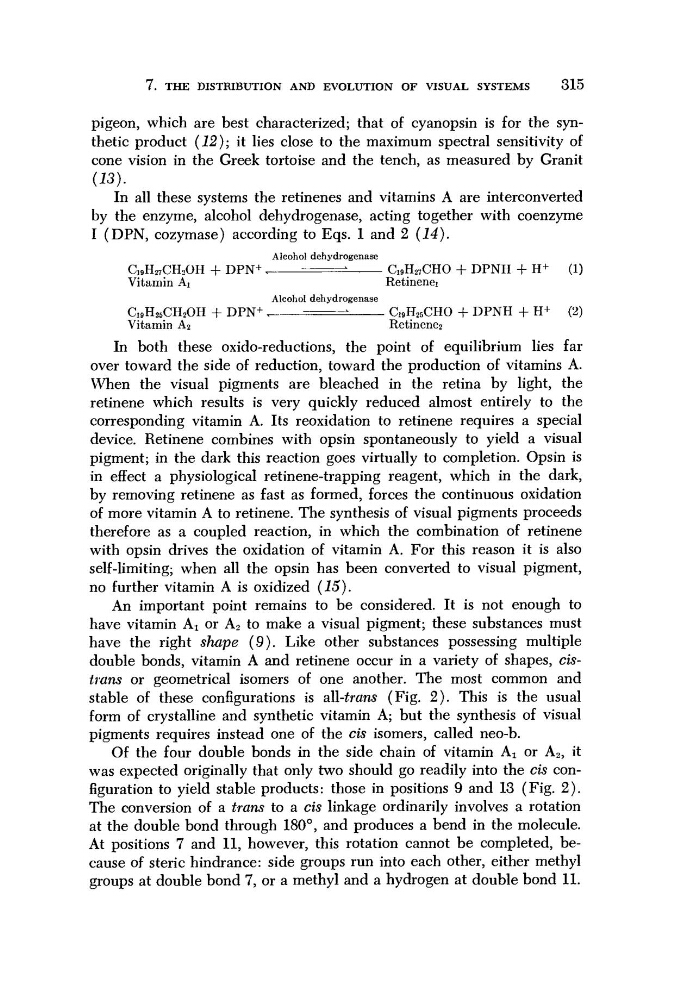
In all these systems the retinenes and vitamins A are interconverted
by the enzyme, alcohol dehydrogenase, acting together with coenzyme
I (DPN, cozymase) according to Eqs. 1 and 2 (14).
Alcohol dehydrogenase
C 19 H 27 CH 2 OH + DPN+ ,
==±
C 19 H 27 CHO + DPNH + H+ (1)
Vitamin Ai
Retinenei
Alcohol dehydrogenase
C M H tt CH 2 OH + DPN+ ,
d 9 H 25 CHO + DPNH + H+ (2)
Vitamin A 2
Retinene 2
In both these oxido-reductions, the point of equilibrium lies far
over toward the side of reduction, toward the production of vitamins A.
When the visual pigments are bleached in the retina by light, the
retinene which results is very quickly reduced almost entirely to the
corresponding vitamin A. Its reoxidation to retinene requires a special
device. Retinene combines with opsin spontaneously to yield a visual
pigment; in the dark this reaction goes virtually to completion. Opsin is
in effect a physiological retinene-trapping reagent, which in the dark,
by removing retinene as fast as formed, forces the continuous oxidation
of more vitamin A to retinene. The synthesis of visual pigments proceeds
therefore as a coupled reaction, in which the combination of retinene
with opsin drives the oxidation of vitamin A. For this reason it is also
self-limiting; when all the opsin has been converted to visual pigment,
no further vitamin A is oxidized (15).
An important point remains to be considered. It is not enough to
have vitamin Ai or A 2 to make a visual pigment; these substances must
have the right shape (9). Like other substances possessing multiple
double bonds, vitamin A and retinene occur in a variety of shapes, cistrans or geometrical isomers of one another. The most common and
stable of these configurations is all-trans (Fig. 2). This is the usual
form of crystalline and synthetic vitamin A; but the synthesis of visual
pigments requires instead one of the eis isomers, called neo-b.
Of the four double bonds in the side chain of vitamin Ai or A 2 , it
was expected originally that only two should go readily into the eis configuration to yield stable products: those in positions 9 and 13 (Fig. 2).
The conversion of a trans to a cis linkage ordinarily involves a rotation
at the double bond through 180°, and produces a bend in the molecule.
At positions 7 and 11, however, this rotation cannot be completed, because of steric hindrance: side groups run into each other, either methyl
groups at double bond 7, or a methyl and a hydrogen at double bond 11.
315
pigeon, which are best characterized; that of cyanopsin is for the synthetic product (12); it lies close to the maximum spectral sensitivity of
cone vision in the Greek tortoise and the tench, as measured by Granit
(13).
In all these systems the retinenes and vitamins A are interconverted
by the enzyme, alcohol dehydrogenase, acting together with coenzyme
I (DPN, cozymase) according to Eqs. 1 and 2 (14).
Alcohol dehydrogenase
C 19 H 27 CH 2 OH + DPN+ ,
==±
C 19 H 27 CHO + DPNH + H+ (1)
Vitamin Ai
Retinenei
Alcohol dehydrogenase
C M H tt CH 2 OH + DPN+ ,
d 9 H 25 CHO + DPNH + H+ (2)
Vitamin A 2
Retinene 2
In both these oxido-reductions, the point of equilibrium lies far
over toward the side of reduction, toward the production of vitamins A.
When the visual pigments are bleached in the retina by light, the
retinene which results is very quickly reduced almost entirely to the
corresponding vitamin A. Its reoxidation to retinene requires a special
device. Retinene combines with opsin spontaneously to yield a visual
pigment; in the dark this reaction goes virtually to completion. Opsin is
in effect a physiological retinene-trapping reagent, which in the dark,
by removing retinene as fast as formed, forces the continuous oxidation
of more vitamin A to retinene. The synthesis of visual pigments proceeds
therefore as a coupled reaction, in which the combination of retinene
with opsin drives the oxidation of vitamin A. For this reason it is also
self-limiting; when all the opsin has been converted to visual pigment,
no further vitamin A is oxidized (15).
An important point remains to be considered. It is not enough to
have vitamin Ai or A 2 to make a visual pigment; these substances must
have the right shape (9). Like other substances possessing multiple
double bonds, vitamin A and retinene occur in a variety of shapes, cistrans or geometrical isomers of one another. The most common and
stable of these configurations is all-trans (Fig. 2). This is the usual
form of crystalline and synthetic vitamin A; but the synthesis of visual
pigments requires instead one of the eis isomers, called neo-b.
Of the four double bonds in the side chain of vitamin Ai or A 2 , it
was expected originally that only two should go readily into the eis configuration to yield stable products: those in positions 9 and 13 (Fig. 2).
The conversion of a trans to a cis linkage ordinarily involves a rotation
at the double bond through 180°, and produces a bend in the molecule.
At positions 7 and 11, however, this rotation cannot be completed, because of steric hindrance: side groups run into each other, either methyl
groups at double bond 7, or a methyl and a hydrogen at double bond 11.