

6. PHOTOTROPISM AND PHOTOTAXIS
295
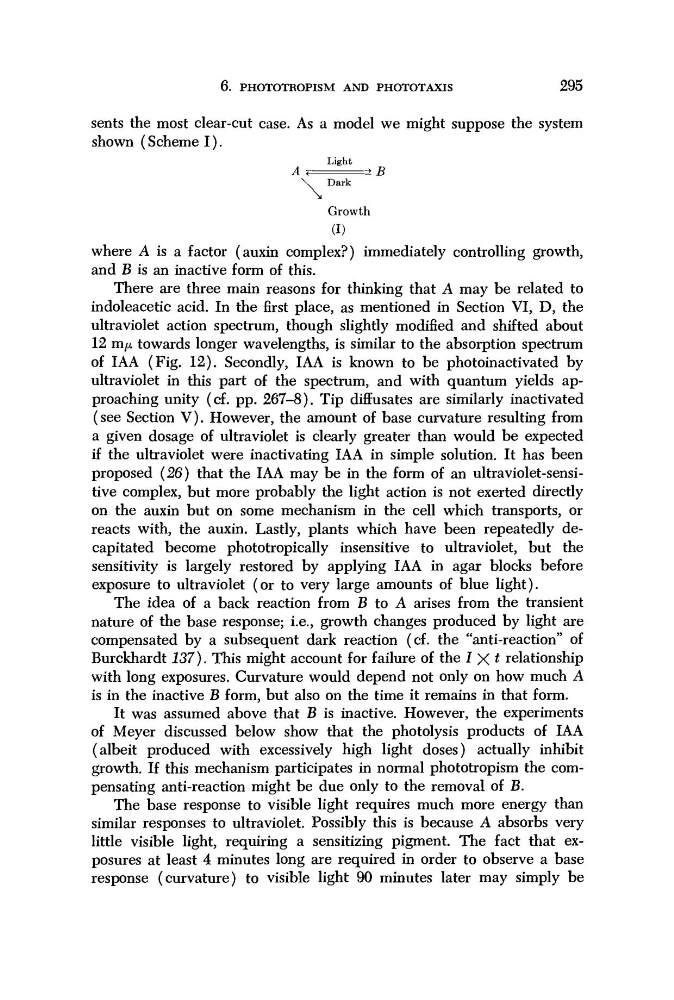
sents the most clear-cut case. As a model we might suppose the system
shown (Scheme I).
Light
A r
±B
\
Dark
Growth
(I)
where A is a factor (auxin complex?) immediately controlling growth,
and B is an inactive form of this.
There are three main reasons for thinking that A may be related to
indoleacetic acid. In the first place, as mentioned in Section VI, D, the
ultraviolet action spectrum, though slightly modified and shifted about
12 π\μ towards longer wavelengths, is similar to the absorption spectrum
of IAA (Fig. 12). Secondly, IAA is known to be photoinactivated by
ultraviolet in this part of the spectrum, and with quantum yields approaching unity (cf. pp. 267-8). Tip diffusates are similarly inactivated
(see Section V). However, the amount of base curvature resulting from
a given dosage of ultraviolet is clearly greater than would be expected
if the ultraviolet were inactivating IAA in simple solution. It has been
proposed (26) that the IAA may be in the form of an ultraviolet-sensitive complex, but more probably the light action is not exerted directly
on the auxin but on some mechanism in the cell which transports, or
reacts with, the auxin. Lastly, plants which have been repeatedly decapitated become phototropically insensitive to ultraviolet, but the
sensitivity is largely restored by applying IAA in agar blocks before
exposure to ultraviolet (or to very large amounts of blue light).
The idea of a back reaction from B to A arises from the transient
nature of the base response; i.e., growth changes produced by light are
compensated by a subsequent dark reaction (cf. the "anti-reaction" of
Burckhardt 137). This might account for failure of the I X t relationship
with long exposures. Curvature would depend not only on how much A
is in the inactive B form, but also on the time it remains in that form.
It was assumed above that B is inactive. However, the experiments
of Meyer discussed below show that the photolysis products of IAA
(albeit produced with excessively high light doses) actually inhibit
growth. If this mechanism participates in normal phototropism the compensating anti-reaction might be due only to the removal of B.
The base response to visible light requires much more energy than
similar responses to ultraviolet. Possibly this is because A absorbs very
little visible light, requiring a sensitizing pigment. The fact that exposures at least 4 minutes long are required in order to observe a base
response (curvature) to visible light 90 minutes later may simply be
295
sents the most clear-cut case. As a model we might suppose the system
shown (Scheme I).
Light
A r
±B
\
Dark
Growth
(I)
where A is a factor (auxin complex?) immediately controlling growth,
and B is an inactive form of this.
There are three main reasons for thinking that A may be related to
indoleacetic acid. In the first place, as mentioned in Section VI, D, the
ultraviolet action spectrum, though slightly modified and shifted about
12 π\μ towards longer wavelengths, is similar to the absorption spectrum
of IAA (Fig. 12). Secondly, IAA is known to be photoinactivated by
ultraviolet in this part of the spectrum, and with quantum yields approaching unity (cf. pp. 267-8). Tip diffusates are similarly inactivated
(see Section V). However, the amount of base curvature resulting from
a given dosage of ultraviolet is clearly greater than would be expected
if the ultraviolet were inactivating IAA in simple solution. It has been
proposed (26) that the IAA may be in the form of an ultraviolet-sensitive complex, but more probably the light action is not exerted directly
on the auxin but on some mechanism in the cell which transports, or
reacts with, the auxin. Lastly, plants which have been repeatedly decapitated become phototropically insensitive to ultraviolet, but the
sensitivity is largely restored by applying IAA in agar blocks before
exposure to ultraviolet (or to very large amounts of blue light).
The idea of a back reaction from B to A arises from the transient
nature of the base response; i.e., growth changes produced by light are
compensated by a subsequent dark reaction (cf. the "anti-reaction" of
Burckhardt 137). This might account for failure of the I X t relationship
with long exposures. Curvature would depend not only on how much A
is in the inactive B form, but also on the time it remains in that form.
It was assumed above that B is inactive. However, the experiments
of Meyer discussed below show that the photolysis products of IAA
(albeit produced with excessively high light doses) actually inhibit
growth. If this mechanism participates in normal phototropism the compensating anti-reaction might be due only to the removal of B.
The base response to visible light requires much more energy than
similar responses to ultraviolet. Possibly this is because A absorbs very
little visible light, requiring a sensitizing pigment. The fact that exposures at least 4 minutes long are required in order to observe a base
response (curvature) to visible light 90 minutes later may simply be