

276
KENNETH V. THIMANN AND GEORGE M. CURRY
Action spectrum determinations in a variety of higher plants have
shown that the region of maximum phototropic sensitivity lies between
420 and 470 τημ. The spectrum falls off much more rapidly toward longer
wavelengths than it does toward the violet. The lack of sensitivity at
wavelengths above 550 τημ extends to mono- and dicotyledons, liverworts, and several fungi (see reference 16). Near ultraviolet has generally proved to be less than half as effective as blue, as shown by
Blaauw (32) and Sonne (96) for Avena, and Castle (97) for Phycomyces. In almost all of the more recent precise determinations two
peaks have appeared in the blue (e.g., Johnston (98), and Galston and
l.40rr
300
320
340
360
380
400
420
Wavelength in π\μ
440
460
480
500
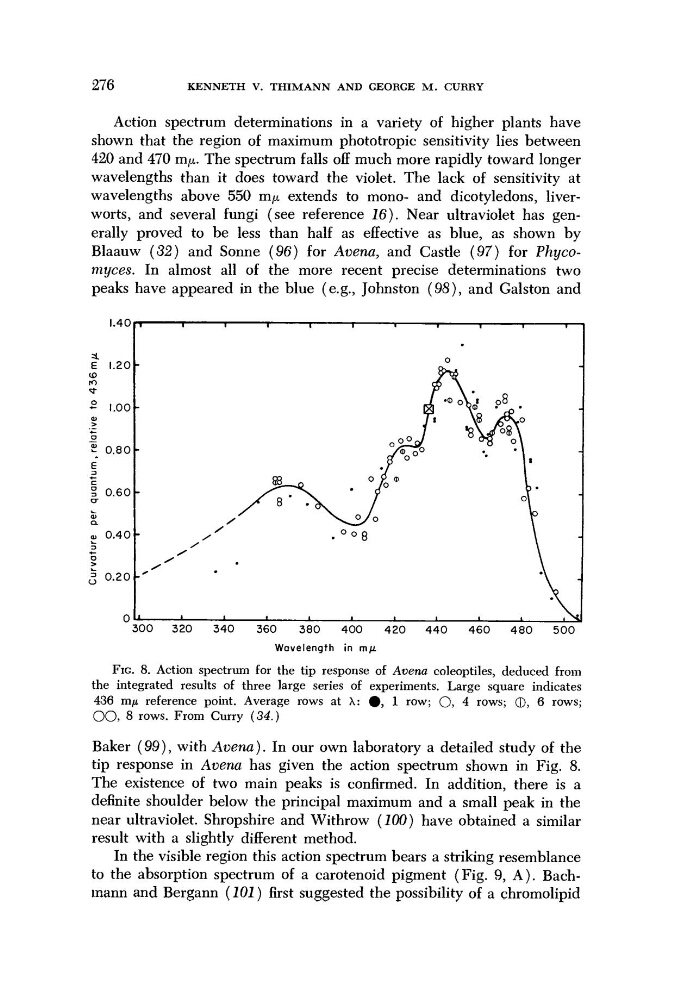
FIG. 8. Action spectrum for the tip response of Avena coleoptiles, deduced from
the integrated results of three large series of experiments. Large square indicates
436 τημ reference point. Average rows at λ: φ, 1 row; O, 4 rows; Q), 6 rows;
OO, 8 rows. From Curry (34.)
Baker (99), with Avena). In our own laboratory a detailed study of the
tip response in Avena has given the action spectrum shown in Fig. 8.
The existence of two main peaks is confirmed. In addition, there is a
definite shoulder below the principal maximum and a small peak in the
near ultraviolet. Shropshire and Withrow (100) have obtained a similar
result with a slightly different method.
In the visible region this action spectrum bears a striking resemblance
to the absorption spectrum of a carotenoid pigment (Fig. 9, A). Bachmann and Bergann (101) first suggested the possibility of a chromolipid
KENNETH V. THIMANN AND GEORGE M. CURRY
Action spectrum determinations in a variety of higher plants have
shown that the region of maximum phototropic sensitivity lies between
420 and 470 τημ. The spectrum falls off much more rapidly toward longer
wavelengths than it does toward the violet. The lack of sensitivity at
wavelengths above 550 τημ extends to mono- and dicotyledons, liverworts, and several fungi (see reference 16). Near ultraviolet has generally proved to be less than half as effective as blue, as shown by
Blaauw (32) and Sonne (96) for Avena, and Castle (97) for Phycomyces. In almost all of the more recent precise determinations two
peaks have appeared in the blue (e.g., Johnston (98), and Galston and
l.40rr
300
320
340
360
380
400
420
Wavelength in π\μ
440
460
480
500
FIG. 8. Action spectrum for the tip response of Avena coleoptiles, deduced from
the integrated results of three large series of experiments. Large square indicates
436 τημ reference point. Average rows at λ: φ, 1 row; O, 4 rows; Q), 6 rows;
OO, 8 rows. From Curry (34.)
Baker (99), with Avena). In our own laboratory a detailed study of the
tip response in Avena has given the action spectrum shown in Fig. 8.
The existence of two main peaks is confirmed. In addition, there is a
definite shoulder below the principal maximum and a small peak in the
near ultraviolet. Shropshire and Withrow (100) have obtained a similar
result with a slightly different method.
In the visible region this action spectrum bears a striking resemblance
to the absorption spectrum of a carotenoid pigment (Fig. 9, A). Bachmann and Bergann (101) first suggested the possibility of a chromolipid