

252
KENNETH V. THIMANN AND GEORGE M. CURRY
utes = "presentation time"). Similarly Ohno (31) found an 8-minute
exposure necessary for a positive response to a certain lamp. On the
other hand Blaauw (32) calculated from his own results that Ohno's
lamp should give observable positive responses with exposures as short
as 1/10 second, and, furthermore, Blaauw found a distinctly graded
response in his system.
A requirement for more precise analysis is a defined stimulus, consisting of exposures for a fixed time to monochromatic light. In this
case the complexity of the response is revealed, and it becomes clear
that more than one reaction is involved.
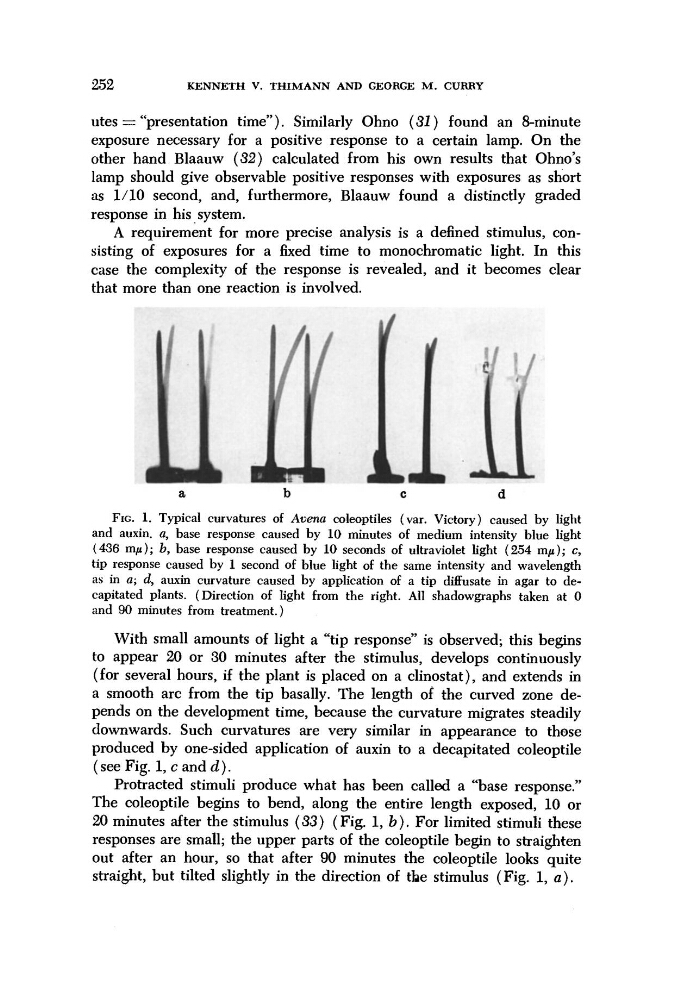
FIG. 1. Typical curvatures of Avena coleoptiles (var. Victory) caused by light
and auxin, a, base response caused by 10 minutes of medium intensity blue light
(436 τημ); b, base response caused by 10 seconds of ultraviolet light (254 m/i); c,
tip response caused by 1 second of blue light of the same intensity and wavelength
as in a; d, auxin curvature caused by application of a tip diffusate in agar to decapitated plants. (Direction of light from the right. All shadowgraphs taken at 0
and 90 minutes from treatment.)
With small amounts of light a "tip response" is observed; this begins
to appear 20 or 30 minutes after the stimulus, develops continuously
(for several hours, if the plant is placed on a clinostat), and extends in
a smooth arc from the tip basally. The length of the curved zone depends on the development time, because the curvature migrates steadily
downwards. Such curvatures are very similar in appearance to those
produced by one-sided application of auxin to a decapitated coleoptile
(see Fig. 1, c and d).
Protracted stimuli produce what has been called a "base response."
The coleoptile begins to bend, along the entire length exposed, 10 or
20 minutes after the stimulus (33) (Fig. 1,6). For limited stimuli these
responses are small; the upper parts of the coleoptile begin to straighten
out after an hour, so that after 90 minutes the coleoptile looks quite
straight, but tilted slightly in the direction of the stimulus (Fig. 1, a).
KENNETH V. THIMANN AND GEORGE M. CURRY
utes = "presentation time"). Similarly Ohno (31) found an 8-minute
exposure necessary for a positive response to a certain lamp. On the
other hand Blaauw (32) calculated from his own results that Ohno's
lamp should give observable positive responses with exposures as short
as 1/10 second, and, furthermore, Blaauw found a distinctly graded
response in his system.
A requirement for more precise analysis is a defined stimulus, consisting of exposures for a fixed time to monochromatic light. In this
case the complexity of the response is revealed, and it becomes clear
that more than one reaction is involved.
FIG. 1. Typical curvatures of Avena coleoptiles (var. Victory) caused by light
and auxin, a, base response caused by 10 minutes of medium intensity blue light
(436 τημ); b, base response caused by 10 seconds of ultraviolet light (254 m/i); c,
tip response caused by 1 second of blue light of the same intensity and wavelength
as in a; d, auxin curvature caused by application of a tip diffusate in agar to decapitated plants. (Direction of light from the right. All shadowgraphs taken at 0
and 90 minutes from treatment.)
With small amounts of light a "tip response" is observed; this begins
to appear 20 or 30 minutes after the stimulus, develops continuously
(for several hours, if the plant is placed on a clinostat), and extends in
a smooth arc from the tip basally. The length of the curved zone depends on the development time, because the curvature migrates steadily
downwards. Such curvatures are very similar in appearance to those
produced by one-sided application of auxin to a decapitated coleoptile
(see Fig. 1, c and d).
Protracted stimuli produce what has been called a "base response."
The coleoptile begins to bend, along the entire length exposed, 10 or
20 minutes after the stimulus (33) (Fig. 1,6). For limited stimuli these
responses are small; the upper parts of the coleoptile begin to straighten
out after an hour, so that after 90 minutes the coleoptile looks quite
straight, but tilted slightly in the direction of the stimulus (Fig. 1, a).