

5. ONIUM COMPOUNDS
235
the liver enzyme is very sensitive to fluoride ions exhibiting, for example, 28% inhibition at 8 X 10
4 M fluoride, while the yeast enzyme is
not inhibited by fluoride at concentrations as high as 2 X 10~
2 M. The
liver enzyme is also more sensitive than the yeast enzyme to inhibition
by one of the products of the reaction, pyrophosphate, although this
difference is difficult to measure precisely because of the effect of pH
upon the inhibition and the fact that different preparations of enzyme
at the same stage of purification differ considerably in their sensitivity
to pyrophosphate inhibition.
Finally while the liver enzyme shows a specific requirement for
Mg
2+ , the yeast enzyme responds when Mn
2+ or other divalent cations
replace Mg
2+ .
3. Biosynthesis of Thiamine
Harris and Yavit (212) have shown that a cell-free extract of bakers'
yeast will catalyze thiamine synthesis according to Reaction 30
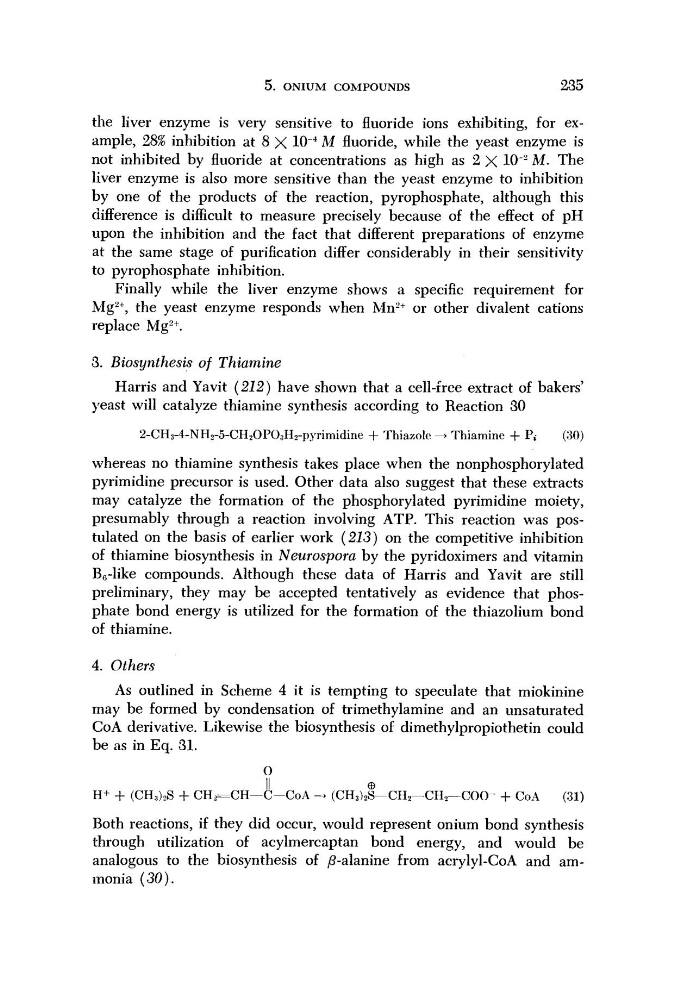
2-CH 3 -4-NH 2 -5-CH 2 OP0 3 H 2 -pyrimidine + Thiazole -* Thiamine + P,
(30)
whereas no thiamine synthesis takes place when the nonphosphorylated
pyrimidine precursor is used. Other data also suggest that these extracts
may catalyze the formation of the phosphorylated pyrimidine moiety,
presumably through a reaction involving ATP. This reaction was postulated on the basis of earlier work (213) on the competitive inhibition
of thiamine biosynthesis in Neurospora by the pyridoximers and vitamin
B 6 -like compounds. Although these data of Harris and Yavit are still
preliminary, they may be accepted tentatively as evidence that phosphate bond energy is utilized for the formation of the thiazolium bond
of thiamine.
4. Others
As outlined in Scheme 4 it is tempting to speculate that miokinine
may be formed by condensation of trimethylamine and an unsaturated
CoA derivative. Likewise the biosynthesis of dimethylpropiothetin could
be as in Eq. 31.
O
II
Θ
H+ + (CH 3 ) 2 S + CH 2 =CH—C—CoA — (CH 3 ) 2 S—CH 2 —CH 2 —COO- + CoA
(31)
Both reactions, if they did occur, would represent onium bond synthesis
through utilization of acylmercaptan bond energy, and would be
analogous to the biosynthesis of /?-alanine from acrylyl-CoA and ammonia (30).
235
the liver enzyme is very sensitive to fluoride ions exhibiting, for example, 28% inhibition at 8 X 10
4 M fluoride, while the yeast enzyme is
not inhibited by fluoride at concentrations as high as 2 X 10~
2 M. The
liver enzyme is also more sensitive than the yeast enzyme to inhibition
by one of the products of the reaction, pyrophosphate, although this
difference is difficult to measure precisely because of the effect of pH
upon the inhibition and the fact that different preparations of enzyme
at the same stage of purification differ considerably in their sensitivity
to pyrophosphate inhibition.
Finally while the liver enzyme shows a specific requirement for
Mg
2+ , the yeast enzyme responds when Mn
2+ or other divalent cations
replace Mg
2+ .
3. Biosynthesis of Thiamine
Harris and Yavit (212) have shown that a cell-free extract of bakers'
yeast will catalyze thiamine synthesis according to Reaction 30
2-CH 3 -4-NH 2 -5-CH 2 OP0 3 H 2 -pyrimidine + Thiazole -* Thiamine + P,
(30)
whereas no thiamine synthesis takes place when the nonphosphorylated
pyrimidine precursor is used. Other data also suggest that these extracts
may catalyze the formation of the phosphorylated pyrimidine moiety,
presumably through a reaction involving ATP. This reaction was postulated on the basis of earlier work (213) on the competitive inhibition
of thiamine biosynthesis in Neurospora by the pyridoximers and vitamin
B 6 -like compounds. Although these data of Harris and Yavit are still
preliminary, they may be accepted tentatively as evidence that phosphate bond energy is utilized for the formation of the thiazolium bond
of thiamine.
4. Others
As outlined in Scheme 4 it is tempting to speculate that miokinine
may be formed by condensation of trimethylamine and an unsaturated
CoA derivative. Likewise the biosynthesis of dimethylpropiothetin could
be as in Eq. 31.
O
II
Θ
H+ + (CH 3 ) 2 S + CH 2 =CH—C—CoA — (CH 3 ) 2 S—CH 2 —CH 2 —COO- + CoA
(31)
Both reactions, if they did occur, would represent onium bond synthesis
through utilization of acylmercaptan bond energy, and would be
analogous to the biosynthesis of /?-alanine from acrylyl-CoA and ammonia (30).