

224
G. L. CANTONI
The sum of Eqs. 21a and 21b is identical with Eq. 21.
Since all attempts to demonstrate the formation of a methylated
enzyme intermediate yielded negative results, it appears that the methyl
group migrates from dimethylthetin to homocysteine directly when one
or both substrates are bound to the enzyme. In the course of studies on
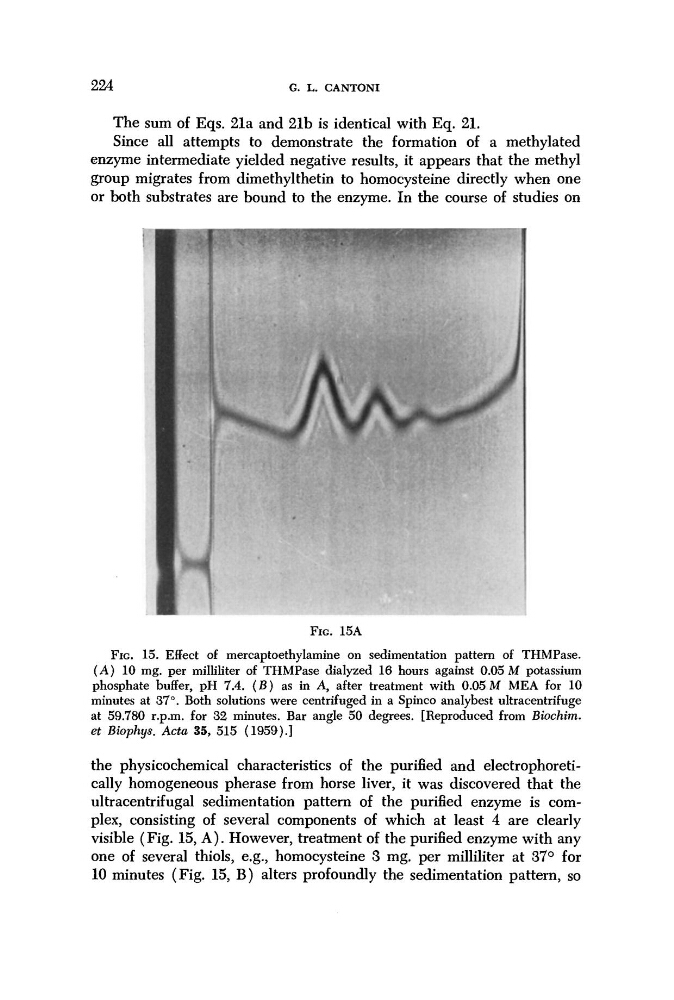
FIG. 15A
FIG. 15. Effect of mercaptoethylamine on sedimentation pattern of THMPase.
(A) 10 mg. per milliliter of THMPase dialyzed 16 hours against 0.05 Af potassium
phosphate buffer, pH 7.4. (B) as in A, after treatment with 0.05 M MEA for 10
minutes at 37°. Both solutions were centrifuged in a Spinco analybest ultracentrifuge
at 59.780 r.p.m. for 32 minutes. Bar angle 50 degrees. [Reproduced from Biochim.
et Biophys. Ada 35, 515 (1959).]
the physicochemical characteristics of the purified and electrophoretically homogeneous pherase from horse liver, it was discovered that the
ultracentrifugal sedimentation pattern of the purified enzyme is complex, consisting of several components of which at least 4 are clearly
visible (Fig. 15, A). However, treatment of the purified enzyme with any
one of several thiols, e.g., homocysteine 3 mg. per milliliter at 37° for
10 minutes (Fig. 15, B) alters profoundly the sedimentation pattern, so
G. L. CANTONI
The sum of Eqs. 21a and 21b is identical with Eq. 21.
Since all attempts to demonstrate the formation of a methylated
enzyme intermediate yielded negative results, it appears that the methyl
group migrates from dimethylthetin to homocysteine directly when one
or both substrates are bound to the enzyme. In the course of studies on
FIG. 15A
FIG. 15. Effect of mercaptoethylamine on sedimentation pattern of THMPase.
(A) 10 mg. per milliliter of THMPase dialyzed 16 hours against 0.05 Af potassium
phosphate buffer, pH 7.4. (B) as in A, after treatment with 0.05 M MEA for 10
minutes at 37°. Both solutions were centrifuged in a Spinco analybest ultracentrifuge
at 59.780 r.p.m. for 32 minutes. Bar angle 50 degrees. [Reproduced from Biochim.
et Biophys. Ada 35, 515 (1959).]
the physicochemical characteristics of the purified and electrophoretically homogeneous pherase from horse liver, it was discovered that the
ultracentrifugal sedimentation pattern of the purified enzyme is complex, consisting of several components of which at least 4 are clearly
visible (Fig. 15, A). However, treatment of the purified enzyme with any
one of several thiols, e.g., homocysteine 3 mg. per milliliter at 37° for
10 minutes (Fig. 15, B) alters profoundly the sedimentation pattern, so