

5. ONIUM COMPOUNDS
223
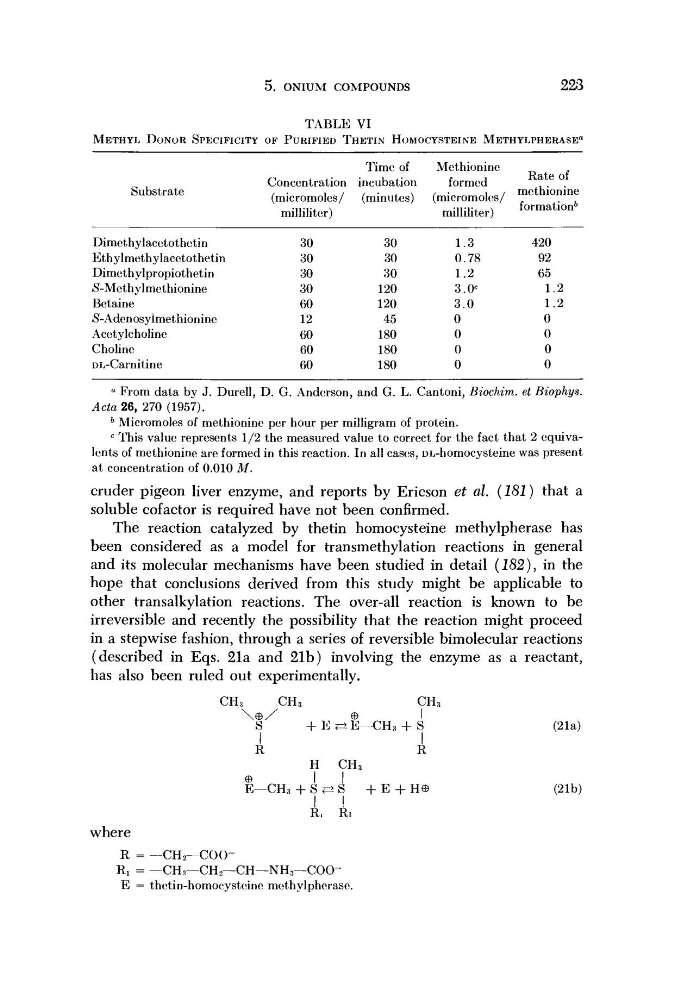
TABLE VI
METHYL DONOR SPECIFICITY OF PURIFIED THETIN HOMOCYSTEINE METHYLPHERASE*
1
Substrate
Dimethylacetothetin
Ethylmethylacetothetin
Dimethylpropiothetin
£-Methylmethionine
Betaine
$-Adenosylmethionine
Acetylcholine
Choline
DL-Carnitine
Concentration
(micromoles/
milliliter)
30
30
30
30
60
12
60
60
60
Time of
incubation
(minutes)
30
30
30
120
120
45
180
180
180
Methionine
formed
(micromoles/
milliliter)
1.3
0.78
1.2
3.0
C
3.0
0
0
0
0
Rate of
methionine
formation
6
420
92
65
1.2
1.2
0
0
0
0
a From data by J. Durell, D. G. Anderson, and G. L. Cantoni, Biochim. et Biophys.
Ada 26, 270 (1957).
b Micromoles of methionine per hour per milligram of protein.
c This value represents 1/2 the measured value to correct for the fact that 2 equivalents of methionine are formed in this reaction. In all cases, DL-homocysteine was present
at concentration of 0.010 M.
cruder pigeon liver enzyme, and reports by Ericson et al. (181) that a
soluble cofactor is required have not been confirmed.
The reaction catalyzed by thetin homocysteine methylpherase has
been considered as a model for transmethylation reactions in general
and its molecular mechanisms have been studied in detail (182), in the
hope that conclusions derived from this study might be applicable to
other transalkylation reactions. The over-all reaction is known to be
irreversible and recently the possibility that the reaction might proceed
in a stepwise fashion, through a series of reversible bimolecular reactions
(described in Eqs. 21a and 21b) involving the enzyme as a reactant,
has also been ruled out experimentally.
CHg
CH3
CH3
S
+ E <=± E—CH 3 + S
(21a)
I
I
R
R
H
CH 3
e
I
I
E—CH 3 + S^S
+Ε + ΗΘ
(21b)
I
!
R» Ri
where
R = —CH 2 —COOR x = —CH 2 —CH 2 —CH—NHn—COOE = thetin-homocysteine methylpherase.
223
TABLE VI
METHYL DONOR SPECIFICITY OF PURIFIED THETIN HOMOCYSTEINE METHYLPHERASE*
1
Substrate
Dimethylacetothetin
Ethylmethylacetothetin
Dimethylpropiothetin
£-Methylmethionine
Betaine
$-Adenosylmethionine
Acetylcholine
Choline
DL-Carnitine
Concentration
(micromoles/
milliliter)
30
30
30
30
60
12
60
60
60
Time of
incubation
(minutes)
30
30
30
120
120
45
180
180
180
Methionine
formed
(micromoles/
milliliter)
1.3
0.78
1.2
3.0
C
3.0
0
0
0
0
Rate of
methionine
formation
6
420
92
65
1.2
1.2
0
0
0
0
a From data by J. Durell, D. G. Anderson, and G. L. Cantoni, Biochim. et Biophys.
Ada 26, 270 (1957).
b Micromoles of methionine per hour per milligram of protein.
c This value represents 1/2 the measured value to correct for the fact that 2 equivalents of methionine are formed in this reaction. In all cases, DL-homocysteine was present
at concentration of 0.010 M.
cruder pigeon liver enzyme, and reports by Ericson et al. (181) that a
soluble cofactor is required have not been confirmed.
The reaction catalyzed by thetin homocysteine methylpherase has
been considered as a model for transmethylation reactions in general
and its molecular mechanisms have been studied in detail (182), in the
hope that conclusions derived from this study might be applicable to
other transalkylation reactions. The over-all reaction is known to be
irreversible and recently the possibility that the reaction might proceed
in a stepwise fashion, through a series of reversible bimolecular reactions
(described in Eqs. 21a and 21b) involving the enzyme as a reactant,
has also been ruled out experimentally.
CHg
CH3
CH3
S
+ E <=± E—CH 3 + S
(21a)
I
I
R
R
H
CH 3
e
I
I
E—CH 3 + S^S
+Ε + ΗΘ
(21b)
I
!
R» Ri
where
R = —CH 2 —COOR x = —CH 2 —CH 2 —CH—NHn—COOE = thetin-homocysteine methylpherase.