

220
G. L. CANTONI
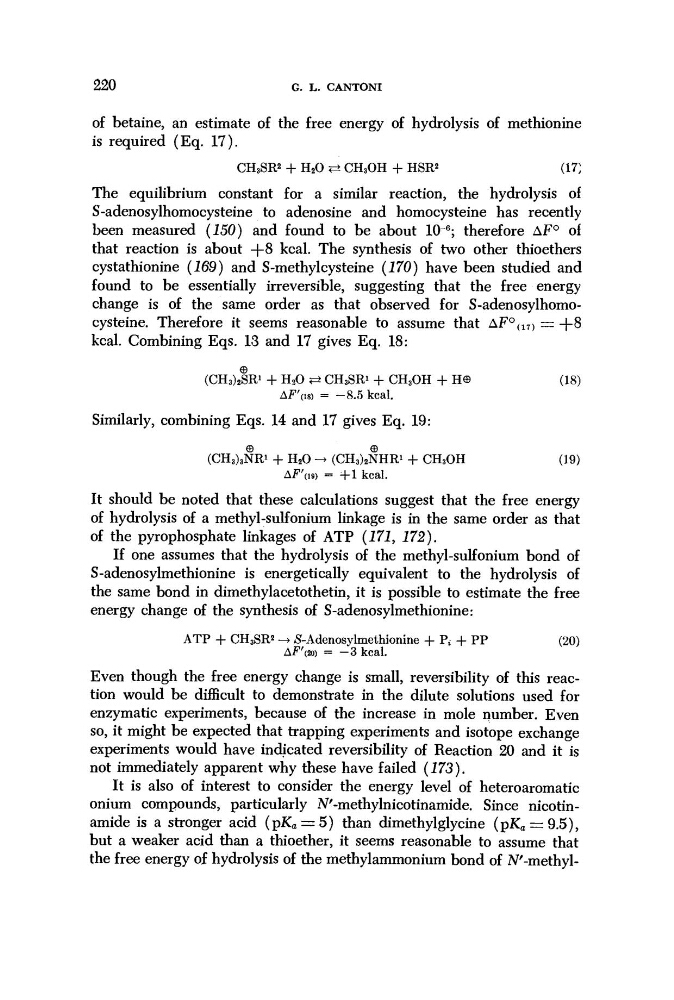
of betaine, an estimate of the free energy of hydrolysis of methionine
is required (Eq. 17).
CH3SR
2 + H 2 0 τ± CH 3 OH + HSR
2
(17)
The equilibrium constant for a similar reaction, the hydrolysis of
S-adenosylhomocysteine to adenosine and homocysteine has recently
been measured (150) and found to be about 10
6 ; therefore AF° of
that reaction is about +8 kcal. The synthesis of two other thioethers
cystathionine (169) and S-methylcysteine (170) have been studied and
found to be essentially irreversible, suggesting that the free energy
change is of the same order as that observed for S-adenosylhomocysteine. Therefore it seems reasonable to assume that AF° (17) = +8
kcal. Combining Eqs. 13 and 17 gives Eq. 18:
(CH 3 ) 2 SR
1 + H 2 0 <=± CH3SR
1 + CH3OH + He
(18)
AF'ds) = -8.5 kcal.
Similarly, combining Eqs. 14 and 17 gives Eq. 19:
(CH 3 ) 3 NRi + H 2 0 -> (CH 3 ) 2 NHRi + CH 3 OH
(19)
AF\i9) = +1 kcal.
It should be noted that these calculations suggest that the free energy
of hydrolysis of a methyl-sulfonium linkage is in the same order as that
of the pyrophosphate linkages of ATP (171, 172).
If one assumes that the hydrolysis of the methyl-sulfonium bond of
S-adenosylmethionine is energetically equivalent to the hydrolysis of
the same bond in dimethylacetothetin, it is possible to estimate the free
energy change of the synthesis of S-adenosylmethionine:
ATP + CH 3 SR
2 -> £-Adenosylmethionine + Pi + PP
(20)
AF'(20) = — 3 kcal.
Even though the free energy change is small, reversibility of this reaction would be difficult to demonstrate in the dilute solutions used for
enzymatic experiments, because of the increase in mole number. Even
so, it might be expected that trapping experiments and isotope exchange
experiments would have indicated reversibility of Reaction 20 and it is
not immediately apparent why these have failed (173).
It is also of interest to consider the energy level of heteroaromatic
onium compounds, particularly N'-methylnicotinamide. Since nicotinamide is a stronger acid (pK a = 5) than dimethylglycine (pK a = 9.5),
but a weaker acid than a thioether, it seems reasonable to assume that
the free energy of hydrolysis of the methylammonium bond of N'-methyl-
G. L. CANTONI
of betaine, an estimate of the free energy of hydrolysis of methionine
is required (Eq. 17).
CH3SR
2 + H 2 0 τ± CH 3 OH + HSR
2
(17)
The equilibrium constant for a similar reaction, the hydrolysis of
S-adenosylhomocysteine to adenosine and homocysteine has recently
been measured (150) and found to be about 10
6 ; therefore AF° of
that reaction is about +8 kcal. The synthesis of two other thioethers
cystathionine (169) and S-methylcysteine (170) have been studied and
found to be essentially irreversible, suggesting that the free energy
change is of the same order as that observed for S-adenosylhomocysteine. Therefore it seems reasonable to assume that AF° (17) = +8
kcal. Combining Eqs. 13 and 17 gives Eq. 18:
(CH 3 ) 2 SR
1 + H 2 0 <=± CH3SR
1 + CH3OH + He
(18)
AF'ds) = -8.5 kcal.
Similarly, combining Eqs. 14 and 17 gives Eq. 19:
(CH 3 ) 3 NRi + H 2 0 -> (CH 3 ) 2 NHRi + CH 3 OH
(19)
AF\i9) = +1 kcal.
It should be noted that these calculations suggest that the free energy
of hydrolysis of a methyl-sulfonium linkage is in the same order as that
of the pyrophosphate linkages of ATP (171, 172).
If one assumes that the hydrolysis of the methyl-sulfonium bond of
S-adenosylmethionine is energetically equivalent to the hydrolysis of
the same bond in dimethylacetothetin, it is possible to estimate the free
energy change of the synthesis of S-adenosylmethionine:
ATP + CH 3 SR
2 -> £-Adenosylmethionine + Pi + PP
(20)
AF'(20) = — 3 kcal.
Even though the free energy change is small, reversibility of this reaction would be difficult to demonstrate in the dilute solutions used for
enzymatic experiments, because of the increase in mole number. Even
so, it might be expected that trapping experiments and isotope exchange
experiments would have indicated reversibility of Reaction 20 and it is
not immediately apparent why these have failed (173).
It is also of interest to consider the energy level of heteroaromatic
onium compounds, particularly N'-methylnicotinamide. Since nicotinamide is a stronger acid (pK a = 5) than dimethylglycine (pK a = 9.5),
but a weaker acid than a thioether, it seems reasonable to assume that
the free energy of hydrolysis of the methylammonium bond of N'-methyl-